Life Lessons in Paint
Homeschool ing is a little more than having a lot of books at your disposal. Not much more, mind you, because books can answer all life’s questions – but still there’s a little bit more.
Our version of more involves a lot of art supplies. I wait for great sales, sometimes I even buy used canvases for next to nothing at Goodwill and garage sales and whitewash them, I’ve even been known to pull canvases out of trash cans. I’m that mom. One way or another I want to get art supplies into my daughter’s hands, and not the “kid” version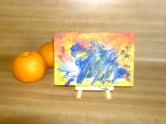 s – I want her to have real paint, real brushes, and real canvases to work with.
At Christmas we requested that in lieu of toys and other items that will end up donated when she outgrows them or trashed when they are obliterated from use, to gift her art supplies instead. We’re not depriving her for the sake of enrichment, I assure you. I believe free play is essential and important. The girl gets tons of toys on her birthday and throughout the year and has mountains of them. Does she need mountains of them? No. Will we use the art supplies? Oh yes.
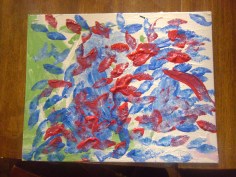
Thus began our friends and family slowly jumping on board with how we handle our week, our budget, and our holiday requests. As my daughter started to produce piece after piece (some not shown as they were gifted away prior to me thinking out documenting them)…

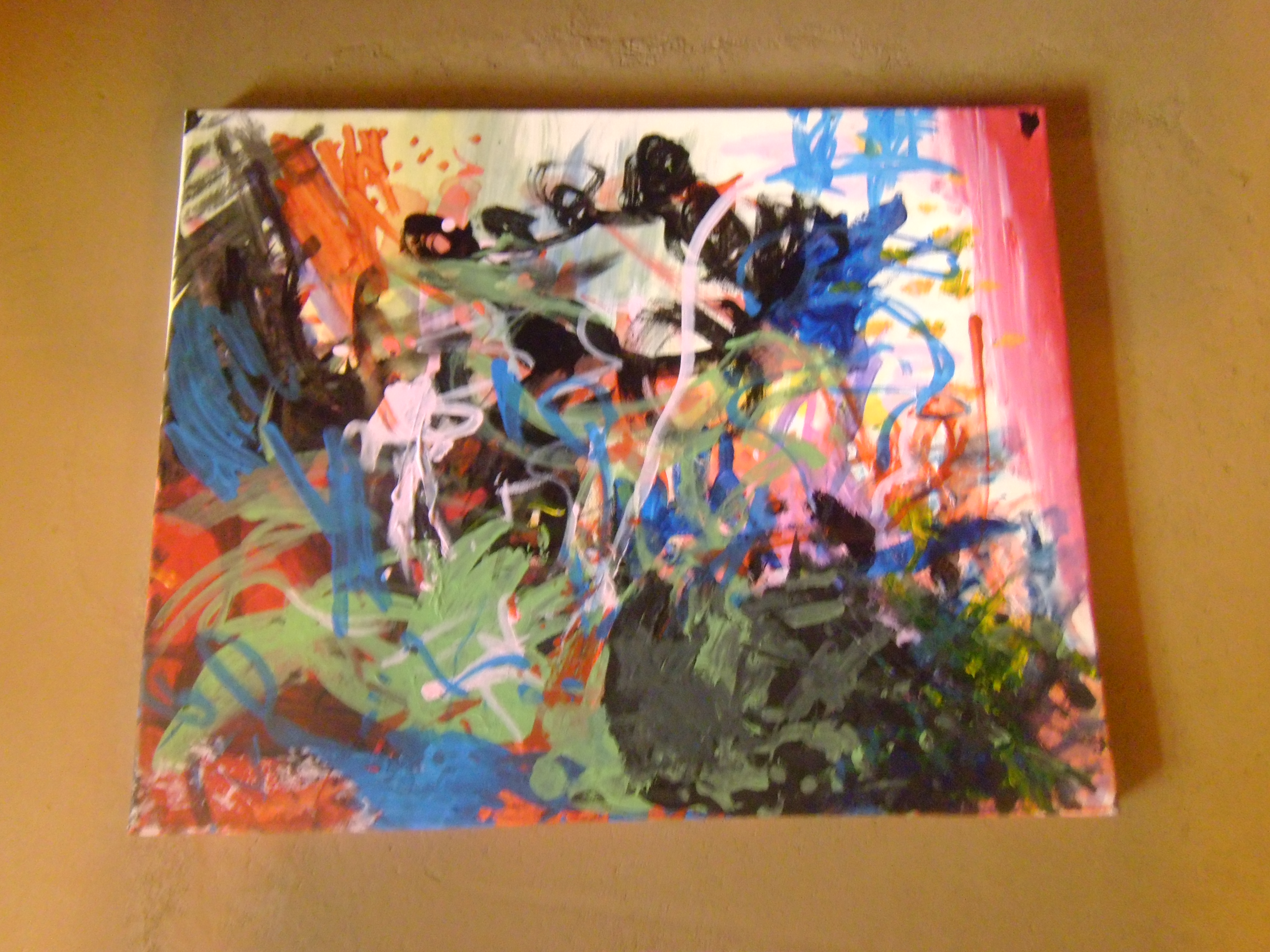
She chooses her own colors, even mixes them if she has to and decides which brush she wants to use at any given moment. 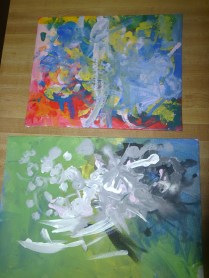 Each piece is entirely her own and we even discuss what she wants to name each one.
Pursuing art in this fashion is a daily exercise in understanding the scientific side of color (what it takes to make a color), as in the beginning we started only with primary colors, though we have been gifted additional ones. She is learning about texture, movement, and how to convey emotion.
In addition to that, she understands saving and budgeting for things she wants. How to prioritize certain desires: sometimes she uses birthday money for books, sometimes for toys, and sometimes for her own art supplies. (Even more often, she opts to put it in the piggy bank or fund an extra trip to Chick-fila.)
It also brings the books we study to life.
Since birth, I have made a point to introduce her to as many of the Getting to Know the World’s Artists
We read through The Metropolitan Museum of Art’s “Monet’s Impressions: Words and Pictures by Claude Monet” all the time. She seems to like the Impressionists a lot.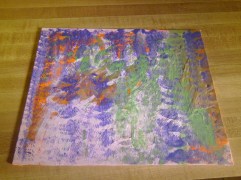
Which kick started our trips to the lake, taking paints and canvases to paint outdoors like they discuss in one of our favorite art books:
Picture This!
We also have a book on Frida, called “Frida Maria: A Story of the Old Southwest” by Deborah Nourse Lattimore, because all art forms are welcome in our house, as well as every bit of history we can find.
Which is why we also picked up a copy of “Leonardo: Beautiful Dreamer” by Robert Byrd at the library. We’ve been reading a few pages of that every day and I could not be more pleased with a picture book.
More than anything in this adventure through motherhood and homeschooling, I’m realizing that so much of ‘homeschooling’ has very little to do with what I know or what I can teach – it’s about granting access to where the knowledge is. It’s about handing her the tools and giving her the freedom to figure it out, to learn, and discover. So many times people argue that homeschooling stunts children to only learn what their parents know, when in reality it is quite the opposite. When they have so much free time, under a little nudge here and some pointers there, children are much more likely to learn to learn for themselves. A parent’s job, a teacher’s job, is to provide the tools for them to do that.
I didn’t think these things from the get go. I merely picked up books that caught my attention. I got her the art supplies initially because I had taken art in high school and my sister has always had natural talent with a sketchbook. I wanted my kid to get these things in her hands sooner rather than later because I had a lot of anxiety regarding art supplies – I was afraid to be freely creative because I feared being wasteful with something considered semi-precious. But over the last year and a half of actively putting these supplies in my kid’s hands, I have shaped a philosophy.
Here is a canvas, here is a paintbrush, here are some paints, here are a few books that show you the glorious nature of art throughout history – suddenly, you have a child who is beginning to understand history, humanity, science, and the world at large. Imagine the implications when I give her the tools to language and math. The sky is the limit and the list of people who learned to think through information on their own become the inspiration: Einstein, Curie, Alcott, Da Vinci…

My Interview at Anakalian Whims & a Book You Should Read
Follow The Fire In Our Heads, check out Jason Kristopher’s books, and bask in the awesomeness of my interview and novella being pimped by someone other than me! 🙂
Interview with Jason Kristopher
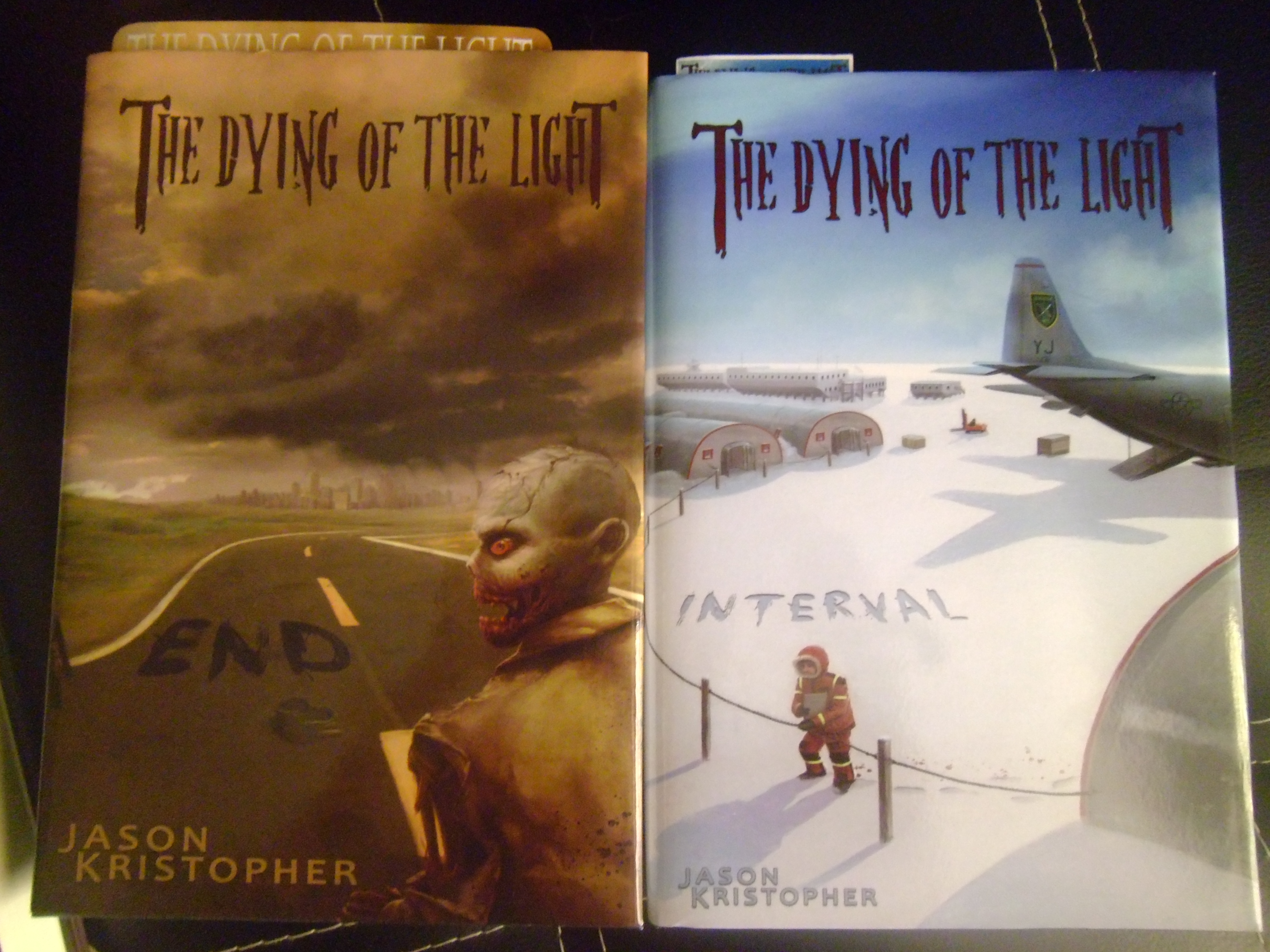 1. Your books (The Dying of the Light
First, a realistic and scientifically-vetted reason for zombies, as in it’s not just supernatural or science fiction ‘hand-waving.’ Second, and this is the key difference, the books aren’t about the zombies. Yes, they have zombies in them, and action and blood and guts and gore, but at its core, The Dying of the Light is a story about people. I always tell potential readers that it could’ve been anything that ended the world: aliens, earthquakes, global warming… none of that matters. This series is about the end of these people’s own personal worlds, and how they deal with what happens during and after, and more importantly, with each other. That’s the real story – the rest is just window-dressing.
2. What inspired you to write zombie novels? Did the characters come to you as products of the apocalypse, or did you drop them into that setting after their inception?
The idea for the story was a mash-up of two different dreams, actually. One about a lone zombie survivor on an island, the other about the end of the world (though I didn’t know at the time what had done it). My writer’s brain smashed them together, and suddenly, there was a zombie apocalypse trilogy. It makes me a bit nervous about the other connections my mind makes, actually…
3. Stephen King says people who don’t read don’t have the tools to write. Who are your favorite authors? Who inspires you to write? Who do you read to gain more writing energy?
 Would it be trite to say Stephen King? His book On Writing is the single best treatise on the craft of authorship that I’ve ever read. As for other fun favorites, I have a ton, but a few that come to mind: Isaac Asimov, Terry Brooks, Jim Butcher, Orson Scott Card, Arthur C. Clarke, Donaldson, Jordan, Koontz, Niven, Pratchett… see what I mean? For inspiration, I look at some of my friends, like George Wright Padgett (Spindown), who wrote one of my personal Top 5 sci-fi books. That is inspiring, to me. I like to re-read some books if I’m having trouble with a book I’m writing, too. For example, I’ll revisit The Hitchhiker’s Guide to the Galaxy series if I’m stumbling over dialogue – even though it’s English slang, Douglas Adams was a master of dialogue.
4. Do you have play lists of mood music you write to? If so, which artists/songs generally make the cut?
If I have music on, it’s generally instrumental – tuneful background noise, basically. The soundtrack to Lord of the Rings, or Last of the Mohicans, that sort of thing. If I’m struggling with a particular type of scene, I’ll find some music that fits that ambiance. For example, my “Car Chase” playlist has Guns N’ Roses, Project Pitchfork, Rihanna, and even Motley Crue. But usually, I like it quiet or very low music when I’m writing; it keeps me focused.
 5. You are not just an author, but the owner of a publishing company: Grey Gecko Press. Tell me a little about that. What made you decide to open such a venture and what are your goals for the company?
I’ve always been business-minded, and when I published my first book, I knew there would be business expenses involved. Originally, I never planned to publish anyone else’s work, but then a friend (author Wayne Basta) asked if I could help him, and Aristeia: Revolutionary Right became the second book published under the Grey Gecko imprint. I found I really enjoyed working with other authors to share great stories, even if they weren’t mine, and I had the ability to do it… so why not? From the beginning, the company has been about treating authors fairly, publishing great books, and doing things the right way, even if that bucks centuries of tradition.
As far as goals… well, I’ve long said that I’d like for Grey Gecko to be ‘the Google of publishing.’ Most people interpret that to mean I want to be rich, when that’s not at all my goal. I want Grey Gecko Press to be huge because it would mean that every author would have a chance at the same kind of success that only a few get now with traditional publishing. Every struggling writer, pounding away at their keyboard (or typewriter, I’m not judging) would know that at least one company would look at their work when it was done, regardless of their past publishing experience – because, at the end of the day, Grey Gecko isn’t about making money: it’s about publishing great books and putting authors first. As you can tell, I’m quite passionate about this endeavor.
6. You’re quite an entrepreneur. What other projects do you have up your sleeve?
I think it’d be gr eat to have a Grey Gecko bookstore, for one thing. For another, we haven’t been able to focus on as much as I’d like with Grey Gecko is giving back to our community. I’ve got some ideas for creating local resources and ‘maker-spaces’ for writers of all types and kinds. When we’re ready, I’d like to take our business model into other fields, as well, including movies, film, and even music. So yeah, a few projects on the horizon!
7. How would you feel about having your books made into a television show or series of movies? Would you want to write your own screenplays? Who would be your ideal director?
One of the comments I have most about my books are that they’re very visual, very cinematic, and I agree! I think they’d make great movies/TV shows, mainly because that’s what I see in my head when I write them. I’m not sure about writing the screenplays myself, although I’d give it a try. There’s a lot about the behind-the-camera part of the film industry that I don’t know, so I’d at least listen to some experts… though naturally I’d want final say. I’d rather not have it made at all than made badly. I’m not sure of all the director’s names on The Walking Dead, but they do such a masterful job with a show that’s so similar in tone, that I’d likely pick one of them, given the choice.
 8. You’ve had booths at Comicpalooza and done numerous book signings with local bookstores. What were those experiences like for you? What are your favorite parts? What are your least favorite parts?
Despite what I may say on Sunday afternoon at a convention, I actually enjoy talking to people about our books. Helping people discover a new book they haven’t heard about, or seeing their excitement at the next volume in a series, or seeing the light of wonder shine in a child’s eyes as I hand them a copy of Greystone Valley is why I do what I do. As far as book signings go, I enjoy them for many of the same reasons; talking to people about my books and getting t hem excited about reading is a blast. What it really comes down to for me, though, is that I’m a storyteller at heart; however I can tell you a story, I’m going to do it. My least favorite part of all these things would be the setup, teardown, and logistics that go into planning them… mainly because I’m lazy! I’d love to show up with a cup of coffee and find everything set and ready to go, but that’s the price you pay for being your own boss, I guess!
9. What other published work have you been a part of? And what can we expect to see from you in the future?
Aside from The Dying of the Light, I’ve also published several short stories, some of which are based in my zombie series, some not. I also contributed one of my favorite short pieces, The Art of Steaming, to the horror anthology A Fancy Dinner Party, along with 9 other Grey Gecko Press authors, and it was also featured in the collection Penny Dreadfuls: Halloween Special. For future work… boy, have I got some ideas for you!
First, I’m finishing The Dying of the Light with the third book, Beginning, due out this winter. Then there’s Under a Cloud-covered Moon, the first in a series about an irascible, anti-hero detective who works for the Seattle Metahuman Crimes Unit, solving crimes by and against ‘metas’ – non-supernatural mutants who’ve been called ‘vampires’ and ‘werewolves’ for centuries by those who had no idea of their true nature. I’ve also got a middle-grade/YA story in mind about a Teddy Bear (because it’s a job, not a toy) named Freddy McPhane, as well as my epic fantasy series of 30 books (no joke), not to mention the 150+ other ideas I have written down. I’m going to be busy!
10. If there is one thing you would want your readers and fans to know about you, what would it be? If you had one request of your readers and fans, what would it be?
I want all my fans and readers to know that I love hearing from them! Whether it’s a quick note, or a detailed letter, I’m always excited to connect with my readers, which is best done through email at jason@jasonkristopher.com.
For a request, I’d request everyone who enjoys the books they read, especially indie books, to leave a review on Amazon, GoodReads, or elsewhere. Short of buying more books, a review is the best way to support indie authors and small press. That and telling all your friends, of course! To find out why reviews are so important, visit my blog: On the Importance of Reviews, or, It’s Just 21 Words!
Sun-Burned Days
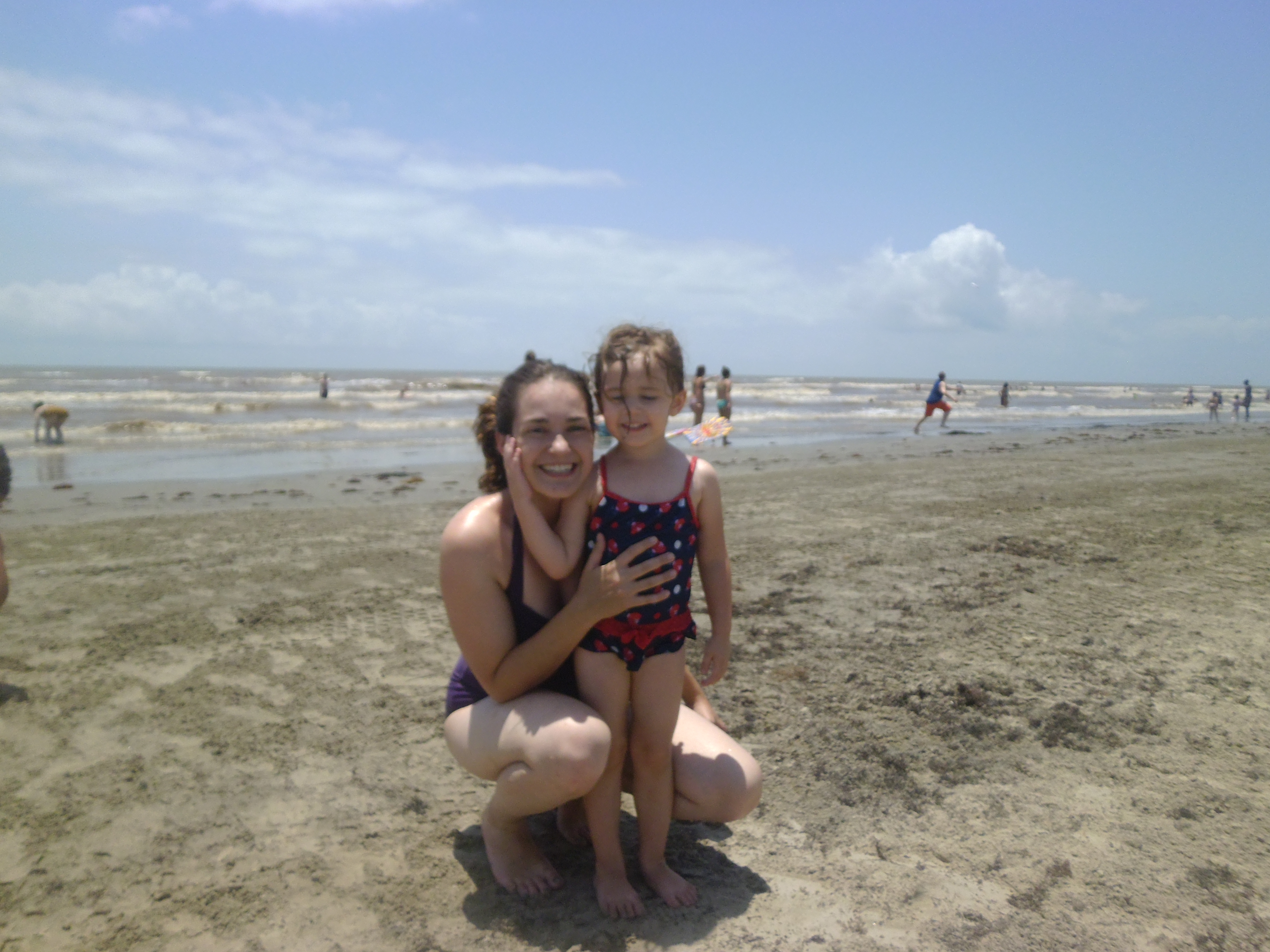 We went to the beach yesterday. It was amazing. We played in the sun, splashed in the waves, built sand castles with moats and walls and invading armies. We applied sunblock every 30 minutes to our fair-fair skin – spf 50. And in between those moments sprayed another kind of sunblock over our whole body to ensure that I hadn’t missed any spots.
Nonetheless, today we are burnt. Really burnt. Ok, so kiddo is moderately burnt and my legs look like lobster legs.
These are the days when being a reader and quasi hermit come in handy… we are sitting in the cool of the house watching book-based movies (The Rise of the Guardians) and patting our body parts down with home remedies.
So far, it has been a steady application of vinegar water (to take the heat out), egg whites (to minimize the blistering), aloe vera (because everyone knows to use aloe!), and at some point today I plan to try out a black tea poultice but that will require me to go purchase some Earl Gray. Frankly, neither one of us wants to leave the house.
Prior to all this excitement (or miserable post-beach adventurism) however, I was seriously looking into the idea of moving closer to the shoreline. (I’m still thinking I want to add this to my bucket list.) If only for a 6 month lease someday.
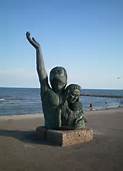 Galveston in particular is full of a rich history that I was briefly introduced to in school, mostly surrounding the epic flood of 1900 and the statue memorializing that event. I remember studying the great September 8th flood in both fourth grade and seventh grade. I even wrote a fictional diary of a girl caught in the flood as part of a required creative writing exercise. With 145 mile an hour winds, near total destruction, families lost and killed, I sort of believed it wasn’t a viable living option. Despite it being a great place to visit for the day, when Ike hit, I was still surprised to learn that people actually live on the island year round. I grew up believing it was a Houstonian’s day trip destination and nothing more.
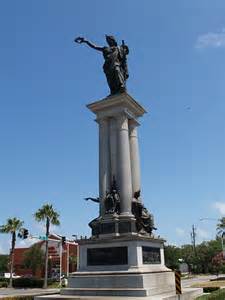 One in particular that amazed me this weekend was the statue regarding the Texas Revolution. It’s huge, and gorgeous, and well worth a child’s research paper. Despite all the intense Texas History a child is submitted to as a ward of the Texas public education system, I had completely been unaware (or merely forgot) that Galveston was the Republic of Texas’ capital city.
I definitely want to incorporate more beach trips into our lives – despite our fair skin and my current severe sun burn. But if I were to ever live there for a few months or so with our kiddo, I have so many cool lessons plans already half built around what would become our daily schedule. Just the architecture alone is worth a good week’s worth of study.
The whole day was a gentle reminder to be a tourist in your own city from time to time. It can be highly educational.
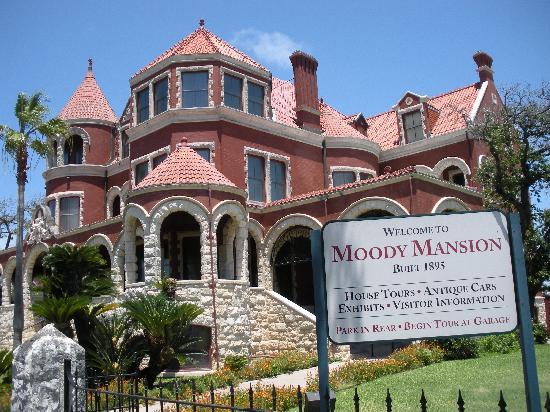
Until then, maybe we’ll check out some Books about Galveston Island
Interview with Wayne Basta
 I had the pleasure of meeting author Wayne Basta awhile back for a book signing at Half Price Books Humble. He has a three part series published under Grey Gecko Press here in the Houston area. This week, I finally had the pleasure of interviewing him.
1. I haven’t had the pleasure of reading your series. Can you tell us about it?
Aristeia
2. What moved you to start writing science fiction?
I’ve always been a fan of the genre. My father got me into Star Trek and Star Wars at a young age and then followed it up with classic science fiction books like Asimov and Clarke.
3. An interviewer (Sam Weller, of the Paris Review) asked Ray Bradbury if writing science fiction satisfied something that mainstream fiction did not. I’d like to ask you that same question. Do you find that science fiction satisfies something that mainstream fiction cannot – both in yourself as well as in society?
I don’t believe science fiction isn’t mainstream fiction. Look at the biggest blockbuster movies and books and you’ll find lots examples of science fiction. Science fiction certainly satisfies something other genre’s do not, but so does every different genre.
4. When did you start writing? Have you always wanted to write?
The first things I wrote were when I was 9 and we got our first home computer. I dabbled in writing ever sense then, though I didn’t make a serious effort to write a complete novel length story until just a few years ago.
5. When you write, do you have a specific place or environment you like to go? Do you play music (and if so, what music?) or do you prefer the quiet?
I usually write from my laptop at the kitchen table. The chairs are less comfortable than my desk chair so its easier to stay focused. The laptop also can’t run most of my games so that clearly defines this computer a work place and the desktop for play.
I write in silence a lot but depending on the scene I’m working on I might put on music. I’ll often try and match the music to what’s happening in the book. During a heavy battle scene I might play some epic sound tracks from movie battles or if its more subdued a lighter piece.
6. What is the easiest part of the writing process for you? What is the hardest?
The easiest part is the writing itself. Figuring out what I’m going to write, finding the time when there’s no toddler demanding attention, marketing the books, editing the grammar and everything else is hard. But when I know what is going to happen to my characters, the words just flow out with ease.
 7. Who designed your book covers?
I worked with an artist named Oliver Wetter to design the cover. I told him what I had in mind and described the looks of my characters. He then brought them to life. He did an amazing job with each of them.
8. You were recently at a Comicpalooza. What were you doing there? What was that experience like?
I sat on a number of writing panels at Comicpalooza. It’s always great to get to sit down and talk about writing and books with fellow authors and fans of the genre.
9. Do you have any tips or advice on getting published for aspiring authors?
Never give up, never surrender. It’s a hard process to wade through and relies mostly on persistence and dedication to succeeding. Keep trying and keep improving your queries and your writing.
Like Wayne’s page on facebook.
Unexpected Odes to Literature
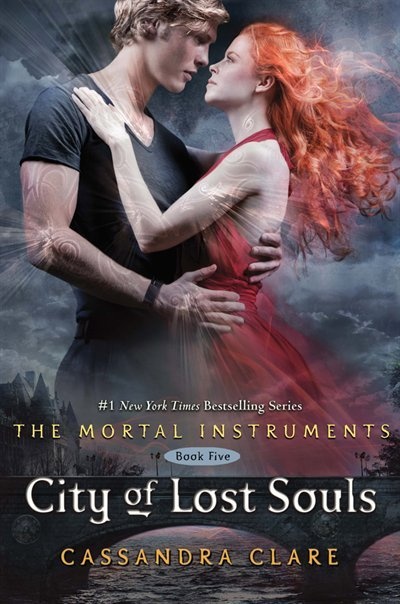 Title: City of Lost Souls
Author: Cassandra Clare
Genre: Young Adult/ Fantasy
Length: 534 pages
For me, what makes the writings of Cassandra Clare so captivating isn’t the fairy tale romance, the paranormal elements, or the bad ass fight sequences… at the heart of it all, it’s the way Clare manages to make a young adult fantasy saga an sequence of unexpected odes to her favorite pieces of literature.
“No man chooses evil because it is evil. He only mistakes it for happiness, the good he seeks.” – Mary Wollstonecraft
“Love is familiar. Love is a devil. There is no evil angel but Love.” – William Shakespeare, Love’s Labour’s Lost
“I love you as one loves certain dark things.” – Pablo Neruda, “Sonnet XVII”
“All changed, changed utterly: A terrible beauty is born.” – William Butler Yeats, “Easter, 1916”
Whether the story was constructed around these quotes, or the quotes  were slipped into the story, the two halves were beautifully married together. Just as Clare always manages to do.
If you recall my review of The Book of Secrets you should be well aware of how much I cherish this particular aspect of storytelling. I love peeping into the mind of the author and what they’ve read before – what work we may have both cherished. I love to see how others acknowledge how literature builds a soul. Even if that soul is an imagined character in another book.
A reviewer on Goodreads mentioned they thought it was silly that all these Shadowhunter kids were completely oblivious of what went on in the mundane world half the time – Jace completely misses references to Madonna or Dungeons & Dragons games – but are well versed in William Shakespeare and Dante.
As a classical book geek it makes perfect sense to me. I was raised on Charles Dickens and the Brontes, not the latest boy band or pop culture trends. Poetry is timeless. New Kids on the Block obviously not so much.
One doesn’t expect these odes and references in a paranormal teen romance. I suppose that’s what makes them so stunningly lovely.
Plagiarism
Plagiarism sort of fascinates me. Mostly because I am a reader, I think. And as a reader I absorb.
I absorb thoughts, ideas, fairy tales, story lines, dialogue… and sometimes when I’m writing I find that I can’t remember if what I’m writing came from a dream I had, a book I read, or a an actual idea that I am actually formulating as my ink pours from my pen.
I am re-reading The Mortal Instruments series, and with a re-read comes more review reading, more research, because I no longer fear a spoiler. So long after the scandal, I discovered this morning that Cassandra Clare was accused of plagiarism on a fan fiction site for a Harry Potter spin-off series about Draco. Not only accused, but her account was cancelled because of it.
I’m not defending plagiarism, it’s not ok. The idea that someone would purposely just copy someone else’s work turns my stomach.
But what if it is purely accidental?
What if you have internalized a work so completely in your youth that as an adult an idea, dialogue, plot points, come to you so wholly formed and you recall that it was inspired by something, but not necessarily who or where the inspiration came from?
I can see that happening to me. I read so much as a child and I cannot remember it all, but I do have to say that I don’t think a single idea I’ve ever had could actually be attributed to myself. They aren’t my ideas. They are the ideas of those who came before me. They are the ideas that came from authors I loved, and characters who became my friends.
I distinctly remember writing a story once, I was maybe seventeen at the time, and I was so in love with it. I thought, man, I’m good – this story is fantastic. I re-read it, I worked on it avidly. Then I realized, about a month later, that it wasn’t mine. I was re-writing The Hero and the Crown by Robin McKinley. Perhaps slightly in my own words, but the essence of it was entirely hers and I was forced to throw it away.
It was the first time I became doubtful that I would ever publish anything. Until then, I had been completely convinced that no matter what happened in my life, I would at least become an author in some capacity. It was in my veins since the first time I picked up a book and could decode the letters that made words and sentences. I had been writing stories and ‘books’ since I could manage to scrawl out a readable letter with my number two pencil. But right then, as a teenager, I realized my biggest fear – that perhaps I didn’t have any words of my own. Perhaps they all came from elsewhere.
That is when I realized what the biggest challenge would be for me to become an author – writing something original. How do you sort through all that you’ve read, all that you love, and find something that doesn’t already belong to someone in some way?
Because of this, my novella doesn’t have much in the way of plot points. The characters came to me, yes. I can write their essence, yes. But ultimately, I am terrified of plot points. I feel like they’ve all been written before. But people, people are always capable of being their own. Characters are easier to write than plots, because I’m surrounded by characters – they live in my head. Plots, on the other hand, only live in books that have already been written. Real life doesn’t seem to consist of plots so I can’t rely on life to deliver inspiration that hasn’t already been had by someone.
Logical fallacies, of course. But that’s how I feel.
And I can’t help but wonder if Cassandra Clare felt the same way from time to time.
City of Glass
It seems even though this is my second time reading this book (my second time through the series as I prep to read the final volume!), I didn’t write proper reviews for each one.
I addressed the series, made references to Cassandra Clare’s work in many of my reviews, but City of Glass never got a review all it’s own.
So here it goes:
 Title: City of Glass
Author: Cassandra Clare
Genre: Young Adult/ Teen/ Fantasy
Length: 541 pages
The book cover finally features a boy *with* his shirt on. However, the cover still annoys me. I suppose I’ll never get over how embarrassing they are. I’ve never preferred having actual people on the front covers of the books I read, unless of course they’re in some sort of Victorian garb. For some reason a person on the cover never truly embodies the mood of a story the way I want it to. I prefer buildings, scenery, landscapes, or the hint of a person.
For instance…
 That’s a cover I don’t mind flashing the masses, a train full of people, other moms at a public park, or I don’t know – MY KID.
Who am I kidding? In the U.S. the cover up top is the only one that is going to move copies of the book. I’m an odd duck. I know that.
Regardless of all that – I still adore these books. Brain candy, teen flick, romance nonsense and all. I just love them.
I love the book references, the intelligent quotes, the very teen appropriate quips. I love that Jace (Jonathan) Wayland/Morgenstern/Herondale/whoever reminds me so very much of my own Jonathan at that age. Clare has cocky teenage boy dialog down to an art. Jace’s cockiness rings true and familiar, the knowledge that he is attractive and desired, edged with angst anyway.
I remember those conversations. I remember the beautiful, desired boy flirting with me – the short, somewhat tomboyish and frumpy nerd who was always a little out of place. Granted, I never got Luke & Leia -ed like Clary and Jace did. But I think what makes these books so marvelous is despite the fantasy, despite the action and apocalyptic level of drama, despite the paranormal parts that drip into every aspect of the story – there’s something familiar for everyone in these stories. Especially City of Glass, and the ever burning question so many romances have: If it’s not forbidden will he/she still want me?
This time around I re-read the first book, City of Bones, after seeing the movie. The library didn’t have the second book, City of Ashes, on hand so I just skipped it and went onto City of Glass. By doing this, I was brought to a whole new level of appreciation for the series, Cassandra Clare, and each book individually.
Even though I jumped in having skipped the second book – I wasn’t lost. Although the second book is pivotal to an epic saga of the Nephilim, I didn’t feel out of sorts by not having read it. Clare does such an excellent job of having each book stand on it’s own even though it’s merely a puzzle piece in a giant story. I love that.
I know it’s the thousandth time I’ve said this, and I shall say it a thousand times more – Well done, Cassandra Clare, Well done.
Do I feel bad about re-reading young adult titles over and over again and the age of thirty? No, not anymore.
“A children’s story that can only be enjoyed by children is not a good children’s story in the slightest.”- C.S. Lewis
Interview with John Oehler

I love doing author interviews, especially for authors whose work I have read and enjoyed. Please allow me to introduce to you John Oehler. Below is an interview in which he was kind enough to participate.
1. I read Papyrus and Aphrodesia and was riveted by both. You have a knack for mystery and detail, whether historical or well-researched professions like perfuming. What inspired you to write these stories?
The initial idea for Papyrus came to me in 1983 when I was in the Egyptian Museum in Cairo and noticed a potential way for thieves to break in. Over time (by which I mean decades, because I was not yet a serious writer), the story concept expanded tremendously. The theft now occupies only a chapter and a half.
Interested readers can see my original sketch of the break-in route by going to http://johnoehler.com , pulling down Papyrus from the Novels tab, and clicking on Behind the Scenes.
Aphrodesia is another story that took years to mature. I first became interested in fragrances while living in London in the mid-80s. I started collecting perfume samples, perfume books, and articles on the psychology of scent. I wanted to write a story centered on fragrances but couldn’t think of an interesting plot — until I met a master perfumer in Versailles who told me that creating a true aphrodisiac is the Holy Grail of the perfumer’s art. I thought: Bingo! I can make a story out of an aphrodisiac.
As with Papyrus, you can read more about the origin of Aphrodesia on my website. Pull down Aphrodesia from the Novels menu, click on Behind the Scenes, and you’ll see two entries illustrated with photos of the master perfumer and of ISIPCA, the perfume school in Versailles where the story begins.
2. You got an Amazon Breakthrough Novel Award for Papyrus and First Place in the Pacific Northwest Writers Association for Tepui. How did you feel about being recognized so well on these novels? (Also, what’s your secret to success?)
 Papyrus was a semifinalist in the 2009 ABNA competition, ranking in the top 1% out of 10,000 submissions. I was thrilled. At the same time I was disappointed, because the Publishers Weekly reviewer praised everything about the story except for the “downbeat” ending — a major character died. It made me wonder if a more upbeat ending might have advanced Papyrus into the finals. I knew, from critique partners and others who had read the story, that opinion was divided about 50:50 between those who loved the last chapter and those who didn’t. Ultimately I decided to change the ending.
As an aside, I have toyed with the idea of posting the original ending on my website. But beyond those who read this interview, very few people are even aware that the current last chapter was not my first choice.
Winning the PNWA competition was probably the biggest surprise of my writing career. It’s a major contest that attracts lots of agents and editors. I’d entered a thriller titled Tepui and received a hint that it might be a finalist. At the award ceremony, I was sitting at a big round table with my wife and about ten other people as the finalists were read off. When my name was announced as the winner, I blurted, “Are you shitting me?” The whole table laughed.
Perhaps the coolest thing was that this led to a role reversal. Like most unpublished writers, I’d endured years of frustration playing supplicant to the deaf gods of agentdom. Now, suddenly, agents were courting ME.
In the end, the agent I signed with turned out to be a poor choice. Several months into our relationship, she sold a YA fantasy for half a million bucks and a second YA fantasy for a quarter million. She lost interest in thrillers. On the flip side, I lost interest in agents and have been more than happy to self-publish ever since.
Secret to success? I’m certainly not as “successful” as I’d like to be. But I attribute my modicum of popularity to excellent teachers (like Chris Rogers) and critique partners I trust and respect. I strive to create unusual characters, take them to places most readers have never seen before, and keep readers guessing what’s going to happen next. I also try to engage all of the senses, to help readers feel like they are in the story, not just reading it.
3. I’ve posted reviews for Aphrodesia and Papyrus here on my blog, but I haven’t had the pleasure of discovering Tepui. Can you tell us a bit about it?
Tepui is the story of a burn-scarred botanist who treks into the remote Venezuelan highlands in search of a living fossil but stumbles onto something far more astonishing, and deadly.
This story stems from my work and travels in Venezuela and on the history of the region.
4. Tell us about your other writing ventures. What other brilliant ideas have you got up your sleeve? When can we expect to see your next book?
 Tepui will be the next book I publish. I’m currently refining it and hope to get it out by the fall.
I’m not sure what will come after that. I’ve always loved old books and libraries. While visiting a monastery in Prague last Christmas, I spent an hour contemplating their library and especially their locked collection of forbidden tomes. I’d like to set a story in that environment. The idea might sound derivative of The Name of the Rose (one of my all-time favorite stories), but I would set it mainly in modern times.
In a similar vein, I’ve long wanted to write a story set in western Ireland during the Viking raids of the early 900s. It would center on a mixed male-female monastery with a round tower that serves as a repository for volumes rescued from the anti-intellectual book burnings of the Dark Ages. I’m torn between this and the Prague story. I don’t think I can do both, because there’d be too many similarities.
I’ve written parts of several other stories I’d like to expand if I live long enough. One centers on a powder created by an 8th-Century Arab alchemist (a real person) that extends life for centuries, provided you keep taking it. The story opens with the spectacular (true) robbery in 1976 of a bank in Nice, during which thieves spent an entire weekend looting safe deposit boxes in the underground vault. In my twist, the thieves were working for a woman who knew the powder and the alchemist’s formula were in one of the boxes, and that’s all she wanted.
Most of the others involve things like ancient mysteries and labyrinthine puzzles.
5. What got you started in the writing world? Have you always wanted to write or is it a passion you discovered later in life?
In high school I wrote poetry about society’s outcasts, some of which was published in a scholastic magazine. In college I occasionally ghostwrote sonnets for girls who were supposed to write them as a class assignment. Simple rhyming poetry always came easily to me.
What started me writing novels — or trying to — was hubris. In the late 70s and early 80s, I traveled internationally quite a bit and spent my time on planes reading Robert Ludlum
Flash forward several years and I’ve finally finished my first version, a 240,000-word tome I called The Papyrus of Tiye. A friend of mine offers to take it home with him at Thanksgiving and show it to his mother, a vice president at Bantam. P.S. It came back with a note that read, “Tell him to take a creative writing class.”
Exit all traces of hubris, never to return. Enter the long, hard slog of learning to craft stories that OTHER people enjoy reading.
6. Your writing style is truly unique; I’ve never read another quite like you. Who are your favorite authors to read? Who inspires you?
Interesting that you should mention my “style.” I was once told that I don’t have a style. In truth, I don’t think about it when I write. But when I proof a story, I do notice a lot of “habits” that surface on every page.
Modern authors I enjoy reading include Ken Follett, Michael Crichton (before his stories became political), Umberto Eco, Nelson DeMille, Daniel Silva, Trevanian, Frank Herbert, Stieg Larsson, Wilbur Smith, Elizabeth George (her earlier books), and Laura Hillenbrand (a monument to writing beautifully under major adversity). Sadly, several of these authors have left us.
If I had to pick one author who inspires me, it would be Michael Crichton. As a scientist, I like the way he turns science into adventure and often combines that with history. My own stories do the same.
7. Your ‘on location’ scenes in your books are so detailed. Have you traveled to the places you write to describe them so vividly?
What a wonderful compliment. Thank you.
Yes, I’ve traveled to many of the places I describe: Egypt for Papyrus, France for Aphrodesia, Venezuela for Tepui. In fact, I’ve traveled to fifty or sixty countries and lived in six. But there are places in my stories I have not visited. Two examples are Yemen in Aphrodesia and Sudan in Papyrus. For these I used my experiences in Somalia, combined with books and articles I have plus a lot of Internet research.
If you’re going to take a reader to someplace exotic, I believe you have a duty to make that place as real as possible. And not just visually. What does it smell like? What sounds do you hear? How does the food taste? What textures do you feel? Those details help the reader feel “there.”
8. Other than writing, what are your other hobbies and interests?
I read a lot, of course. I love to cook. And my wife and I continue to travel as often as we can. She’s a member of the Mars Science team, which operates and analyzes data from NASA’s Curiosity rover, so our travel opportunities are limited by the rover’s activities. But we manage to get away frequently and always enjoy the foods, wines, art, music, and history of the places we visit.
 Then there’s our Old English Sheepdog, Elfie, who has her own Facebook page (https://www.facebook.com/elfie.oehler) and takes a chunk of my “spare” time.
As to interests, name something, and I’m probably interested. I have files on everything from art, poisons, labyrinths, and magic to ancient and medieval history, symbology, gold, gypsies, and food. Probably I’m most interested in things that influence the way we think and behave, especially early Catholicism, medieval Islam, taboos, superstitions, and the like.
9. If there is one thing you’d want your readers and fans to know about you, what would it be?
My whole reason for writing is to please my readers and make them hungry for more of my work. I want to share with them the excitement of exotic places, the richness (and sometimes terror) of foreign cultures. And (don’t kill me for saying this) I try to educate by painlessly integrating elements of history, art, and science. I love it when readers say, “I never knew that.” And I love it even more when they wonder, Could this really happen?
10. Previously you have participated in book signing events in the Houston area. When (and where) can we expect to see you out and about again?
Nothing scheduled at the moment. But when Tepui comes out, I hope to have several signings. I’ll definitely let you know. Signings offer a unique opportunity to speak personally with potential readers, and I look forward to the next round.
Love Letter to Literature
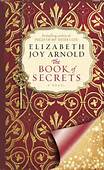 Title:The Book of Secrets
Author:Elizabeth Joy Arnold
Publisher: Bantam Books
Genre: Fiction/ Literature/ Books About Books
Length: 450 pages
I checked this book out from the library, but this is not a library book. This is a book you need three copies of – a hardback first edition signed by the author, a copy for reading and scribbling notes in the margins, and a copy to loan to your friends. I’m devastated that I’ll be shoving it through a book drop later this afternoon, it will leave my hands and slide down a shoot to be re-cataloged and re-shelved. When all I really want to do is sleep with it under my pillow.
I was up all night reading. Not all night, but well passed my thirty year old motherhood appropriate bedtime.
Part One was titled Chronicles of Narnia, Part Two: Where the Wild Things Are, and so on – each section of the book titled and designed to reflect story that tied ever so gracefully into a famous book title. The whole book is not just a riveting story, it is a love letter to literature.
If you are a Kate Morton fan, the architecture of this book will be right up your alley. It’s beautifully done, marvelously written, and simultaneously raw and eloquent. It may even be better than anything Kate Morton wrote, and saying that feels like blasphemy because I adore her and own all her books.
There were so many gorgeous quotes I wanted to underline, and now I don’t know where they were in the book, because it was a library copy so I couldn’t. I should have jotted them down, but I was too eager to read what would come next. The whole reading experience was captivating and surreal.
“I thought it was a dream,” Thomas said. We were sitting in the library…





 Anakalian Whims