Abuse, Affairs, and Amateurs
Usually if I don’t finish a book, I don’t review it. If I don’t finish it, am I truly the most qualified person to throw opinions on it around to the public.
I’m not talking about books that you CAN’T finish because they are too awful. I’m talking about the ones that I start, I sorta enjoy, and then I simply abandon to read something else – or, I decide that even though it’s interesting, it’s not quite interesting eno ugh. Or, I just get bored with the topic halfway through.
I used to not be this way. I used to barrel through. I used to treat a book like a ship, me its Captain, and come hell or high water I would make it to its end – together. This practice became cause for some dark moods and much wasted reading time.
I picked up Wedlock when I took a sabbatical from my family (sort of) to work full time in the bookstore for a few months. I saw it on the shelf as I was running history and thought, this looks interesting, and I loved Georgiana, Duchess of Devonshire. I thought this one would be similar. And it was. But it wasn’t.
Although the life of Mary Eleanor Bowes is one for the history books, and she was an incredible closet botanist for her time, I found that reading about her life, unfortunately, felt more like reading about Kim Kardashian or Brittany Spears than, say, reading about Marie Curie. The heiress was often in the social limelight, easily wooed by absurd men, and seemed to spend her life being abused by the system. This is to no fault of the biographer, but to the fault of society and the fact that, although intellectuals will complain how enraptured we are as a modern society by celebrities and trashy magazines – the reality is that s ociety hasn’t changed all that much over the last few hundred years.
Moore’s book includes reports worthy of People magazine and Star. Elite gossip regarding who has married whom, how much money so-and-so is in debt, affairs, bastard children… If these things excite you, this book is for you. It just made me tired. It made me very tired, indeed.
So I gave it up. I was halfway through, and I pulled my bookmark and re-shelved it.
I’d love to do a full on study of her botany research. I’d love to visit museums dedicated to her pursuits outside of her abusive marriage. (Alas, I must be content to surfing the internet for now, visiting other bloggers’ reports) I wish I could see her experimental hothouses where she grew exotic plants. But it seems we are mostly to be doomed to read about her trials of being swayed by sociopaths and used for her money. That’s what makes sensational stories, after all, both now and then.
Most people will hear or read her story and say, “Aren’t we lucky that post suffrage, women now will not suffer like this!” But I don’t feel that way. Women will suffer like this as long as they behave like idiots, as long as they swoon over a seemingly kind word, as long as they can’t keep their panties up. I found myself feeling less sympathetic for Mary’s plight and more and more annoyed that she seemed to just dig her hole deeper and deeper. The simplest version of events, boiled down to all the ways she was victimized can be found here: http://historyandotherthoughts.blogspot.com/2013/03/mary-eleanor-bowes.html. Beating and torturing your wife is never ok. Treating any human the way Stoney treated Mary is completely unacceptable. I’m not saying that these things in her life were not awful. I’m just saying there is much she could have done to avoid additional pain, even in that era.
Although I agree with the commentator below in many ways, it pained me to see – centuries later – Mary’s missteps, all the things she could have done to avoid such a terrible life.
marmeladecatOctober 10, 2011 at 5:38 AMI have just finished reading Wendy Moore’s fantastic “Wedlock”, an account of Mary Eleanor Bowes’ life, in particular, her disastrous marriage to Stoney. What a woman, not only did she survive incredible domestic abuse and terror at the hands of her second husband, who tricked her into marrying him, but also had to suffer the heartbreak of losing her older children because of the dictates of the Georgian society of the time. Yet Mary Eleanor’s spirit was not crushed and eventually she managed to escape Stoney’s clutches and obtain just retribution for all his wrongdoings through the courts. The biography reads like a novel, I have never read a historical account so quickly. I can only recommend it.
I didn’t make it to the triumphs. I didn’t make it to the courts. I was still plodding through the terrible ache of lost children, another affair gone wrong with poor Mary not finding true love with her sexual partner yet again. Tip: Keep your dress on, dear. Don’t “fall in love” so quickly, and if you do, practice some propriety. Knowing that bastards very rarely stay with their mothers, why risk having them? I’m not talking about abortion, that to me is also unacceptable. I’m talking about keeping a marriage bed pure – even if you’ve fled from your psychotic husband, shacking up with someone else isn’t going to make everything right, it just makes it all a little bit worse.
Has anyone else studied the life of Mary Eleanor Bowes? What are your thoughts. What do you suppose she was like aside from the tabloids and history books? What would you say to her? What would you ask her?
I’m filing this one away with Anna Karenina.
Chris Rogers Talks About Emissary
 I’m a long time Chris Rogers fan. I met her a few years ago booking signing for Half Price Books books and I’ve enjoyed reading her work, featuring her on my blog, and hanging out in bookstores with her ever since. The following is an interview regarding her latest work, Emissary
1. Emissary is drastically different from your previous work in the Dixie Flannigan series, but I understand you started writing it first. What was it like finally getting such a long term project completed?
The idea came to me just after I published the third Dixie Flannigan book, Chill Factor. I do a lot of driving, and this is often when I get the ideas I turn into stories. On a long trip to Wyoming I was sort of cursing the sun beaming
through my windshield no matter how I tried to block it, then reasoning that rain would be even worse, when I flashed on the idea of having no sun at all. What if our sun went supernova? We’d fry, right?
But our scientists would surely see it coming long before the actual event, so what would we do? Build spaceships and try to escape? But to where? And how could we possibly build enough ships for the world’s population?
After pondering that idea for a few miles, I flipped it. What if the supernova occurred to an inhabited planet in another solar system? They’re more advanced that we are, so they build ships and look for a planet that will take them in. One emissary is sent to Earth, where he becomes embroiled in our political and criminal problems. Naturally, I’d want the emissary to connect closely with an interesting individual, and I chose a cop.
I liked it, but when I pitched it to my agent, he said, “Can you do it without the alien?” So I continued writing the next Dixie Flannigan book. But the story stayed with me, and though I wrote others over the years, I kept coming back to this one. So yes, I love this story and it’s wonderful to have it finally launched so readers can enjoy it, too.
2. Emissary is so much bigger than the Dixie stories. Dixie is sort of self contained, the impact is on her own life, the lives of the criminals, and the safety within her community; whereas Emissary involved a full cast of lives, cultures, and worlds. Was this a more difficult writing task? Or was it nice to stretch your wingspan a bit?
Not easy, I’ll admit, but a book I fell in love with as a child was Red Planet by Robert A. Heinlein, which is about a boy who attends school on Mars and takes his pet, Willis the Bouncer. So science fiction has been as dear to me as mysteries. When I envisioned Emissary Ruell, I knew he would be young (as most front-line soldiers are young) and inexperienced (since no Szhen had been in this situation before), and the whole “stranger in a strange land” feeling came to me. When I’m writing, I become the characters in my book, the good ones and the bad, so I envisioned how I would attempt to communicate the plight of my people, and also envisioned the difficulties I would encounter. Ruell would start with the “most powerful person in the free world,” which brings in American President Addison Hale. As with any novel, he can’t succeed on the first try, so he expands his efforts globally, which means the book also expands, because extraterrestrial emigration would be a global concern. Then, to rein in the story, I introduced Ruell to Officer Kirk Longshadow, who has his own problems, and they eventually create the “close community” feeling you mentioned, even as they pursue solving an international crime involving the president.
Tackling a story that exists on a broader canvas than my previous books challenged me on many levels. Considering the result, it was well worth the effort.
3. You did your own cover art, which I love by the way. Was this painting done specifically for Emissary or did it merge as one project later?
I was poised to self-publish Emissary when I met Jeffrey Hastings, who was launching his Houston publishing company, Chart House Press. The book was finished except for the cover. The painting I chose was actually one of my early works, but the sleeping woman with blue skin resonated for me with Ruell’s girlfriend, Jianna, who appears in the book only in Ruell’s memory.
It seemed like a great starting place, yet I really didn’t know how to prevent it appearing as purely science fiction, when it’s more of political thriller with science fiction overtones. Once I decided to link my efforts with Chart House Press, I inherited a team who turned the painting into the final cover art, with an excellent result. Sometimes we get too close to a project, and fresh eyes can save the day.
4. I would love to see Emissary put to film. (Despite what it may seem, I’m a huge science fiction nerd and one of my own long term projects is a time and space opera.) If that were to happen, who would be in your ideal cast? What director would you desire? Do you have a favorite film score composer? Would you want a lot of involvement or a little?
For Longshadow, I’d definitely choose David Giuntoli, who plays Nick Burkhardt on the TV series, Grimm. David doesn’t have the appearance of a “typical cop”, which fits Officer Longshadow, who often wonders why he ever thought he was cop material. David does have the toughness of a copy when he needs it, which Longshadow also has. Ruell would be harder to cast, but Neil Patrick Harris in his younger years as Doogie Howser, MD, would’ve been great. President Addison Hale is the third major character in the nuclear family of Emissary, and my choice would probably be Tea Leoni, who is terrific as Secretary of State on Madam Secretary.
And while I realize this is the expected answer to the choice of a director, it has to be Steven Spielberg. It’s not only that he’s an incredible director who makes excellent blockbuster movies but that his attitude about extraterrestrials is similar to mine. In most science fiction films, the aliens are bad guys who come here and make war, or we make war with them in space. I recently watched Close Encounters of the Third Kind again. No war, and I was as moved by it as when I first saw it in 1977. Yes, I know that dates me, but facts are facts.
As for musical score, I’d have to leave that to the experts, and being intricately involved in the film production would be terrific—but not likely. Hollywood likes to keep writers at a distance.
5. Now that you’ve emerged into the science fiction world, after being a long time mystery genre writer, are you here to stay? (I look forward to reading more projects like this one.)
My early writing attempts were neither mystery nor sf. Back then, I didn’t believe I could plot the exciting and intricate stories I loved to read. So I started with children’s books, mistakenly thinking they’d be easy since I had four children. I was wrong. Then I tried the romance genre because I’d had a few romances in my life, whereas I’d never killed anyone and wasn’t a science nerd. Romance wasn’t easy, either and my stories kept being rejected for having “too much mystery.”
A diehard sf reader might say the same of Emissary, that it has “too much mystery,” but it’s a combination I enjoy, and it works for me. So yes, I plan to continue in this venue. For readers, Emissary opens the door to a world where humans interact with extraterrestrials, the way J.R.R. Tolkien created Middle-earth, Isaac Asimov created a world where robots with positronic brains dwell alongside humans, and J. K. Rowling created Hogwarts. Without giving
away the story, I can say that I planned Emissary as a trilogy, and the ending of this first book is the beginning of an exciting new future for the humans who dwell in that story world.
At present, I’m also working on a paranormal mystery about a 300-year-old pirate who runs his many times-refurbished ship today as a Caribbean cruise ship. Passengers attracted to a Molly Dore cruise always include at least one person with a dark paranormal problem that Captain Cord McKinsey helps resolve, despite the fact that he can’t cure his own curse of immortality. I started this story in 2011 and put it aside to work on Emissary. Now it’s scheduled for release in May 2015.
6. If you could interview any existing science fiction author and pick their brain, who would it be? Did that author and their work influence Emissary in any way?
Sadly, I don’t read current sf, but my favorite sf author of all time is Harlan Ellison. He writes the sort of speculative fiction I enjoy. My first introduction to Ellison’s work was his short story, “A Boy and His Dog,” which first published in 1969 and was adapted into a film in 1975 by L.Q. Jones. I’m a feminist, and the story’s hero, 15-year-old Vic Blood, is a knuckle-dragging brute, but I still enjoyed the story. Many fans will know Ellison for his work on the original Star Trek series, his numerous Hugo- or Nebula Award-winning stories, his often caustic personality, which he demonstrated as Guest of Honor at the first AggieCon in 1969, or from his being the first author to win a copyright dispute against a major television network. In picking Ellison’s brilliant brain, I would come away with scars, but I’d still love to sit down with him for an hour or so.
As to whether Ellison’s work influenced Emissary, how can I judge? I’ve read literally thousands of stories and seen hundreds of movies, and all that material is muddled together somewhere in my consciousness. But no, I didn’t base Emissary on any author’s work. That’s not to say I don’t steal from the best when I fall in love with an idea or a great line. What author doesn’t?
7. What’s the main thought you would want readers to walk away from Emissary thinking?
This is the question I tell my students to consider early on in the process of writing a book, yet it’s a hard one to answer without sounding a bit full of myself. I suppose it’s this: people are complicated and wonderful and shouldn’t be pigeon-holed into any sort of group analysis. Each of us has value and heart but we also have a dark side that rises at times, and no one is without flaws, so stop throwing stones at strangers who are “different” and look for the wonder that each person can bring. On the other hand, remain watchful for the horrors that rise in certain malcontents, because they really are out there and can be devastating.
8. Do you plan to take Emissary to any sci-fi conventions in the future? (Say, Comicpalooza in May?)
I’m signed up for AggieCon 46, which happens March 27-29 2015 in College Station, Tx. Never having attended a science fiction convention, I’m a little scared.
9. What would you say to a graphic novelization of Emissary?
I grew up reading EC Comics, such as Vault of Horror and Tales From the Crypt, which I loved, so for me graphic novels are still comic books. I know there’s a difference. I have a copy of The Illustrated Harlan Ellison, which features several of his stories and was produced by Byron Preiss in 1978. It’s great. Some truly talented illustrators were selected for this graphic compilation, but I believe some of the stories converted well to graphic presentation while others didn’t. In that light, I don’t see Emissary as a graphic novel. But that’s just me.
10. Has the publication of Emissary opened any new doors for you as an author that were previously closed in the mystery genre?
Not yet. I’m not even sure which doors I’d knock on, but I’m open to whatever happens. Meanwhile, writing and painting continue to make me happy, and that’s what really counts.
On the other hand, Emissary is already available in print, e-book, and audio—which took much longer when I was associated with a major publisher. For me, that’s an important door, because it makes this big-format story that’s so dear to me available to more readers.
February Reads
One of my literary counterparts, Neon Gods, posted a “February Reads” article. In general, she’s more organized, I think, in her reading ventures. We’ve kept track of each other’s reading habits for years, having met on Shelfari about 5 or 6 years ago. Despite my aversion to meeting people on the internet, she has been a pretty stellar internet friend. I’ve never met her in person, and yet she has influenced me – my reading life, atlas – greatly.
My reviews these last few months have felt less consistent than usual, so I thought I’d take a page from her book and do a monthly summary. At least for this last month anyway.
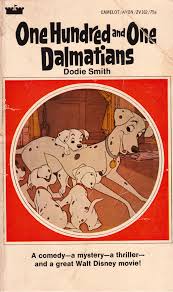 We wrapped up January with One Hundred and One Dalmatians by Dodie Smith.
  The original, not these new media tie ins you’ll find with the Glenn Close movie cover on them. For once I can actually say, No, it’s not the same book! Typically you can tell book buyers that it was just a marketing tactic. They put a movie cover on an old manuscript and sold the same book again. That is not the case with One Hundred and One Dalmatians. Pay attention when you purchase. Also… now that we’ve read the original, I’ve discovered that there was a sequel. Of course, now me must find it and read it too. (Until then, we are tackling The Wind in the Willows as our evening family chapter book.)
As previously mentioned, I read Guide to Wild Foods & Useful Plants by Nyerges. But I also read through A Game of Thrones last month. (And caught up on the tv show.) There’s a reason the masses are in love with George R.R. Martin’s world. It’s impressive. It’s grossly human. It’s epic fantasy. The prude in me would like a little less nudity and sex out of the show – the books are far less detailed in that regard – but from a cinematic point of view, I’m blown away. The sets, the actors, the crew, everyone just seems to have nailed the feel for the world. Clearly, I’m very late to this party – as usual – but I love it. Obviously, it brought a whole new appreciation to this moment from Comicpalooza in 2013:

Yes, that would be me, braiding the hair of the Father of Dragons. I knew what I was doing, knew what we were emulating, but I didn’t really have a full appreciation for it all until now.
Then, I kind of went all self improvement in my reading. I read through The Excellent Wife by Martha Peace and The Homeschool Life by Andrea Schwartz. I don’t particularly care for self-help books, but I do manage to keep them in my life via my “read for every discipline” mentality. No section of a bookstore is left untouched by the end of the year, if it’s a good year.
I also read through Garden Crafts for Kids
Finally, I finished The Gardener’s Bed Book by Richard Wright. I’m not going to touch too heavily on the book here, because honestly, I have far more than an online book review in mind for my experiences while reading it. My favorite thing about a reader’s life are the books written in response to other books. They are like love letters through time and space to people you’ll never meet or know, but feel more akin to than any other humans on the planet. I feel like Melanie Kerr’s Follies Past was her love letter to Jane Austen. I have projects in mind that will be odes to Madeleine L’Engle and Richard Wright. They have moved me so completely and become a part of who I am, it’s only right they are responded to with ink and paper.
Teaching Life and Liberty
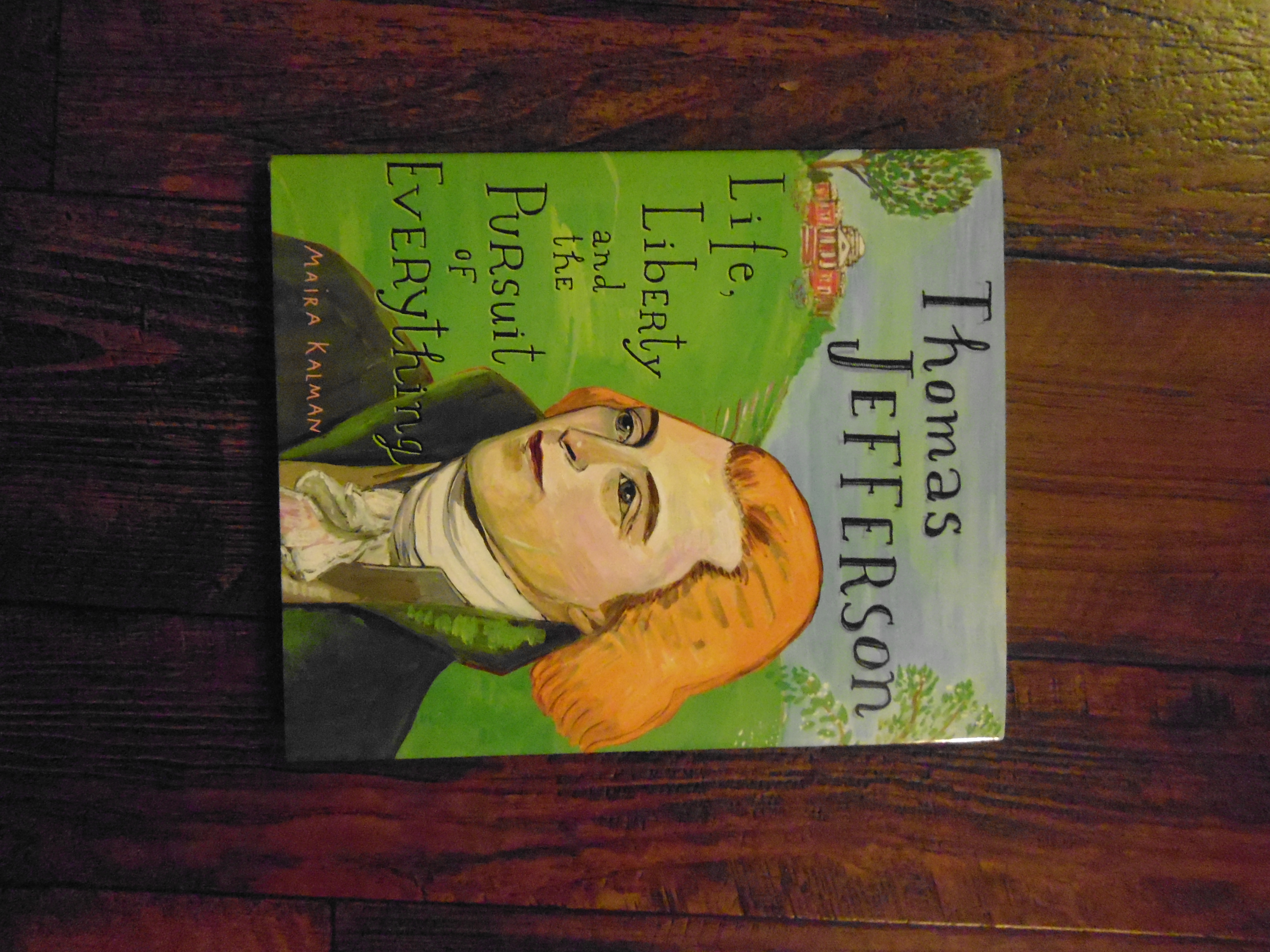 Title: Thomas Jefferson
Author/Illustrator: Maira Kalman
Publisher: Penguin
If you want to teach about the founders of America via biographical picture books, Maira Kalman is a great place to start. With spunky pictures and fonts, Kalman introduces children to Jefferson (and in another book she tackles Lincoln), his love for books, language, and gardening.
Kids can discover in Thomas Jefferson quirky details about how Jefferson got out of bed in the morning, his obsession for peas, and learn the quote he told his wife:
“Determine never to be idle. No person will have occasion to complain of the want of time who never loses any.”
There’s a few pages dedicated to Jefferson’s friends: John Adam, Benjamin Franklin, and George Washington, and the ideals the team struggled for.
Kalman doesn’t pull any punches. She talks about slavery and addresses the truth of Sally Hemings. Jefferson had so many wise quotes that adults praise and sharing them with a four year old is especially wise:
“When you are angry, count TEN before you speak; if very angry, to ONE HUNDRED.”
The book ends with a visit to his burial grounds and notes regarding his epitaph.
As a whole it’s lovely and educational. When I told kiddo I was finally posting the review and asked her what she wanted to say about it, she said, “I think we should read it again.”
President’s Day is fast approaching. This one is worth having in your hands on that day.
Goodnight Goon
*A Weekly Low Down on Kids Books*
 Title: Goodnight Goon
Author: Michael Rex
Every parent I know can recite or nearly recite Goodnight Moon. It’s a timeless favorite. I’m not sure why, kiddo loves it, but it has never really moved me personally.
“In the great green room, there was a telephone
And a red balloon
And a picture of a cat jumping over the moon…”
― Margaret Wise Brown, Goodnight Moon
It’s probably the cadence, the familiarity, the simplicity. It’s a lot of things. For kiddo, it’s also because she has the hallmark version that her out of state grandparents was able to record into… so she can flip through the pages and hear the story at her own leisure and will, the most exciting thing for a kid when they can’t read yet.
But to be fair, it’s boring. It’s appropriately sleepy, but I already have a hard enough time staying awake while I read bedtime stories.
I saw Goodnight Goon and took a risk. She loves Goodnight Moon, but she’s also wonderfully weird and gets very excited about monsters. I know my child, though, and sometimes she can be a bit of a purist. I wondered if a parody would be up her alley if it was just up mine.
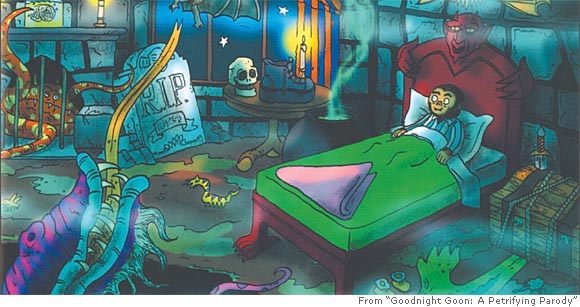
In a cold gray tomb
There was a gravestone
And a black lagoon
And a picture of –
Martians taking over the moon
She laughed her butt off! She loved every page. Especially the end where the monster is cast under the bed for the night, “Goodnight Monsters Everywhere.”
“He’s under the bed!” she laughs.
“Maybe other kids will like it,” she says.
“Why?” I ask.
“Because they’re little. And the monsters. I like the bat. That’s the kind of monster I like.” Of course, she watches me type the review and also insists that I “put an L in it.”
L
I should have known all would be well. After all, this is a kiddo that adored the The Swamps of Sleethe.
Chinese History at Lunch
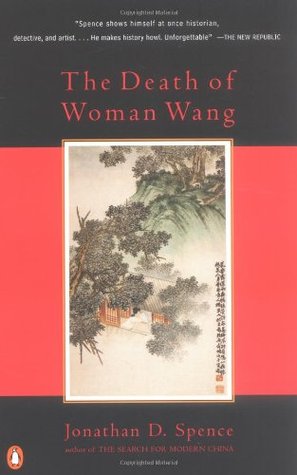 Title:The Death of Woman Wang
Author: Jonathan D. Spence
Genre: History
When picking up books at bookstores, there’s always the lovely predicament of what to do during lunch hour. As if any bookworm wouldn’t know what to do during lunch. I like to pluck books that I would otherwise not read, things that probably wouldn’t make the cut when selecting reading material at home, but are intriguing nonetheless.
Chinese history and social commentary via anecdotes and tales from a specific region are fit the bill exactly.
Though Jonathan D. Spence’s The Death of Woman Wang is fairly short, and probably something I’d be able to get through over two cups of coffee at home, at work – with the distractions of barbecue sauce, walking (because I must always do a bit of walking), and a number of other lunch break occurrences – it took me a number of weeks to get through it. (I only work on Saturdays, mind you.)
I have decided that even though I’m not keeping The Death of Woman Wang (I’m in purge mode and not keeping as many books as I have been inclined to in the past), I will read more of Spence’s work in the future. Treason By the Book looks especially fascinating.
[Unrelated note to the book review: I just googled his name to see what else there might be and stumbled across his face. He’s endearingly handsome for an old fellow.]
Spence is a British-born Chinese historian (what an interesting description for a person). He retired from Yale in 2008 – my childhood bestie attended Yale from 2002-2006, I wonder if she ever met him…
He has a warm way of relaying history. He tells stories in a fashion that you’d think perhaps you were sitting around a fire listening to a beloved professor while on some sort of educational retreat. He manages to do this without feeling novelized or ill researched.
I’ve been enjoying my Chinese History lunches, and I’m a little sad that they’re over.
The Year of the Hydra
Reviewing things and taking names!
I’m not really taking names… but I am reviewing a lot these days, and getting quoted on book jackets!
![Year of the Hydra [Back Cover]_Back Cover](https://anakalianwhims.com/wp-content/uploads/2015/01/year-of-the-hydra-back-cover_back-cover.jpg)
I recently got to read an advance copy of The Year of the Hydra by W.B. Burt. You can preorder it now or wait until February 19th to purchase it. Either way, you don’t want to miss this new release.
The Haunted Bookshop
“It’s one of the uncanniest things I know to watch a real book on its career – it follows you and follows you and drives you into a corner and makes you read it. […] Words can’t describe the cunning of some books. You’ll think you’ve shaken them off your trail, and then one day some innocent-looking customer will pop in and begin to talk, and you’ll now he’s an unconscious agent of book-destiny.” – pg. 121, The Haunted Bookshop by Christopher Morley
 Title: The Haunted Bookshop
Author: Christopher Morley
Length: 265 pages
I am constantly haunted by books. As a reviewer your TBR pile grows and grows, but there are books that you want to read that no one is asking you to that sit and lurk until finally they demand that you pick them up.
I purchased The Haunted Bookshop years ago; it was the same time I bought Parnassus on Wheels. Nearly two years after finally reading my first encounter with Morley, I’ve finally been hunted down and captured by his wonderful sequel.
“There’s only one way to lay the ghost of a book, and that is to read it.”
 Now that I’ve revisited Roger and Helen Mifflin, however, I just want more. I want to know what happens after this glorious book fetish mystery. After Parnassus on Wheels, it was exciting to see Mr. and Mrs. Mifflin after they settled down. But now I want to know: how does all the inadvertent advertising change the face of Mr. Mifflin’s business. I want to hang out with these fine people until we experience their inevitable deaths. Favorite characters deserve that much, for their fans to sob at their memorials.
Mostly, I adore Mr. Mifflin’s constant book recommendations. As long as people love books there will be books about bookstores, I am convinced, because the truly bookish seek out recommendations from their favorite characters, always. That was the romance, for me, in writing The Bookshop Hotel. I hope in time that fans will see more similarities in my work to Christopher Morley than to Debbie Macomber (of whom my writing has been compared) and the like. Ultimately, however, I’m happy with however I am categorized as long as people are enjoying them.
A Boy Called Dickens
* A Weekly Low Down on Kids Books *
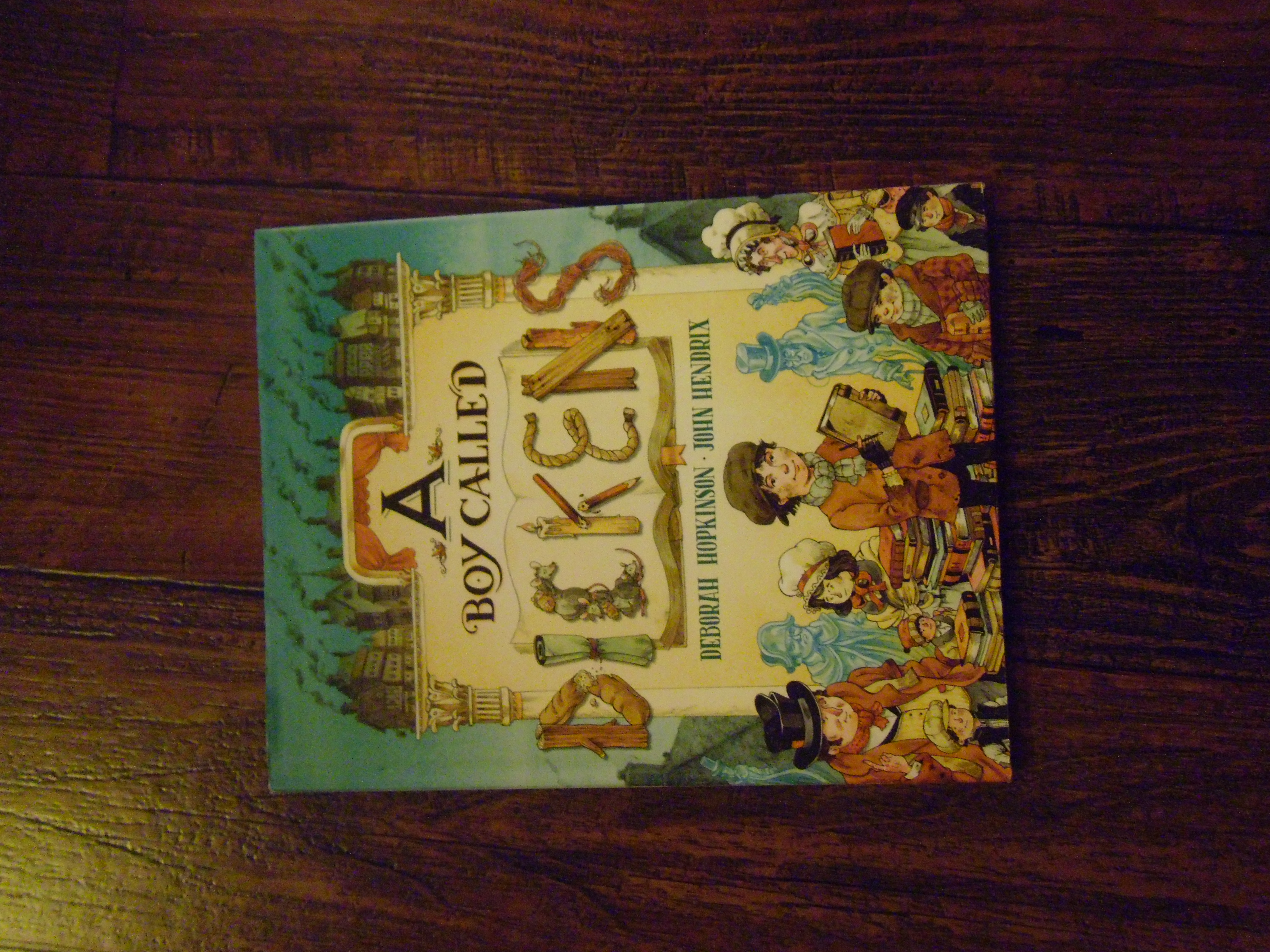 Title: A Boy Called Dickens
Author: Deborah Hopkinson
Illustrator: John Hendrix
As a homeschool family, we’re suckers for the educational picture book. Especially biographies.
A Boy Called Dickens tells the life of Charles Dickens. Obviously there are some creative liberties taken with Dickens’ boyhood thoughts and how he might have come to write certain stories, but that happens with any piece of biographical fiction.
As an adult Dickens fan, you recognize characters peeking around corners and haunting the boy’s subconscious as he works at the factory, tells stories to his friend, helps get his family out of debtor’s prison, and finally returns to school.
When I finished read the book, kiddo said, “Let’s read it again.”
I was out of breath from my strained fake British accent. I’m not an actress, but I like to make story time fun. It takes more effort than I’d care to admit. “No, I’m not reading it again right now.”
“Well, I think we should do the same thing with this one – let other kids read it!”
“You mean you recommend it?”
“Yes.” She gave it a literal thumbs up, with a tongue half sticking out the side of her mouth in thought.
Any biographical picture books you can find are great teaching tools, and you might as well fill them with as much information as you can while they’re sponges. History is easiest to remember as a tale, Dickens world and era becomes one you can touch and taste. Telling it from his boyhood makes it more relatable to a tiny one. Whether you’re a homeschool mom, or just someone who reads to your kids when you can, this book is a great resource; it’s colorful, factual, and engrossing.
(If you’re a seasonal reader, this one is perfectly wintery.)
The Snail and the Whale
I used to do a Weekly Low Down on Kids Books. Well, I used to pretend to do them, and really they were haphazard and sporadic at best, but sort of happened a few times a month at least.
I’m back. I’m back with a mission to share all the marvelous books we’ve been reading. Because, well, we have been reading more than we’ve let on. I know, our silence is stifling.
 Title: The Snail and the Whale
Author:Julia Donaldson
Illustrator: Axel Scheffler
I bought The Snail and the Whale on impulse. I’ve been trying to do less of that lately, but it was too darn cute and the kiddo had been working on a snail painting. Plus, I was feeling a little bit guilty over keeping Christmas as sparse as I was.
A few new picture books seemed a good addition to a Jake and the Neverland Pirate lego set (the third set to polish off the Jake collection); but we purposely are trying to keep Christmas gifting simple… “What you want, what you need, what you’ll wear, and what you’ll read.” Accumulatively, we’d like for her to get no more than 4 presents from each category once all the grandparents have pitched in. Ideally I’d keep it to four items total, but I’m practical and I know the family members won’t let that fly.
 So she got the rest of her desired lego collection, a Frozen tiara and tambourine, socks, new boots, and a handful of new picture books. There were some stocking stuffers and some other odds and ends – a geode science project for her school work, new paints, a painting apron, some canvases – and they were given to her in waves, not all at once on Christmas day. It gave her time to enjoy each gift before getting overwhelmed with another. We enjoyed it. She was spoiled without being spoiled. It felt like a nice simple holiday, yet kiddo managed to get everything she’d asked for.
Although The Snail and the Whale feels like a summer book – crossing oceans, travelling the world, visiting islands – we were excited to read it while cozied up in blankets and pjs. I can’t wait to read it to her at the beach once it warms up, though.

Working on her Snail painting, which has an actual shell glued to the canvas.
After reading this book for the second or third time, I finally asked kiddo, “So what are your thoughts?”
Kiddo, age four, says, “Other kids should read it, that’s my thought! But how about we put it where people can’t find it. So no one can tear it up.”
I think she was missing the point of the conversation. We started talking about the illustrations and what she thought. She likes the pictures, but thinks they got the font “mixed up.” I think the font is appropriately cute, but she’s learning to read and I think some of the swirly snail words were hard for her to recognize.
The book, however, is wonderful. The rhymes are fun, the pictures are fun. It’s all about adventure, having courage, and taking care of your friends. It’s definitely a great gift book for any little one, no matter what season.





 Anakalian Whims