M.G. King: the new voice of young adult fantasy
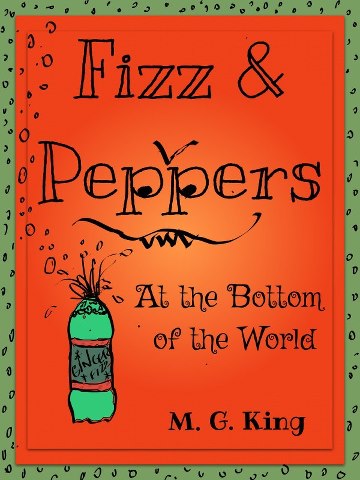
 Title: Fizz & Peppers
Author: M.G. King
Genre: Young Adult/Fantasy/Adventure
“Sometimes great ideas are so genius and unlikely they fall from the heavens; but sometimes the best ones are simple, waiting to be found already in the palm of your hand.”
I don’t know if this idea fell from the heavens or was found in the palm of King’s hands, but Fizz & Peppers is utter genius. It’s quite possible we have the next J.K. Rowling on our hands, folks.
Meet Colin Colbeck and a girl named Pepper, arch enemies and ex-best friends. Also, meet Colin’s kid brother Sid… by the way, he has trolls living under his bed. There’s also a nutty but endearing grandmother to rescue, an entire world under suburbia and the nearby wood, thrums, hot peppers, and a game called knattlebones.
This book, written by a mom for and with her own middle-grade sons, is about two boys who are full of some of the most “brilliantly, beautiful idea[s] ever to be thought of in the history of the world” as they fight off trolls to rescue their kidnapped, sometimes senile grandmother from the bottom of the world.
What an imagination this family has! The family responsible for writing the book that is… After reading King’s dedication at the front of the book to her “what if?” family, immediately I wanted to be a fly on the wall at their house as they speculate the nature of the world. What minds! To come up with the idea that a little bit of fizz from a soda pop would wake up a sleeping troll from a stone-like state and send them romping the underground, free to steal from (and eat!) Peoplekins and wreak havoc on everything.
Not every author can make such a smooth transition between genres – picture book to young adult is a couple hundred page leap – but King has done an excellent job. Fizz & Peppers is just as wonderful as Librarian on the Roof, and I am excited to have an author to share with my daughter for her whole life, not just her babyhood.
The only draw back is that Fizz & Peppers is currently only available on e-book, and I am very old fashioned when it comes to books… I like them in my hands, I like to sniff their pages, I like the risk of a paper cut. Lucky me, King printed me a copy in a binder! (Yes, I am bragging to cyberspace, I have this book in a binder! And I feel special.)
Reminiscent of The Labyrinth (come on you ’80’s kids, I know you were fascinated with Jareth the Goblin King as much as I was) and Lewis Carroll’s Alice in Wonderland, Fizz & Peppers will captivate you and keep you wide-eyed from the first hint of a troll until the very last drop of ginger ale. It’s a fantastic adventure for all ages that I believe will stand the test of time.
***UPDATE*** Fizz & Peppers is now available in paperback!
The Secret of Lost Things – A Review
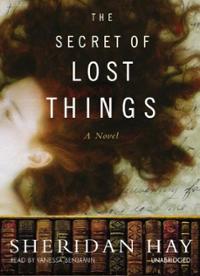 Title: The Secret of Lost Things
Author: Sheridan Hay
Publisher: Doubleday
Genre: Fiction
Length: 354 pages
I have a shelf in my house dedicated to what I’d like to call “bookish books.” On this shelf are the likes of Carlos Ruiz Zafon’s Shadow of the Wind and first edition copies of Basbanes’ A Gentle Madness
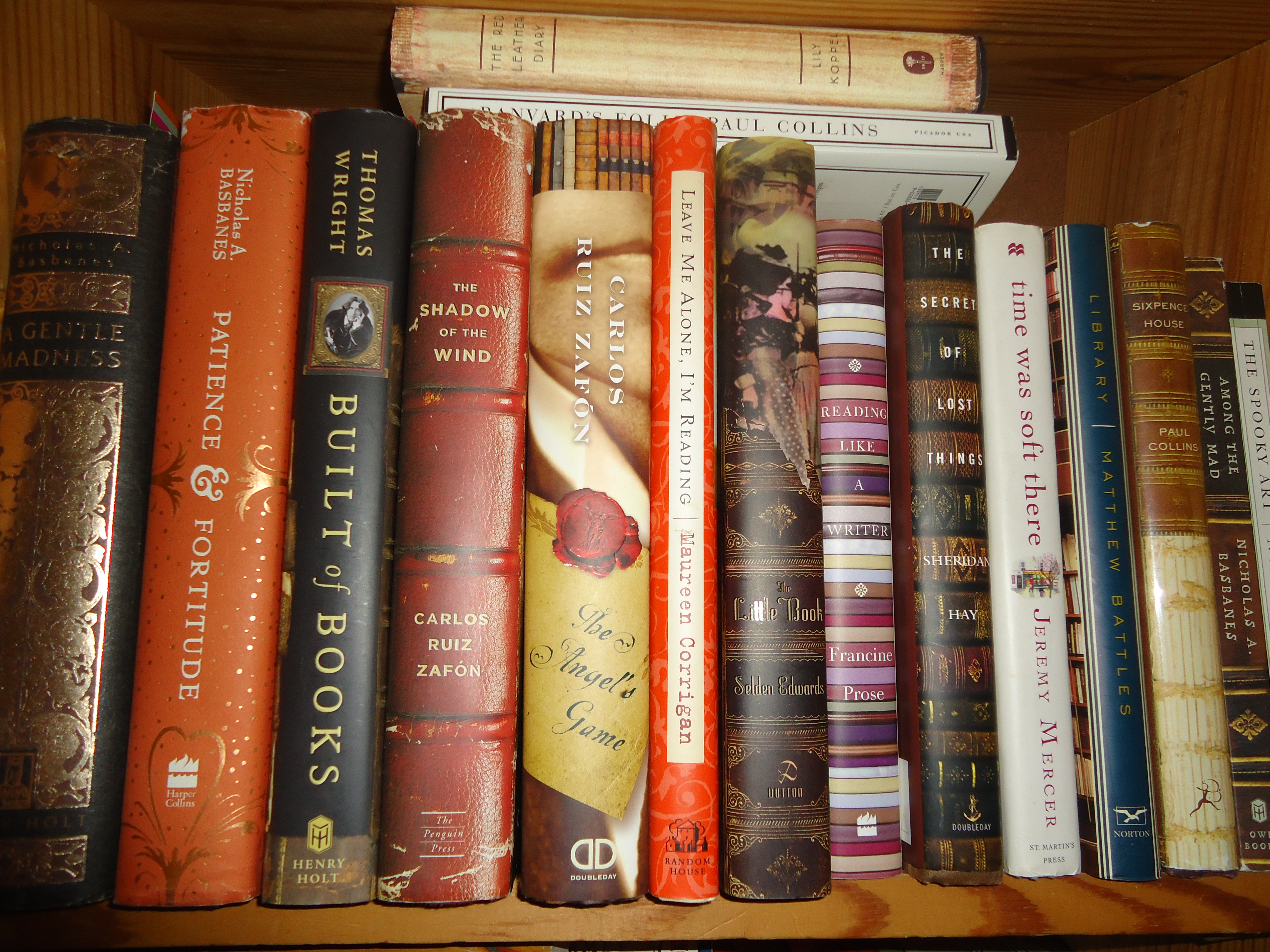 The Secret of Lost Things is a book written in the spirit of A.S. Byatt’s Possession, filled with dark library corners, clues in letters, and missing manuscripts. The difference is, most books of this nature romanticize secrets, portraying the keeping of them as a means to grow closer to others. Hay, on the other hand, presents a scenario closer to the truth: when all is said and done, these secrets cause heartbreak and drive people apart.
I find the character of Rosemary endearing. Instead of being a master secret keeper, like many heroines thrown in the this kind of novel, she is awful at it. Keeping a secret is her kryptonite, but not because she’s a chatty Cathy, just because it is not in her nature to be deceptive or to omit information from people she calls friends. It’s a refreshing take on an often visited theme.

” ‘Reality is as thin as paper, girl,’ said Pearl, shaking her head. ‘I thought that was one thing you did know, what with an imagination like yours – as thin as paper, and as easily torn.’ ” – pg. 137 of The Secret of Lost Things
I love reading these kinds of books because they always give me lists of things to tackle, information to seek out, as well as reminders of things I have already enjoyed. In this title alone, I am reminded of The Book of Imaginary Beings
After reading this novel I am also inspired to tackle more Melville titles. I have read Moby Dick twice now, but I have Typee, Omoo, and Mardi on the shelf, as well as a biography I have passed over far too many times to read other biographies first. It is virtually impossible to read Hay’s Secret of Lost Things and not want to immediately dive into a Melville
Exchanges like these are what really do it for me:
“We’re looking for something that’s lost,” he said. “A book that was lost.”
“Well, if it’s lost, and people don’t know it’s lost, what am I supposed to notice?”
“Here, read this book of letters. Just read and tell me when you find something interesting. It’s called research. The idea is that you don’t know what you’ll find until you find it,” he added irritated.
 At one point, the character Pearl gives Rosemary a copy of Ovid’s Metamorphosis, a title that repeatedly haunts me in everything I read. Seriously, will every author I love mention this title in every book that moves me until the end of time? I think so. I have a beautiful hardback waiting for me on my coffee table. It has been there for months. It will be there for months still, but I am one step closer to diving in than I was before I read Hay.
So yes, Sheridan Hay’s book is appropriately dubbed one of my bookish books. I have loved it, it shall join it’s literary cousins on my shelf. One day I will take the time to read it again; it is that good. In the mean time, I have research projects to tackle.
Aside from it’s bookish-ness, The Secret of Lost Things is exceptionally well written. I don’t read the backs of books before I read them. That’s especially rewarding when reading books like this where the sensation of experiencing a story the way you do a boat ride occurs… on waves of unexpected tales in motion with the lulls of the story you thought you would get. It’s beautiful and pleasant and especially appropriate in a novel where the author of Moby Dick stands in the forefront. What is equally lovely is that I had this sensation of being on a ship a mere ten pages before the narrator expresses the same sentiment about the setting of the bookshop.
What Rosemary likes about the Arcade is the same thing I first remember liking about Half Price Books when I was hired in 2007. On page 139 Rosemary says, “Well, the Arcade is like the ship to me. You know, people from everywhere, on a great adventure.” When I think of the Arcade, I imagine it to look and feel more like Good Books in the Woods of The Woodlands or The Recycled Bookstore in Denton than my Half Price Books location, but the sentiment is the same.
Note: People who enjoyed Kate Morton
Fizz & Peppers
From the author of Librarian on the Roof comes Fizz & Peppers…
Out in E-book March 7th, 2013!
Purchase Fizz & Peppers
HPB Humble Book Club Meeting March 2013
Lords of Finance Discussion Part Three (to read parts one and two, start here)
 Title: Lords of Finance
Author: Liaquat Ahamed
Publisher: Penguin
Genre: Economics/ History
Length: 508 pages
When all was said and done, Lords of Finance was a pleasant (and very meaty) read. It was definitely nice wrapping up the completion of the book with a discussion at Half Price Books among customers turned friends. The discussion definitely went down well with some home made German Chocolate Pie brought by a member.
 We sat together with internet research and a handy dandy chart of all the key players in Ahamed’s book and brought up our favorite quotes as well as bits and pieces that piqued our interest.
I was especially intrigued by the dialogue between Senator Mayfield and Senator Brookhart on pages 316-317 regarding Texas wanting to pass a bill prohibiting gambling via the stock market. Apparently, there were a lot of hearings that went on “in an attempt to refine the distinction between investing and gambling.” Upon reading this I immediately wanted to hash out the distinction and research the laws with others. What a fascinating paper this would make for a young economics student to be assigned in order to both understand the inner workings of the stock market and to establish their own world view in terms of monetary ethics and morals. Honestly, have you ever wondered… What is the line between gambling and investing? Off hand, I’m not sure I have a steadfast answer to give. Do you?
At the meeting we talked about businesses that are publicly traded verses those that are not. We touched on Roosevelt and Hoover and what they had to deal with as presidents in comparison to what Obama is dealing with today, and over all what a relevant piece of history this book is. One of my favorite quotes came very late in the book on pages 438-439:
When, in August 1932, a reporter for the Saturday Evening Post asked John Maynard Keynes if there had ever been anything like this before, he replied, “Yes. It was called the Dark Ages, and it lasted four hundred years.”
That line from Keynes about the Great Depression had me smitten with him. When I got to the store, I immediately headed toward the economics section and picked out a book he wrote called The General Theory of Employment, Interest, and Money
It took us awhile to decide who would actually be purchasing the only title by Keynes in the store. Everyone, I think, likes to read titles mentioned in books they read and Ahamed mentioned Keynes work quite a bit. We are in agreement that the books (both Keynes’ and Ahamed’s) should be used as require reading for economics classes, both high school and college. As someone who actively participates in continuing education on a self-study basis, I am interested to see how the end of this book leads into World War II. So many financial agreements were made and unmade, I want to know in detail how things were handled during the war on a financial level. None of us in the group were financial historian buffs and were unable to answer our own questions, but discovering the answers in the future should be exciting.
As for our reading future as a group, we tossed around ideas for the next set of books. This isn’t quite set in stone just yet, but it’s looking like the HPB Humble Book Club reading schedule will look like this:
April: On Chesil Beach – Ian McEwan (we will probably also discuss Atonement)
May: The Heart is a Lonely Hunter – Carson McCullers
June: The Princess Bride – William Goldman (the online Half Price Books book club will also be discussing this book in June)
July: John Adams – David McCullough
August: The Color Purple – Alice Walker
Any changes to this tentative reading schedule will be made at the April meeting.
The Froggy Books
 Weekly Low Down on Kids Books
Title: The Froggy Books
Author: Jonathan London
Illustrator: Frank Remkiewicz
If I never have to read another one of these books that would be fine by me! BUT, that’s not going to happen as the kiddo so kindly nominated these as the must read series for the last two weeks running.
I picked up ten titles in the series at the library and have not had a break from them since. She saw frogs on the cover, so frogs we had to have, and we checked out everything available in the series.
They aren’t bad, they’re very toddler friendly actually, I’m just tired. Any time Froggy goes somewhere he has to flop, flop, flop. When he puts on his clothes it’s with a lot of zips, zats, and znats. There are bonks and clangs, lots of “Froooooooogggggy!” and “Whaaaaaat!” exchanges between Froggy and his parents. Then of course, there’s that defining moment in each story when Froggy “more red in the face than green” discovers he’s doing something ridiculous.
The kiddo loves them and I cannot sit down to read a Froggy book without reading at least three Froggy books. This week, on multiple occasions, Froggy has gone to school, learned to swim, gone to bed, played T-ball, eaten out, gone to Hawaii, played in a band (kiddo’s favorite), gotten dressed (my least favorite), had the best babysitter, and had a sleepover.
They don’t have to be read in any particular order, but if you happen to find them in order you will definitely benefit. London does a good job of bouncing previous lines from previous stories into a later book. For instance, if we had not read Froggy Learns to Swim I would not have understood why in Froggy Goes to School the characters start chanting ‘bubble bubble toot toot chicken airplane soldier’ and think that it has anything to do with swimming. I guess I missed out on that swimming lesson as a child. But thankfully, I’d been to Froggy’s swimming lessons, so it wasn’t too weird.
There’s a lot of Froggy books and I’m sure we shall read more of them in the future as we come across them. As I said, great toddler titles… for the toddler. Parents: you’ll be longing for the days when you were reading Eric Carle twenty times instead.

The Price of Excellence
I have a love/hate relationship with education. Or should I say formal education.
I love to read, I thoroughly enjoy research. But most my teachers over the years would tell you I was a horrible student, if they even remember me. My work was typically mediocre, often done at the last minute. The ones that do remember me probably remember a fairly obstinate and argumentative irritant, not really someone you want filling out your back row.
 I went to a very expensive private university. Between the severe debt it put me in and the obsession with appearances, it left a really bad taste in my mouth. I think in many cases, college is pretty useless these days. It doesn’t really prepare you for anything, merely gives you four years to either party a lot or exhaust yourself with work – depending on your financial situation. I feel betrayed by universities and the entire education system.
Yet, I find myself longing for the chance to go back and get a frivolous Master’s degree. I watch movies only to be wooed by the montages of students in glorious libraries. I fall in league with nerds like Rory Gilmore and Felicity Porter and lean toward books like May Sarton’s The Small Room
 The Small Room is a 1960’s novel about a professor teaching in a woman’s college called Appleton. Don’t judge too quickly, it is most definitely NOT Mona Lisa Smile. Instead it is a social commentary of the very tender and sometimes volatile relationship between teachers and students, and how an entire campus reacts to the scandal of the theft of intellectual property.
Rather than an emotional feminist vs. anti-feminist story one would expect from the setting, The Small Room is about exploring the many nuances of excellence in education… and the price of obtaining it for both teachers and students.
“What is the price? […] The price is eccentricity, maladjustment if you will, isolation of one sort or another, strangeness, narrowness. Excellence costs a great deal.” – Carryl Cope of Sarton’s The Small Room.
Frankly, education is such a moving and sensitive topic. Who isn’t brought to tears by Dead Poet’s Society? Who doesn’t stand and applaud Mr. Holland’s Opus or The Emperor’s Club
Then on the counter balance… Who doesn’t laugh their butt off reading Kaufman’s Up the Down Staircase and acknowledge how utterly familiar it sounds?

While reading, I imagined Appleton to be a smaller version of Wellesley.
May Sarton’s The Small Room is delightful and truthful. Without full on hating on education altogether, it takes into careful consideration the heavy weight being a teacher or a student can be on a human being and their relationships.
“[…] before she went to sleep, she wondered whether just this were not what you did take on if you chose to be a teacher… this, the care of souls.” – The Small Room
I have a 1976 Norton Library edition (featured above) and I fell in love with the book immediately. Long before I picked it up to read it, Sarton’s novel was part of my personal collection. I remember being so struck by the green leafy cover, the musty smell, and the promise of imaginary academia while holding the book in the used bookstore. The novel has lived up to the promise of its cover (and its smell!) and I think any alumni or teacher would appreciate the ethical discussions within its pages as Sarton and her characters attempt to define the price of excellence.
What’s Awesome on Audio
 FOR KIDS… actually, for adults too!
Title: The Bippolo Seed
Author: Dr. Seuss
Read by: Neil Patrick Harris
Until I went browsing through the audio book section of our public library I had never heard of The Bippolo Seed. I love Dr. Seuss, he’s pretty much always awesome… but the clincher for me picking up this edition to enjoy at home with the kiddo… why, Neil Patrick Harris of course!
Most child stars are annoyed by being referred to by the role that gave them their big name… I know Mark Wahlberg hates being called Marky-Mark and Maureen McCormack has made it quite clear that she is not Marcia Brady. But seeing Neil Patrick Harris’ name on that Bippolo Seed box, all I could think (and I apologize to NPH in advance!) was: Doogie Howser reads Dr. Seuss! What could be better!? Nothing, I tell you, nothing.
The fabulousness of Dr. Seuss combined with the sheer genius of Neil Patrick Harris is awesome. I love stumbling upon these kinds of wonderful things, because I’m certain my child is as tired of hearing my reading voice as I am of reading sometimes. I don’t feel so guilty passing the buck when I know someone as boisterous and Harris is taking the lead.
As for the “other lost stories,” there are a ton of talented stars featured on this audio book. Angelica Huston was surprisingly wonderful. Surprising not because she’s untalented or anything, just because I confuse her with Sarah Douglas and always imagine it was Huston, not Douglas, who played Ursa in Superman II (don’t ask me why)… and Ursa always appropriately gave me the creeps.
The point? Whether you’re a kid or a grown up, it’s never too late to hear The Bippolo Seed on audio.
Economic Education

Lords of Finance Discussion Part One (I am writing this only 150 pages into a 508 page book. I anticipate a series of reviews, much like how I handled Les Miserables in 2012, except over a short amount of time. I will have the book completed no later than March 4th, 2013)
Title: Lords of Finance: The Bankers Who Broke the World
Author: Liaquat Ahamed
Publisher: Penguin
Genre: Economics/ History
Length: 508 pages
Inevitably I read something and find about ten more things I need to read. My constant lament on this blog is why we didn’t read more source documents in school. So is it any wonder at all that while reading Lords of Finance for the HPB Humble Book Club I discover that I absolutely must have a copy of The Economic Consequences of the Peace
In addition to that title, I find myself longing to dive into more history books on the time period as well as full length biographies on a few of the people mentioned. You wouldn’t expect that kind of revelation out of reading a finance book, but Ahamed has a way of turning a phrase that makes interest and exchange rates, and the people directly responsible for their flux, fascinating.
I think this would be a great title to hand to a high school student during an economics course, it would definitely make the class more interesting. I enjoyed my economics classes in college, taught by a clever little man with a wonderful accent (Scotland? Liverpool? Not sure) and had a great sense of humor despite teaching all his courses at eight o’clock in the morning. But what I remember of high school economics was pretty cold and void of any kind of spunk. It was filled with boring formulas, worksheets, and a fairly heavy textbook that we read very little of. Obviously, the formulas are handy and important, but couldn’t there have been a little more meat? A little more perspective? A little more history?
Maybe living in a recession has weighed heavily in how I view the dollar, but I would like my child to grow to understand how much the economy effects politics, social customs, humanity, and art.
Idolizing money is a concern and a problem, but seeing how money fits into our lives and the bigger picture is important. So often we are taught that money is separate and that we should keep it that way, but the truth is money is never separate. Our history is riddled with money driven politics, so why is our history class and our economics class separate? Our religions are filled with instructions on what to do with our money, our philosophies rooted in our thoughts on whether to live richly or poorly and how rich and poor are defined. I think the history of banks, the dollar, and what your views are on the matter should all be addressed while you are learning how to calculate it, not as a completely separate train of thought.
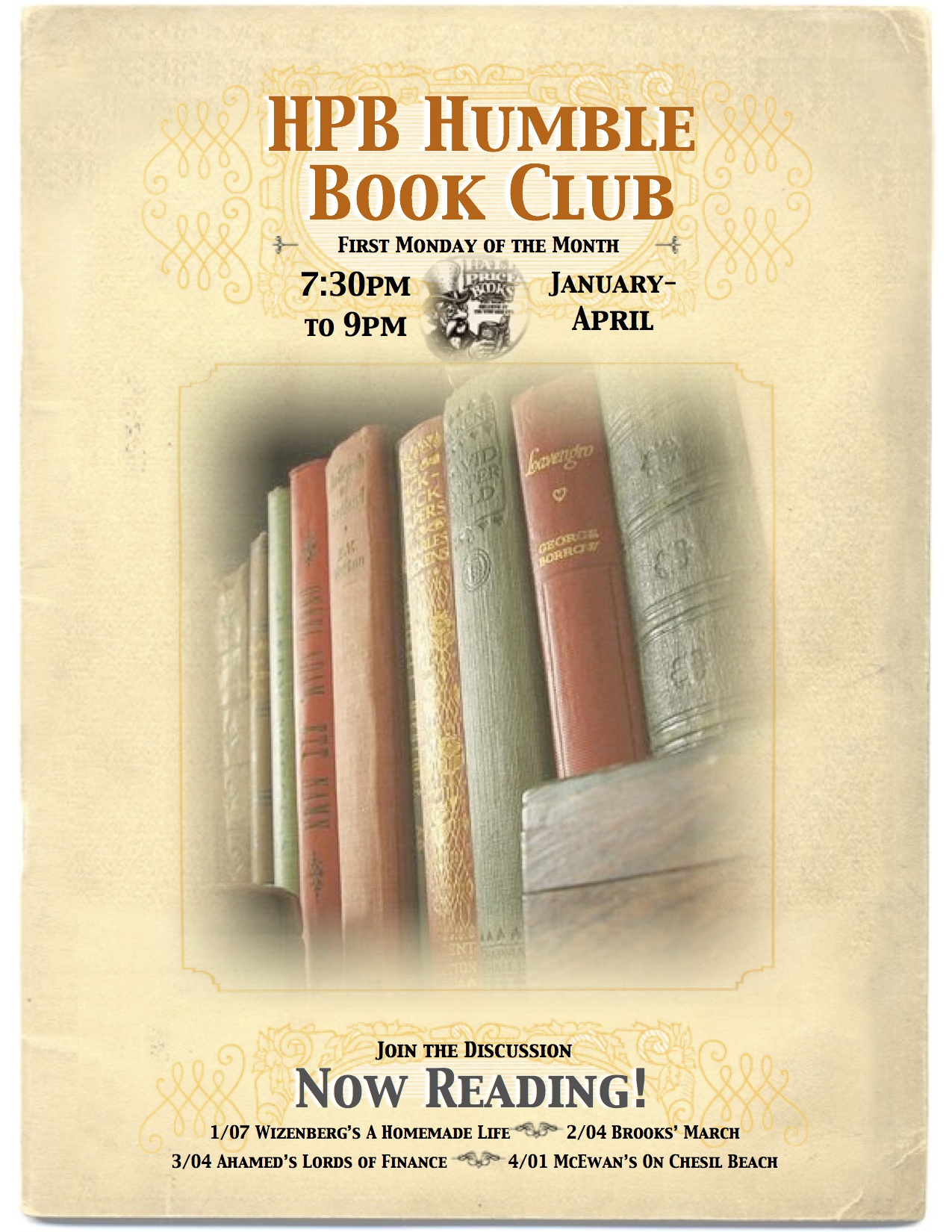 Ahamed’s Lords of Finance was recommended to me by a customer at Half Price Books, it was actually chosen for the Humble location’s book club by that same customer, and I am so glad I took his advice. We will be discussing the book as a group March 4th, 2013, starting at 7:30 pm. Additional members are welcome, so if you are interested in the book and are in the area, please join us. Treats are provided.
So far, the book is enlightening and informative, it covers a lot of the banking information provided in the documentary Zeitgeist without the haze of conspiracy theories and blasphemy. I imagine we will have a lot to discuss when we meet. Until then, I plan to share my own thoughts here.
Other titles in my personal Economic Library:
Adam Smith’s The Wealth of Nations
Thorstein Veblen’s Conspicuous Consumption
Craig Karmin’s The Biography of the Dollar
Thomas Stanley’s The Millionaire Next Door
Please share any titles you think should be added from a historical, philosophical, or sheer financial perspective.
Valentine’s Book Love Art
If you don’t already, you should really follow Bookshelf Porn on Facebook. Click the image they shared today (Valentine’s 2013) to visit their page.





 Anakalian Whims
Eden’s Outcasts – A Review
March 10, 2013 at 9:18 pm (Reviews) (A Whisper in the Dark, American History, An Old Fashioned Girl, bill bryson, Bill Cosby, biography, books, Bronson Alcott, Civil War, debt, Dickens, Eden's Outcasts, education, fame, family relationships, feminism, Fruitlands, Goethe, history, homeschooling, jo march, John Matteson, Little Women, Louisa May Alcott, Love and Self-Love, mental illness, pulitzer prize winner, race relations, Ralph Waldo Emerson, reviews, social commentary, Thereau, transcendentalism)
Author: John Matteson
Genre: Biography/ History
Publisher: W.W. Norton & Company
Length: 497 pages
I knew I wanted to read this book the first time I saw it at Jill’s Books in The Woodlands a few years ago. I have loved Louisa May Alcott all my life and in the last few years I’ve really started to enjoy the art of the biography. My best friend bought it for me on the spot because she is one of those beautiful people who doesn’t think people should be denied their bookish desires. It wasn’t until March (a novelization of the younger years of Marmee and Mr. March) was chosen for the HPB Humble Book Club that I actually committed to sitting down with it in an attempt to understand Brooks’ portrayal of the patriarch.
*Notes about A Family in Debt*
So my review of the biography begins with Bronson Alcott’s astonishing ability to over zealously botch everything he touches. This trait of Bronson is made overwhelmingly clear around page 181. By this time in the biography, his utopian commune Fruitlands has failed, he has lost all his manuscripts, the house the family is living in was purchased with his wife’s inheritance, and he has completely disappointed me. At this point in his life Bronson refused to be employed and takes up an architectural endeavor on Emerson’s land, a building that would be nicknamed “Tumbledown Hall” and “The Ruin.” For a man portrayed as one so taken with education, he tackled projects with a whole lot of zeal and not nearly enough research. When he did research, others’ ideas were usually disregarded in order to implement his own innovative plans. To me, most his plans pretty much always sucked.
On the other hand, Louisa, his daughter, was exceptionally prudent. She had an intense crush on Ralph Waldo Emerson when she was young, which I find adorable, but never shared the love letters she wrote to him. Instead, when the crush was over, she burned them, but continued to look up to Emerson as a teacher. Emerson would be a part of Louisa May Alcott’s life from her birth until his death.
Bronson may have failed in many things during the first half of his life, but his efforts as a father are later a solid testament to home schooling. Matteson shares on page 182 that
Bronson Alcott, I believe, had some serious issues. Matteson has the grace to allow you to come to this conclusion on your own before he shares the fact that mental illness did indeed run in the family and that it is likely that both Bronson and Louisa May were manic depressive or bipolar, but that there is no way to know for sure.
Bronson’s worldview was both passionate and skewed. He established his house at Hillside (a few years before the well-known Orchard House) as an underground railroad station and fought viciously for equal political rights for African Americans. Then in contradiction to his own actions stated that blond hair, blue eyed people were closer to God and that black men should not be allowed to reproduce. How these beliefs reside in one human being baffles me. It reminds me of an observation Bill Bryson made in his book The Lost Continent, where when traveling the United States he identifies a curious contradiction in American culture and race relations. In the north, Yankees are known for their belief in equality and pretend to make no distinction between black and white in personal treatment and political issues, yet they live very segregated lives and rarely share the same neighborhood. However, in the deep south, there is a general assumption of hatred between the two groups, but they live side by side as neighbors.
Why such dichotomy? I find it all rather ridiculous. In Bronson’s case, he refused to use products made by slaves and destroyed his career on the principle that even black students had a place in his school. Kudos! But then he thinks something so crass as an idea that black men should be denied their God given right to have children. Absurd!
I find Bronson entirely too duplicitous. He insisted on a family commune but almost left his family to a more philosophic way of life. He was passionate about fatherhood, but made it very difficult for his children to feel worthy of his praise. He desired a Utopia, but in every action tore what could have been to the ground. His ease in living off hand outs from the labor of his friends while simultaneously declining anything done honestly through the labor of animals is confusing. It is no wonder to me that the father figure in Little Women is both absent and idolized. The fact that Bronson went to such great lengths to have a perfect transcendental family and then refused to accept work when it was offered because he had as “yet no clear call to any work beyond [him]self,” is irritating. The Alcotts were flooded with debt and Bronson had the means to fix it, but was too busy living in his head.
The greatest contradiction of all is that in the second half of his life he would rectify my horrible opinion of him…
*Notes about An Authoress*
The thing I love most about biographies is the same thing I love about “bookish” books – they provide lists, a more diverse reading experience. While reading Eden’s Outcasts, the biographer periodically offered reviews and insightful critiques to Alcott’s little known works. So while reading her biography, I was also led to read specific stories out of A Whisper in the Dark , like Love and Self-Love. It also led me to desire to seek out a piece called Hospital Sketches.
Matteson continues to offer literary criticism on many of Alcott’s publications and goes into a lengthy discussion of An Old Fashioned Girl . It is during this portion of the biography that Bronson has redeemed himself as a father in my eyes. At this point he was quietly living at Orchard House in between traveling and making his money. His ideals were far less irritating later in life than when he had a poor young family to support, because at this point Louisa’s fame had made the entire Alcott family debt free. This success and income is also what finally made Bronson a more supportive father who spent many of Louisa’s later years doting on her and praising her success.
This age old story of the parent-child relationship reminds me of a Bill Cosby sketch where he laments his parents as grandparents.
In the story An Old Fashioned Girl, Alcott actually praises her father by inferring that,
Matteson continues to say,
This is a much different sentiment than that during the aftermath of Bronson’s failed Fruitlands. Mostly proud father, but partly opportunist, Bronson wrote, “I am introduced as the father of Little Women, and I am riding in the chariot of glory wherever I go.” Bronson may have begun to be capable of providing for his wife and family, but only because Louisa made it possible with her fame.
As Matteson picks apart Alcott’s life and novels, he states:
Of her own fame, Alcott said: “I asked for bread and got a stone, – in the shape of a pedestal.”
*What it all Means to Me…*
All in all Matteson’s biography of Louisa May Alcott and her father is the most well-written and thorough biography I’ve ever had the pleasure of reading. I hung on every word.
All the detailed family relationships, the well thought out literary critiques, and little factoids like the fact that Louisa was the first Concord woman to register to vote, made the whole book a joy to read.
Above all, I am pleased that Matteson has finally put into words a truth that has been part of my own beliefs since childhood when I first read most of Alcott’s work. Without reading Matteson’s biography I may have never come to understand a piece of myself and where aspects of my own worldview were initially formed. It seems that my ideas regarding feminism may be largely attributed to what Louisa imparted to me through her novels, as our views are nearly identical.
Louisa’s ideas call for
Matteson also says that
Whether you want to be a doctor or stay home and bake pies, male or female – just do it well.
I could not agree more.
Permalink 2 Comments