The Brain Station and little Italian Conductors
An Essay of the Mind
by: A.Z.K.R.
The “Train of Thought” is a very common expression, that I’ve discovered is (at least for me) very helpful in visualizing and understanding my AuDHD mind, as long as you remember, it’s a whole train station and not just one train.
“The Brain Station” first came to mind when I was trying to explain why (I think) I tend to repeat myself and have the same kind of conversations over and over.
I picture a topic like a train car. When several topics/stories/memories/thoughts or ideas are connected in a way, probably not by one grand picture, but like how Spot It cards all have one thing that they share with each other Spot It card, they get hitched together on the same train, and most likely stay on that train together for a while—or indefinitely—so that if something gets brought up that triggers a need for one of these cars, the little conductor just brings the whole train in and unloads the information accordingly.
This idea came back to me when I was getting stuck in logic puzzles and geometric proofs. My mom said that based off of how I described “The information just being there or not” (and how she observed me staring off into space until an answer came to me) it seemed that, as opposed to just being incredibly stupid (my conclusion) I was just so smart that I was used to having answers come to me and not using my thinking muscles. So when I actually needed to think, those thinking muscles had atrophied. Now I understood what she said, but it didn’t quite ‘click’ in the right way until a specific proof in my geometry book about parallel lines. I was able to articulate that I understood the proof just fine, but on my own, I would have never been able to come up with and break down the steps to explain why the given was true, because it just obviously was true based on the definitions on the previous page. (Now the reasons for the proof were all, ‘because of this definition’ but I wouldn’t have realized I was supposed to write that.) Mom connected this scenario to the proofs and logic puzzles I had been doing and I was able to understand my struggle, which I explained to myself first through how reading works, and from there, to train cars.
I realized that my problem was like learning to read. In the early stages you learn phonics and sounding out. But once you’ve learned to read proficiently, you don’t need to sound out every word anymore. So, in my case, if for some reason I needed to sound a word out now, it would be as if I have completely lost the information of how because I haven’t in so long. (I can sound out words, but not with a very high success rate. I can read at a college level… and spell like a fifth grader. I might be being generous with myself on the spelling part.) Now we bring in the Italian Conductor.
You’ve learned to read, or maybe you can come up with a more suitable example, but you no longer need the basic, rudimentary, information for your topic of choice.
It is tedious to the little conductor to have the “phonics” and “sounding out” train car on the train of information responsible for every time you read. There are probably several of these reading trains depending on how much you compartmentalize school subjects; so to be more accurate, it is tedious to the little conductor to move these cars back and forth from each needed train. There’s probably a more useful car he needs to put in that spot, like word definitions that keep getting lost. (Let’s face it, if the words are in a bin like a coal car, the new ones will fly off the top anyway.) So, he unhooks the “phonics,” and “sounding out” train cars, and leaves them in the “Graveyard of Information” to rust.
Then, inexplicably, one day, you need that information. But it isn’t on the train. The little conductor goes to the graveyard, but he cannot find the lone rusted train car among many similarly rusted train cars he had thought wouldn’t be need anymore. On top of that, they’ve accumulated even more things that he’s forgotten for you, as you were learning more things. So, it’s lost. He’s missplaced this outdated information. He scratches his head.
“Eet-a ees-a not-a here.” (This is why he’s Italian.) So he shrugs and moves on. He has better things to do than check the faded label of every rusted train car to find one among thousands.
But, “Eet-a ees-a not-a here” obviously isn’t enough for your parents, or teachers, or what have you.
(No, for real, it’s not enough. My mother made me look up the translation for “It’s not here” in Italian. So, my little Italian Conductor cartoon in my head should be saying: “Non è qui.” Thank you Google translate.)
“But we taught you this! It has to be there!”
And they’re right, of course, it is there. You just don’t know how to remember it. You can’t talk to the conductor as far as you know. His telegraph machine is probably broken.
The even more irksome part is that if the memory of actively learning the information is connected to the information itself, (who am I kidding? it absolutely is!) then when Mr. Italian Conductor unlatches ‘unnecessary’ information he probably left the memory of learning it in the first place, also in the “Graveyard of Information,” still hooked to “phonics” and “sounding out.” Which means that you might only remember the parts of learning that are actively connected to still-relevant information. Which could just be a funny story you like to tell, or a particular lesson you loved for any given reason, which leaves huge gaps in your memory that annoys everyone. Especially your mom.
Sir Arthur Conan Doyle has a quote he wrote for Sherlock Holmes, along the lines of this: Everyone’s brain is an attic that must be furnished with the necessary information of getting through life. He says that this attic does not have rubber walls and can’t be stretched to accommodate information you don’t need. Which is why, he argues to Watson, that as a detective, facts about the solar system are a clutter to him, and he doesn’t need to know who orbits what, or how many planets there are, in order to solve crimes.
I think Sherlock is wrong on the part about not stretching our attic walls. We can, he’s just lazy. The answers come to him.
Maybe people have different consistencies of rubber, but I think you can stretch it. Like my mom said, it’s like a muscle. The part he is right about is clutter and furniture. While we work on stretching the rubber attic muscles, we still have a lot of crap to sort through and keep track of. That’s what the train station is for, to bring information in and out of the crowded attic, or across parts of it, you pick. Our problem? It’s this: The person in charge of maintaining and organizing the attic? He’s just as confused as your are, because he’s a just little cartoon Italian Train Conductor. And his English ees’a not’a too good.
(Mom is an Amazon affiliate, so she might earn something if you click through and buy that Spot It game.)
Jane Austen’s Use of Satire In Northanger Abbey
by: A.Z.K.R., from Tales of Porcelain Thrones: Middle School Edition
Jane Austen was an author in Regency Era England. She wrote satirical novels and enjoyed mocking the frivolities of English society and “the Novel” itself. Satire as defined by Webster’s New Word Dictionary is a literary work in which vices and follies are held up to ridicule, satire doesn’t have to be funny, but Austen’s work definitely is.
Jane Austen was born nine months after the beginning of The American Revolution, she had several brothers, and one sister (Leithart 1). Austen was an avid reader and loved novels, but she still found them a little ridiculous. Austen wanted her books to reflect the real world, showing real dangers. Instead of writing about bandits and murderers, Jane’s villains included liars and social climbers. Jane Austen was fighting against stereotypical heroines, bizarre and dangerous social expectations, and the problems of treating novels like real life. Yet, ironically, Jane Austen’s novels were realistic, which was sort of the point. Jane Austen wrote about real problems in a funny way. Even for someone who does not live in Regency Era England, Austen’s characters represent real types of people and can help give young women the wherewithal to avoid the Big Bad Wolves (John Thorps) of the world and find their very own Prince Charming (Henry Tilney).
Austen starts her book Northanger Abbey with a mockery of a novel’s heroine. Austen does this by describing her heroine, Catherine Morland, as normal, and “almost pretty,” emphasizing her normality by saying her family was neither rich nor poor, her father was a clergyman, neither of her parents were abusive, and her mother was—unfortunately—alive. Catherine loves reading novels, but not history books. These are all in direct contrast to the kinds of heroines Catherine herself reads about over the course of the book, stories such as Ann Radcliffe’s The Mysteries of Udolpho where the heroine, Emily St. Aubert, is beautiful, orphaned, and well versed in the arts. Catherine’s neighbors, the Allens, a childless couple of some fortune, decide to take sixteen year old Catherine to Bath. Bath is a tourist destination in England, complete with spas, parties, and shopping centers, which served many as a ‘coming out’ excursion (Cunliffe 41). Austen was able to write about Bath well because she lived there. Even while making fun of novels, Austen used some of their troops to her advantage, such as having a relative or family friend taking a young heroine on a coming out trip.
In English society one couldn’t just walk up to someone and talk to them, you had to be introduced by someone you already knew, forcing everyone to rely on family, family friends, other acquaintances, or the master of ceremonies. At Catherine’s first ball Mrs. Allen laments constantly that they don’t know anyone of consequence, while Catherine wishes they knew anyone at all (Austen 30).
At Catherine’s second ball, the master of ceremonies introduces her to Henry Tilney. Halfway through a conversation that they were having, Tilney interrupts by saying, “I hitherto have been very remiss, madam, in the proper attentions of a partner here; I have not yet asked you how long you have been in Bath.” Jane Austen mocks polite society through Henry Tilney’s comical performance of asking Catherine all the ‘right’ questions, such as ‘how long have you been in Bath,’ ‘do you enjoy Bath,’ ‘Is this your first ball,’ et cetera. Tilney, although he thinks society is silly, still follows its rules, and remains a respectable young man.
Jane Austen uses Catherine’s naivety to point out how unspoken rules can be extremely problematic, and even dangerous. The real dangers of society were people like the Thorps, social climbers and narcissists, who used these unspoken expectations to put other people in sticky situations. The Thorps, through a series of blunders, suppose that the Morlands have lots of money. They had already met Catherine’s older brother, James, at Oxford. Upon meeting Catherine with Mrs. Allen, they supposed that she would receive the Allen’s fortune due to the kind way the childless Allens were treating her. They catch their mistake when Isabella Thorp becomes engaged to James Morland and she receives a letter about James’s future income, one that sounds reasonable to the Morlands, but is disappointing to the gold digging Thorps. Isabella attempts to break off the engagement to run off with Henry Tilney’s older brother, Captain Frederick Tilney, but this proves to be her downfall. Captain Tilney, unlike his brother, is a rake, he doesn’t care about any of societies rules, and breaks the social customs that were actually worth keeping.
Because the Thorps thought Catherine so rich, and John Thorp planned to marry her, and they gossiped about her wealth in order to make themselves look better. At a theater, they brag to General Tilney, Henry’s father, who then wished to have Catherine married to his son. In order to empress her he invites her to stay at his home, Northanger Abbey for a holiday. Catherine is naive and unaware of the Thorps deceptions until she receives a letter from her brother explaining Isabella’s behavior. She is totally unaware that money is the reason General Tilney is interested in her alliance. Henry however is aware that his father cares a great deal about money, and isn’t sure why he is interested in having Catherine for a daughter-in-law. With these events Jane Austen is showing us the true the ‘villains’ of society, and how Catherine was totally oblivious to their presence. She was so caught up in the idea of bandits and mysterious murderers that she could not see the danger at the end of her nose.
‘The Novel’ becomes increasingly important in this part of the story, as it leads to Catherine’s embarrassment several times over the course of her stay at Northanger Abbey. Catherine’s preconceived notions about abbeys, established while reading gothic romances, leads her to disappointment when discovering modern renovations inside the home of her hosts. She fails to find secret passages, or incriminating letters, as the heroine Adeline did in Radcliffe’s Romance of the Forest, in her guest room and, worst of all it leads to a terrible confusion regarding the cause of Henry’s mother’s death. General Tilney is harsh, but not villainous. He takes good care of his servants and his estate, hence the renovations. He wants his children to marry well, thus his interest in Catherine’s supposed inheritance. General Tilney’s stony demeanor, combined with Catherine’s overconfidence in the reality of novels, leads her to make the worst of blunders: she makes assumptions. She speaks briefly to Miss Tilney, Henry’s sister, and finds she was not at home when her mother died, leading Catherine to assume no one was at home when Mrs. Tilney died. Catherine suspects foul play. Her blunder is discovered when she sneaks into Mrs. Tilney’s old room and is discovered by Henry. When she admits her thoughts, he admonishes her. He and his brother had been home when his mother had died, and she had perished of sickness rather than ill treatment. General Tilney’s behavior had nothing to do with skeletons in a closet. Catherine’s gothic fantasies stop here; she has learned and grown. The dangers are not ended, though.
The Thorps, angry due to their hurt pride, speak to General Tilney again and tell him not only that the Morlands are not rich, but that they were exceedingly poor, projecting their own flaws onto Catherine. General Tilney, in a rage, comes home and sends Catherine off in the middle of the night without a chaperone or money. The situation is quite unforgivable, but Catherine doesn’t yet understand and cannot fathom what she has done to displease General Tilney. Henry later comes to her house to explain and offer his hand in marriage, not just because he loves her, but because he feels responsible due to his father’s behavior. General Tilney, of course, does not approve.
Jane Austen, for all her realism, never leaves her stories with sad endings. Henry’s sister, previously forbidden, marries the man she loves, and by a novel twist of fate, now financially outranks her father. She demands that General Tilney allow Catherine and Henry to marry, and her will is done. Jane Austen defends the ending of her own book, at the beginning of the story, while talking about novels in chapter five. “For I will not adopt that ungenerous and impolitic custom so common to with novel-writers, of degrading by their contemptuous censure the very performances, to the number of which they are themselves adding— joining with their greatest enemies in bestowing the harshest epithets on such works, and scarcely ever permitting them to be read by their own heroine, who, if she accidentally take up a novel, is sure to turn over its insipid pages with disgust. Alas!” (Austen 42) Jane Austen is talking about Catherine’s own habit of consuming dramatic stories, but she’s also explaining here, that despite her book calling out the faults in these stories, its still a novel its self.
The story is funny, you can’t help but laugh when Catherine finds not evidence of murder, but instead laundry receipts in the cabinet. This is not was makes it satire however, Jane Austen books are satire because of exactly how it is funny: elements of the story mock society, and express its difficulties, she’s calling to attention problems regarding expectations when they are appropriate and when they are silly. We’re lucky to have Jane Austen doing this is a humorous manner as opposed to long dry articles listing the problems of society like a grocery list. Not all satire is presented in a comical fashion, but a point is better made when it provokes some kind of emotion, either anguish, or in Jane Austen’s case, joy.
Works Cited
Austen, Jane. Northanger Abbey. Signet Classic, 1996.
Cunliffe, Barry. The Roman Baths at Bath: Authorized Guide Book. Bath Archeological Trust, 1993.
Leithart, Peter. Jane Austen. Thomas Nelson, 2009.
Radcliffe, Ann. The Mysteries of Udolpho. Penguin Books, 2001.
Radcliffe, Ann. The Romance of the Forest. Oxford University Press, 1988.
Timothy and the Dragon Defenders, Part Two
A Short Story from the Archives of A.Z.K.R., author of Tales of Porcelain Thrones: Middle School Edition
[To read Timothy’s adventure from the beginning, click here.]
The purple dragon roared fiercely. A river rushed behind it, the sun made the water glisten, peeking over what almost looked like pines. The sudden brightness pierced Timothy’s eyes and all his senses were overwhelmed at once. He was grateful for the warmth, but the sun beat down harshly on his skin.
“Good thing the basement wasn’t a wardrobe and this place isn’t Narnia,” Timothy said to the dragon. “I’d be freezing and I’ve no time for tea with Mr. Tumnus, I have a test tomorrow.”
The dragon roared. And burped. Bits of Mrs. McCracken’s jelly still lingered on the corners of its mouth.
“So you are?” Timothy asked.
The dragon burped again.
“Ok, then. I’ll call you Burp.”
The dragon shook his head no.
“Belch?”
It shook its head again, then fluttered its wings. The right wing featured a brand, or tattoo, and when they came to rest against the beast’s back again, Timothy saw the name, “Galen” etched into the dragon’s flesh.
“Galen?”
The dragon danced, a bit like the McCracken’s golden retriever puppy when someone dropped bacon on the breakfast room floor.
“Like the Greek physician?”
The dragon danced again.
“So where are we, Galen?”
Galen belched another round, evicting all the glass from the crunched Mason jars into the river as he did.
“Ew.”
The dragon seemed to shrug and began walking away.
“Hey, wait!” Timothy followed. Pebbles from the riverside massaged his bare feet, not so unpleasantly. “Seriously, wait!”
He caught up to the bumbling dragon, “So where are we, anyway?”
Galen burped, then stopped abruptly, and Timothy bumped into a tree to avoid running into him.
Burgess, Beatrix, and Our Favorite Bear
One thing I didn’t expect to be doing in my forties was re-reading all the books of early childhood. I was a mom of only one for nearly eleven years and thought surely I wouldn’t revisit Thornton Burgess, Beatrix Potter, and Winnie-the-Pooh until I was a grandmother. But then I had three more babies.
I started reading Thornton Burgess out loud to my oldest and two of my niblings when there was a family crisis and I absorbed a niece and a nephew into my household for two months while my second child was two months old. Thornton Burgess always brings calm to an afternoon when you need it. He’s gentle, like Mr. Rogers, and tells you all about the animals the way Bob Ross tells you all about painting. During this season of chaos, we read The Big Book of Burgess, the pale green front board and back board matched my bedroom walls and put us all in a soothing nap-like mood. We usually read over elevenses or afternoon tea, the sunlight from my east facing living room windows often cascading over my shoulders while the baby kicked in the bouncer and the older kids settled in to watch the oak tree’s leaves dance across the area rug and faux hardwood flooring. What I learned then while the fifth graders sat restfully (the only time of day they were restful) and listened, is that I would never stop reading Burgess ever again. Never. Now, we always have a Burgess book going. I read bits of the Adventures of… series to my toddler, Lightfoot the Deer and Bowser the Hound when I had a teenager, a preschooler, and a toddler, and even now with a highschooler, preschooler, toddler, and newborn, we are reading Blacky the Crow. Burgess writes delightful little chapter books every age can enjoy, but…
Beatrix Potter’s work are picture books. I definitely didn’t expect to be reading The Tales of Peter Rabbit nearly every day for another decade. Even more, I didn’t expect to not get tired of them. Jeremy Fisher doesn’t stop being exciting, if anything I think he’s more exciting now that I have a little boy obsessed with fishing. Two Bad Mice is especially amusing with two precocious little human partners in crime scurrying about my home.
Last, I’ll never forget the first time I picked up the Winnie-the-Pooh collection to read to my second born. He was pudgy and snuggly and the lamplight was low and my voice fell into the patterns that my oldest calls my Winnie-the-Pooh voice and I thought, “Oh I get to do this again. How lovely.” The book smells like vanilla and baby powder, the spine reassuring in my palm. Winnie-the-Pooh of the Hundred Acre Wood, floating up to steal honey like a rain cloud really never gets old. It might be my favorite bedtime book.
(As an Amazon affiliate I earn from qualifying purchases.)
Hard Roads to Cultural Literacy
In May of 2019, I read a book called Hard Road West: History and Geology Along the Gold Rush Trail by Keith Heyer Meldahl. I remember it being riveting. When I logged it on Goodreads all I wrote was, “Excellent and fascinating.” I was dating my now husband at the time and I remember sharing with him sections I thought he would enjoy, as we both like geology and one of our dates was to the HMNS gemstone exhibit. At one point I laughed out loud at something clever Meldahl wrote (I don’t recall what it was) and my husband commented that it is a rare geology book that causes one to laugh in pleasure.
Naturally, I thought this would make excellent assigned reading for my homeschooled highschooler. But one chapter into it she was struggling. It wasn’t the reading level, she has a collegiate reading level and has had one for a few years now. I was certain it couldn’t be the science as she had been perusing geology books since childhood and had done a whole geology curriculum with a friend as part of their own little science club they created. Nerds. I went over the science with her and she kept reading. It became less of a struggle, but she is not laughing out loud with pleasure from her geology book.
Then I started reading Cultural Literacy by E. D. Hirsch and things became clearer. In Cultural Literacy Hirsch talks about a study done on the results of seven year olds who took a reading assessment test. In the test the children were asked to read a story about a spider. The children who had more prior knowledge about spiders scored higher on the reading comprehension questions about the story (which did not require special knowledge about spiders) than those who did not know much about spiders.
I shared this with my oldest daughter, as we often study together while the younger kids are playing. We discussed it and determined that it makes sense to not get hung up on something being mentioned in passing because you already know a lot on a topic and can picture it in your mind with little effort, but to struggle to retain what something is about if it mentions a lot of things you’re trying to picture because you’re not as familiar with them. Perhaps it is easier to envision Charlotte in Charlotte’s Web if as a child you also have watched a real spider build its web, perhaps it is easier to remember the story if you’ve seen or read about how baby spiders hatch. Or, if you’ve had Charlotte’s Web read to you as a child, maybe a technical book on pig husbandry would be easier to retain as an adult. Hirsch includes an example of college students reading a paragraph about Ulysses S. Grant and Robert E. Lee and struggling because they had no prior knowledge of who they were and how they related to the Civil War (shocking because these were college students out of Virginia).
I was reminded about a public schooled girl I was working with who had failed her reading portion on her standardized tests. Her phonics were impeccable, but where she struggled was comprehension. When I worked with her, almost every time she struggled to read something it was because she had never heard the word. She didn’t have the vocabulary to support her phonics skills. I advised the family to listen to audiobooks, read stories together at night, talk to each other more, look words up in the dictionary. Children learn the meanings of words by hearing them, then when they see them on paper for the first time while sounding it out… they have a picture in their mind of what that word means, feels like, or how it can be used in different sentences. Kids should always have access to stories above their reading level, so that they can learn grammar structures and vocabulary words organically. Hirsch drives home the idea that you can know how to read and still be illiterate if you don’t know anything about what you’re reading.
I told my daughter how this was interesting to me because my husband had said he thought she didn’t know enough geology to read Hard Road West smoothly, even though I thought it was a very approachable book and that she had a strong foundation in geology. She and I laughed over the time a volunteer at the museum asked her what a specific rock smelled like and the big reveal fell flat when she answered, “Sulfur.” Poor guy deflated and said, “Yes, it’s Sulfur. You must be homeschooled.” Apparently the public school kids her age on field trips liked to shout “Farts!” She was about seven at the time and it is one of her favorite museum memories. (I’m not going to lie, even if I knew it was sulfur at seven, I’d probably have shouted “Farts!” too, but I went to public school.)
“So, why, if you’ve read all the same geology books we read as children, is this geology book difficult? Because I genuinely don’t think it would have been difficult for me at fifteen.” That is when she confessed that the geology books we owned and had spent hours reading… she hadn’t actually been reading them: “I was looking at the pretty rocks. I could tell you the page numbers where all my favorite rocks are, all the prettiest ones, I didn’t read all the stuff…” We genuinely laughed together, two wildly different personalities approaching children’s geology books in wildly different ways. As Charlotte Mason said, “Children are born persons.” But for every moment, like this geology one where she struggles because maybe she didn’t pay as much attention to what was put before her in the past, she has so many where she shines. She catches every Shakespeare reference. Every time. (Hirsch writes a bit about how Shakespeare allusions used to be quite common in all kinds of writing, including business memos, but as of the publication of his book in 1987, that was no longer the case.)
Hirsch’s argument for cultural literacy was never meant to be for homeschool parents to refine the presentation of their educational feasts, his goal is educational reform in the public sector. There is extensive discussion in his book about the struggle to properly regulate education in that if you mandate that schools teach at least two Shakespeare plays there will always be arguments about which two should be selected and that no two districts will choose the same two, therefore knowing who Shakespeare is might be universal, but catching Shakespeare references will vary. (I vote for all the Shakespeare. Every play! All the sonnets!) But I did feel like Hirsch’s essay very much affirmed the education I am providing. Maybe my oldest gets a little bogged down in this particular geology book, but to be fair, it could easily be assigned in a college course, most high school students wouldn’t be reading it between their Homer and Geometry lessons. The paragraph that boggled the minds of the Virginian community college students in the 1980s didn’t phase her, and for that I have hope.
Additional affirmation came when I realized I had owned other books by Hirsch in the past. He’s the one that wrote the series Everything Your ___Grader Needs to Know. My first two years of formal homeschooling (first and second grade), I had read those books out loud the last month of the traditional school year to see if we were covering everything. What I learned was reading those books out loud was a waste of time because a classical Charlotte Mason education is thorough and she not only knew what she needed, but she knew richer versions than the sad paragraphs presented. That was the final nail in the coffin on us ever relying on textbooks. Cultural literacy can be gained from textbooks, but it’s boring and far less effective. The better road to true literacy, in my opinion, is living books. I donated Hirsch’s other books, but I’m keeping Cultural Literacy.
One whole day after finishing Cultural Literacy, I went to our local library to donate a bag of books I was purging from my collection. There on the shelf next to the library bookstore register was E. D. Hirsch’s Dictionary of Cultural Literacy, a compilation of all the things the average American graduate should know, for $2. Of course I bought it.
“Also unrealistic is the pragmatist emphasis on individuality, at least as the idea has been institutionalized. The best teaching does accommodate itself to individual differences in temperament, but a child’s temperament does not come freighted with content. To learn a culture is natural to human beings. Children can express individuality only in relation to the traditions of their society, which they have to learn. The greatest human individuality is developed in response to a tradition, not in response to disorderly uncertain, and fragmented education. Americans in their teens and twenties who were brought up under individualistic theories are not less conventional than their predecessors, only less literate, less able to express their individuality.” – E. D. Hirsch, Cultural Literacy, pg. 126.
One More Year of Reading
It has been a year since I last wrote a blog post. The choir girl in me starts humming “Five hundred twenty-five thousand six hundred minutes” as soon as I think the words “a year.”
I don’t measure my years in daylights or sunsets or cups of coffee, although I observe, draw, and inhale many of them. This last year was measured in inches grown by my thirteen-year-old, new words spoken by my two-year-old, and the birth of a new baby… and, as always, a lot of books.
After my last post, I re-read the Hunger Games series. I still like it. I hated the prequel fourth book. Naturally, after spending a lot of time discussing totalitarian governments with my middle schooler, I read Larry Correia’s In Defense of the Second Amendment. Everyone should give that one a go. Correia is great.
I read a lot of crap while I was pregnant, at least in the barfing phase. I started purging my shelves of things that I had accumulated for free or cheap over the years but never read. If you haven’t been in the mood to read it in a decade, four moves, and as many 1,000 volume plus purges… you probably don’t want to read the book. I’ve been reading a lot of those books, and giving them away. I’ve donated about a box of books per month this last year, and I plan to keep going. We have exactly the number of bookshelves we will ever have in this house and they are beyond full. Now I curate. I replace the chaff with the gold. I have a lot of “gold” already, I have already decided I do not have the time, patience, or meanness left to write all the bad reviews I have floating in my head. This is not the season of cotton candy fiction, and it shows in my star ratings. This is a season of meat, the books I never want to let go. Still, I’m alternating between reading things I might want to let go with things I know I never will, and organizing my overcrowded shelves of chaos as I do.
In July, two months before I had my third baby, I discovered The Literary Life Podcast. I also discovered that the majority of the books they cover I had either already read before or already owned. I started listening to the podcast voraciously. Around the third trimester of all my pregnancies, my mind begins to “itch,” I start studying anything and everything. My mind can’t be still. I have to learn when there is a baby on the way. The truth is, I’m perpetually desperate for a book club or to go back to school and earn a few useless degrees, and the Lit Life group is the next best thing.
I loved Gaudy Night by Dorothy L. Sayers. It was not one of the Lord Peter Wimsey’s that I had read before the podcast, so that was a real treat. I started re-reading all my G. K. Chesterton titles because they talk about him quite a bit. I was teaching Saint Francis of Assisi, so I read Chesterton’s biography. Surprised by Oxford by Weber came up, so I had to read that one as well. I still haven’t seen the movie, but I would like to. I moved all my Inklings-related titles to my bedroom, so they’d be closer to me when I was nursing. I’ve now listened to over a hundred podcast episodes.
The baby came nearly a month before she was due. She’s perfect. She’s an infant wrapped in a blanket of E. M. Forster stories, C. S. Lewis essays, and Shakespeare plays. My oldest helps set the tone of our homeschool as we study together, and the two-year-old interrupts to have us read to him as well. We are a house of books, and it is my dream come true. I’ve been reading something by Madeleine L’Engle at all times and decided to do it until I’ve read all her work.
I bought Cindy Rollins’s Morning Time book, and have implemented a more consistent and orderly way of doing ours. Her thoughtful reminders and lists have been a blessing. That led to us also using her Hallelujah book for advent. It’s truly lovely and I have enjoyed incorporating fine arts into our worship this way, as I always thought they should go hand in hand.
I will try to write more than once a year. As it is, this post is hardly about anything at all, other than I noticed it was February 15th and that I hadn’t written one since last February 15th. I will try to write something thoughtful about the books I have read another day, but I will admit it isn’t my priority these days. I keep this blog because I have always kept it, but my children are in my care for only so long and I am a homeschool mom. We have reading to do. When I remember, I will share it with you.
My Continuing Adventures with PKD
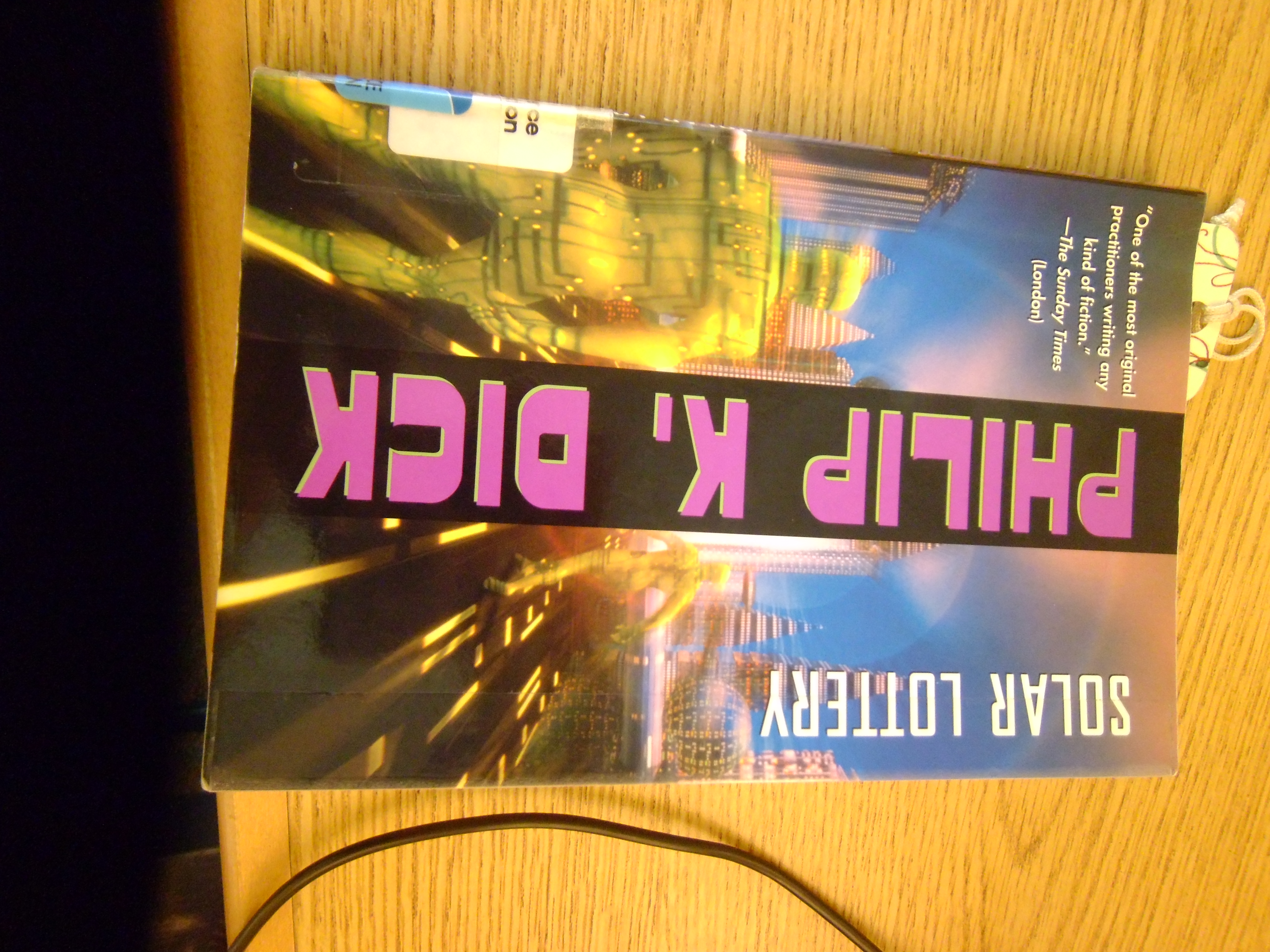 Solar Lottery.
It wasn’t my favorite, but I suppose they can’t all be. It was PKD’s first published novel, and it feels like it. Not because it isn’t good, but because it’s so very typical genre. There was a lack of bravery in it. It’s plot pointed. It’s correct.
I fell in love with PKD’s writing because it wasn’t confined to a formula, because he didn’t seem to care whether or not the plot points occurred when they were supposed to. It is why Clans of the Alphane Moon is my favorite of his work so far.
The same week I read Solar Lottery, I also got a DVD I requested from the library:
 The Gospel According to Philip K. Dick.
It was an interlibrary loan from a college – what I call my “super fancy request” because it has a $3 a day late fee.
It looks like something they’d show in a high school class. I say high school because I always thought showing videos in college courses was a lazy prof’s way out. (You should require students to watch something, then discuss in class.) Also, because by the time I got to college cheesy 90’s videos were being replaced by updated videos.
As I watch the video, I keep thinking how much I’d rather be reading the content in a book than be viewing a documentary. I suffer from a plight the majority of my contemporaries will never understand… watching things on a screen is far more tedious to me than reading them.
Also, as I’m watching, Solar Lottery slips away from my mind as my most recent PKD experience (of slight disappointment) and all the reasons I adore PKD flood back.
There’s a cheesy cartoon of PKD moving his mouth to Phil’s actual audio responses, recorded when he was still living. This would be cool if I didn’t feel like I was watching Southpark. It’s hard to focus on the documentary without closing my eyes because a headache is starting to form behind my eyes, another reason why I don’t watch a lot of tv but can read for days straight.
I’m glad I’m listening, though. There are so many things about him that fascinate me. The break in to his safe, for instance. People relate this tale in direct correlation to his drug use and having an unhealthy level of skepticism for the world around him… then the police thought he orchestrated the explosion himself… to which his supposedly drug addled mind thinks, “Maybe I did…? What would my motivation have been?”
They attribute all of this to a novelist’s mind on drugs.
How is this not just a normal human response to an accusation? I have these spin off thoughts nearly every moment of every day. I’ve written entire novels in my head based on an accusation. My first published novella was born slightly out of a similar strain of thought.
I may not be drug addled. I may not be as prolific or clever. But I do think, had I ever met PKD in person, we may have been friends, at least I think I would have liked him a lot.
Circle of Quiet, Trails of Solace
 Title:A Circle of Quiet
Author: Madeleine L’Engle
Publisher: Harper Collins
Genre: Memoir/ Spirituality
Length: 229 pages

A Circle of Quiet is powerful. So powerful it inspired me to write nearly 10,000 useable words, to writers you may note the awe I have when I say useable.
Some were used for the sequel to my novella, a novel that is supposed to come out in the fall of this year – fingers crossed. But most of the words were for a new book, stories about my trails in the woods that are itching to be told but I’ve not known how to tell them because it’s all still happening, my trails are still real.
What is most impressive to me about A Circle of Quiet is not how many beautifully quotable quotes there are, but how completely relevant L’Engle’s story is to me. So relevant, I didn’t noticed until 3/4 of the way through the book that it was published in 1972 and the things she writes about occurred in the early seventies if not the late sixties.
I was baffled to discover this. A Wrinkle in Time and the rest of her children’s books are as fresh to me as the Harry Potter series. I read them as I child without the impression that they were old. In my mind, L’Engle has been an author of the 80’s who would be around as long as C.S. Lewis once the years had passed. I did not realize that the books were much older than that and that the years had already passed. A Wrinkle in Time was first published in 1962.
How is this possible that every moment, every ache, every joy (aside from winning the Newberry of course, as I’ve won nothing) is one I feel in every fiber of my being as a thirty year old in 2014? When she was born in 1918. What struck me most is that A Circle of Quiet is timeless.
Madeleine L’Engle is timeless.
This is a must read for any mother, any writer or creative, any soul searching for God, any person trying to balance their introversion with their extroversion, and ultimately any person.
She published these from her journals, which she admits were written for publication, but still I am honored to have been allowed a peek into the window of her thoughts.
Plagiarism
Plagiarism sort of fascinates me. Mostly because I am a reader, I think. And as a reader I absorb.
I absorb thoughts, ideas, fairy tales, story lines, dialogue… and sometimes when I’m writing I find that I can’t remember if what I’m writing came from a dream I had, a book I read, or a an actual idea that I am actually formulating as my ink pours from my pen.
I am re-reading The Mortal Instruments series, and with a re-read comes more review reading, more research, because I no longer fear a spoiler. So long after the scandal, I discovered this morning that Cassandra Clare was accused of plagiarism on a fan fiction site for a Harry Potter spin-off series about Draco. Not only accused, but her account was cancelled because of it.
I’m not defending plagiarism, it’s not ok. The idea that someone would purposely just copy someone else’s work turns my stomach.
But what if it is purely accidental?
What if you have internalized a work so completely in your youth that as an adult an idea, dialogue, plot points, come to you so wholly formed and you recall that it was inspired by something, but not necessarily who or where the inspiration came from?
I can see that happening to me. I read so much as a child and I cannot remember it all, but I do have to say that I don’t think a single idea I’ve ever had could actually be attributed to myself. They aren’t my ideas. They are the ideas of those who came before me. They are the ideas that came from authors I loved, and characters who became my friends.
I distinctly remember writing a story once, I was maybe seventeen at the time, and I was so in love with it. I thought, man, I’m good – this story is fantastic. I re-read it, I worked on it avidly. Then I realized, about a month later, that it wasn’t mine. I was re-writing The Hero and the Crown by Robin McKinley. Perhaps slightly in my own words, but the essence of it was entirely hers and I was forced to throw it away.
It was the first time I became doubtful that I would ever publish anything. Until then, I had been completely convinced that no matter what happened in my life, I would at least become an author in some capacity. It was in my veins since the first time I picked up a book and could decode the letters that made words and sentences. I had been writing stories and ‘books’ since I could manage to scrawl out a readable letter with my number two pencil. But right then, as a teenager, I realized my biggest fear – that perhaps I didn’t have any words of my own. Perhaps they all came from elsewhere.
That is when I realized what the biggest challenge would be for me to become an author – writing something original. How do you sort through all that you’ve read, all that you love, and find something that doesn’t already belong to someone in some way?
Because of this, my novella doesn’t have much in the way of plot points. The characters came to me, yes. I can write their essence, yes. But ultimately, I am terrified of plot points. I feel like they’ve all been written before. But people, people are always capable of being their own. Characters are easier to write than plots, because I’m surrounded by characters – they live in my head. Plots, on the other hand, only live in books that have already been written. Real life doesn’t seem to consist of plots so I can’t rely on life to deliver inspiration that hasn’t already been had by someone.
Logical fallacies, of course. But that’s how I feel.
And I can’t help but wonder if Cassandra Clare felt the same way from time to time.
Freelance Writing
 I wish this blog was a post about me receiving one of those… see Daphne, above, a royal portable from 1930. Green, no less.
It’s not.
But it is pretty exciting.
I’m pursuing supplementing my income with freelance writing jobs. So far, I have been hired on by Money-Fax.com and I’m enjoying it quite a bit. Money-Fax has me writing about Kid & Family Budgeting, which is pretty perfect because I’m a homeschool mom chronically on an author budget. (That’s code for mommy who lives off nothing.)
Here are links to my published articles, so far:
The Economics of Cloth Diapers
How to Entertain Your Child for Free This Summer
How Much Does it Really Cost to Homeschool
The more traffic my articles get, the more people will want to have me write them – naturally. So, please, if you have someone in your life any of these articles would interest, share them.
There are more to come. Keep checking Money-Fax.com for budget friendly pets and ways to celebrate Easter. Browse through their site for other helpful articles as well. They are an education service geared toward helping the public learn to improve the state of their finances.



 Anakalian Whims