Homeschooling / Life With a Toddler
Tea Time
We have tea parties with our geography lessons. She knows her southern states and can identify North America on a world map. No matter what, she can always find Texas, even when all its borders aren’t clearly drawn on… she looks for the Gulf of Mexico.

Card Games
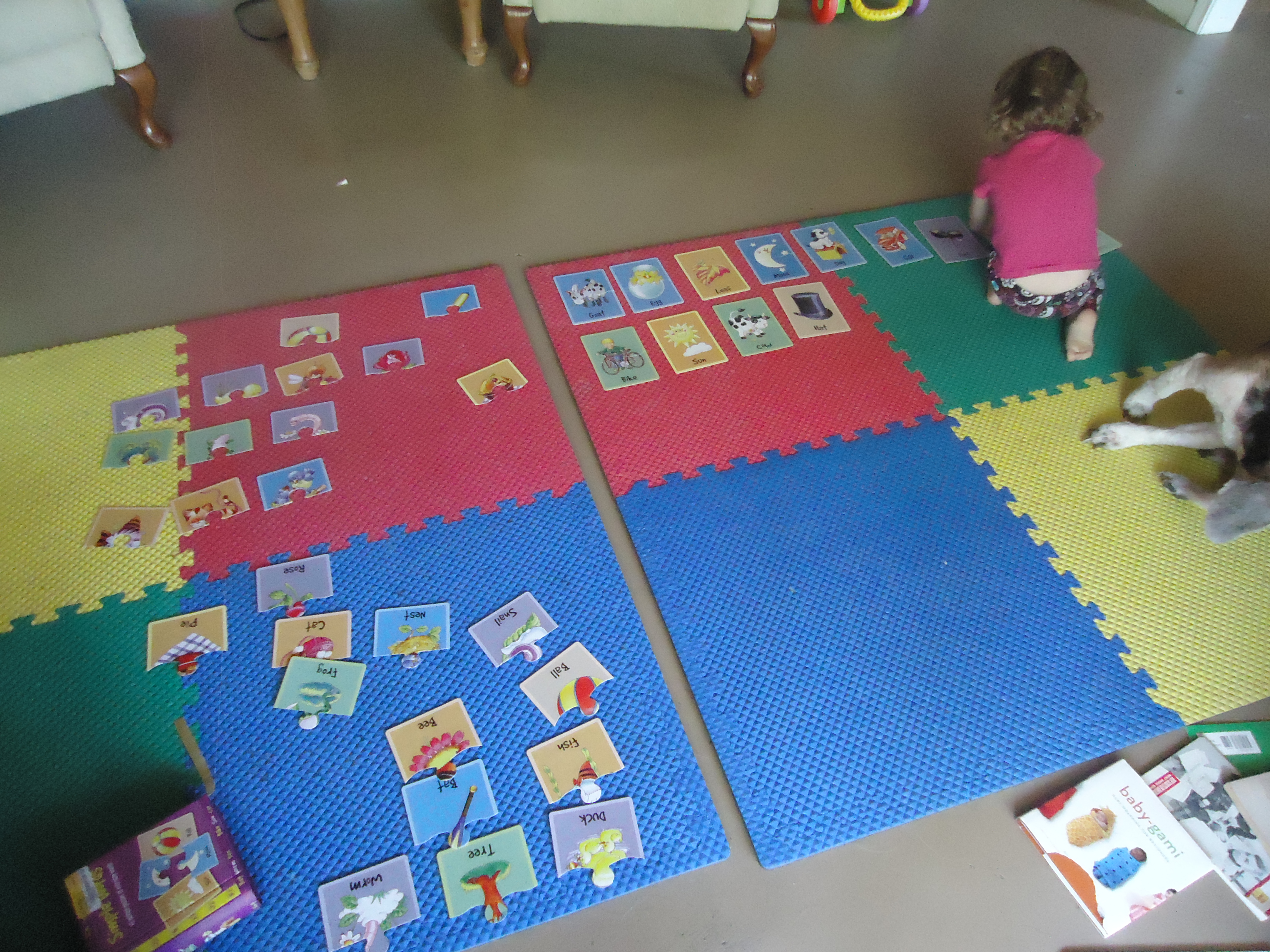
She loves to play cards… these are first word matching puzzle cards. The nice, straight rows are all her doing. She’s quite the neat-nick.
Arts & Crafts
Painting is the best. Featured here is an acrylic on canvas piece.

Story Time
Story time at Half Price Books cannot be missed. It is an essential part of our weekly lives.

A Two Year Old Reads The Lorax
I sat down at the breakfast table with my daughter who will be two and a half in a month. It’s St. Patty’s Day, so I thought I would read something appropriately Irish to her over breakfast. I didn’t have much follow through, though, because my daughter looked at me with those big blue eyes, batted them, and said, “Read The Lorlax, Mommy, the Lorlax.” This pronunciation is a great improvement from when she was calling him the “Workass.”
So I went and got Dr. Seuss’s The Lorax and began to read. There was an interruption regarding her cereal, another about the dog, a few more about the characters in the book. Two pages in I shoved the book at her and said, “You read it.”
And this is how my two year old read The Lorax, along with great gestures and emphatic pointing:
“Town!
Grickle-grass!
Essepting Oooooooold crows.
TED!
Find the Lorlax! The Lorlax!
Baby Lorlax!
Butterfly milk!
Truffula Trees…
and seeds!
And Seed.
Last Seed.
The End.
Ok, Green Eggs and Ham, Mommy.”
HPB Humble Book Club Meeting March 2013
Lords of Finance Discussion Part Three (to read parts one and two, start here)
 Title: Lords of Finance
Author: Liaquat Ahamed
Publisher: Penguin
Genre: Economics/ History
Length: 508 pages
When all was said and done, Lords of Finance was a pleasant (and very meaty) read. It was definitely nice wrapping up the completion of the book with a discussion at Half Price Books among customers turned friends. The discussion definitely went down well with some home made German Chocolate Pie brought by a member.
 We sat together with internet research and a handy dandy chart of all the key players in Ahamed’s book and brought up our favorite quotes as well as bits and pieces that piqued our interest.
I was especially intrigued by the dialogue between Senator Mayfield and Senator Brookhart on pages 316-317 regarding Texas wanting to pass a bill prohibiting gambling via the stock market. Apparently, there were a lot of hearings that went on “in an attempt to refine the distinction between investing and gambling.” Upon reading this I immediately wanted to hash out the distinction and research the laws with others. What a fascinating paper this would make for a young economics student to be assigned in order to both understand the inner workings of the stock market and to establish their own world view in terms of monetary ethics and morals. Honestly, have you ever wondered… What is the line between gambling and investing? Off hand, I’m not sure I have a steadfast answer to give. Do you?
At the meeting we talked about businesses that are publicly traded verses those that are not. We touched on Roosevelt and Hoover and what they had to deal with as presidents in comparison to what Obama is dealing with today, and over all what a relevant piece of history this book is. One of my favorite quotes came very late in the book on pages 438-439:
When, in August 1932, a reporter for the Saturday Evening Post asked John Maynard Keynes if there had ever been anything like this before, he replied, “Yes. It was called the Dark Ages, and it lasted four hundred years.”
That line from Keynes about the Great Depression had me smitten with him. When I got to the store, I immediately headed toward the economics section and picked out a book he wrote called The General Theory of Employment, Interest, and Money
It took us awhile to decide who would actually be purchasing the only title by Keynes in the store. Everyone, I think, likes to read titles mentioned in books they read and Ahamed mentioned Keynes work quite a bit. We are in agreement that the books (both Keynes’ and Ahamed’s) should be used as require reading for economics classes, both high school and college. As someone who actively participates in continuing education on a self-study basis, I am interested to see how the end of this book leads into World War II. So many financial agreements were made and unmade, I want to know in detail how things were handled during the war on a financial level. None of us in the group were financial historian buffs and were unable to answer our own questions, but discovering the answers in the future should be exciting.
As for our reading future as a group, we tossed around ideas for the next set of books. This isn’t quite set in stone just yet, but it’s looking like the HPB Humble Book Club reading schedule will look like this:
April: On Chesil Beach – Ian McEwan (we will probably also discuss Atonement)
May: The Heart is a Lonely Hunter – Carson McCullers
June: The Princess Bride – William Goldman (the online Half Price Books book club will also be discussing this book in June)
July: John Adams – David McCullough
August: The Color Purple – Alice Walker
Any changes to this tentative reading schedule will be made at the April meeting.
Economic Education

Lords of Finance Discussion Part One (I am writing this only 150 pages into a 508 page book. I anticipate a series of reviews, much like how I handled Les Miserables in 2012, except over a short amount of time. I will have the book completed no later than March 4th, 2013)
Title: Lords of Finance: The Bankers Who Broke the World
Author: Liaquat Ahamed
Publisher: Penguin
Genre: Economics/ History
Length: 508 pages
Inevitably I read something and find about ten more things I need to read. My constant lament on this blog is why we didn’t read more source documents in school. So is it any wonder at all that while reading Lords of Finance for the HPB Humble Book Club I discover that I absolutely must have a copy of The Economic Consequences of the Peace
In addition to that title, I find myself longing to dive into more history books on the time period as well as full length biographies on a few of the people mentioned. You wouldn’t expect that kind of revelation out of reading a finance book, but Ahamed has a way of turning a phrase that makes interest and exchange rates, and the people directly responsible for their flux, fascinating.
I think this would be a great title to hand to a high school student during an economics course, it would definitely make the class more interesting. I enjoyed my economics classes in college, taught by a clever little man with a wonderful accent (Scotland? Liverpool? Not sure) and had a great sense of humor despite teaching all his courses at eight o’clock in the morning. But what I remember of high school economics was pretty cold and void of any kind of spunk. It was filled with boring formulas, worksheets, and a fairly heavy textbook that we read very little of. Obviously, the formulas are handy and important, but couldn’t there have been a little more meat? A little more perspective? A little more history?
Maybe living in a recession has weighed heavily in how I view the dollar, but I would like my child to grow to understand how much the economy effects politics, social customs, humanity, and art.
Idolizing money is a concern and a problem, but seeing how money fits into our lives and the bigger picture is important. So often we are taught that money is separate and that we should keep it that way, but the truth is money is never separate. Our history is riddled with money driven politics, so why is our history class and our economics class separate? Our religions are filled with instructions on what to do with our money, our philosophies rooted in our thoughts on whether to live richly or poorly and how rich and poor are defined. I think the history of banks, the dollar, and what your views are on the matter should all be addressed while you are learning how to calculate it, not as a completely separate train of thought.
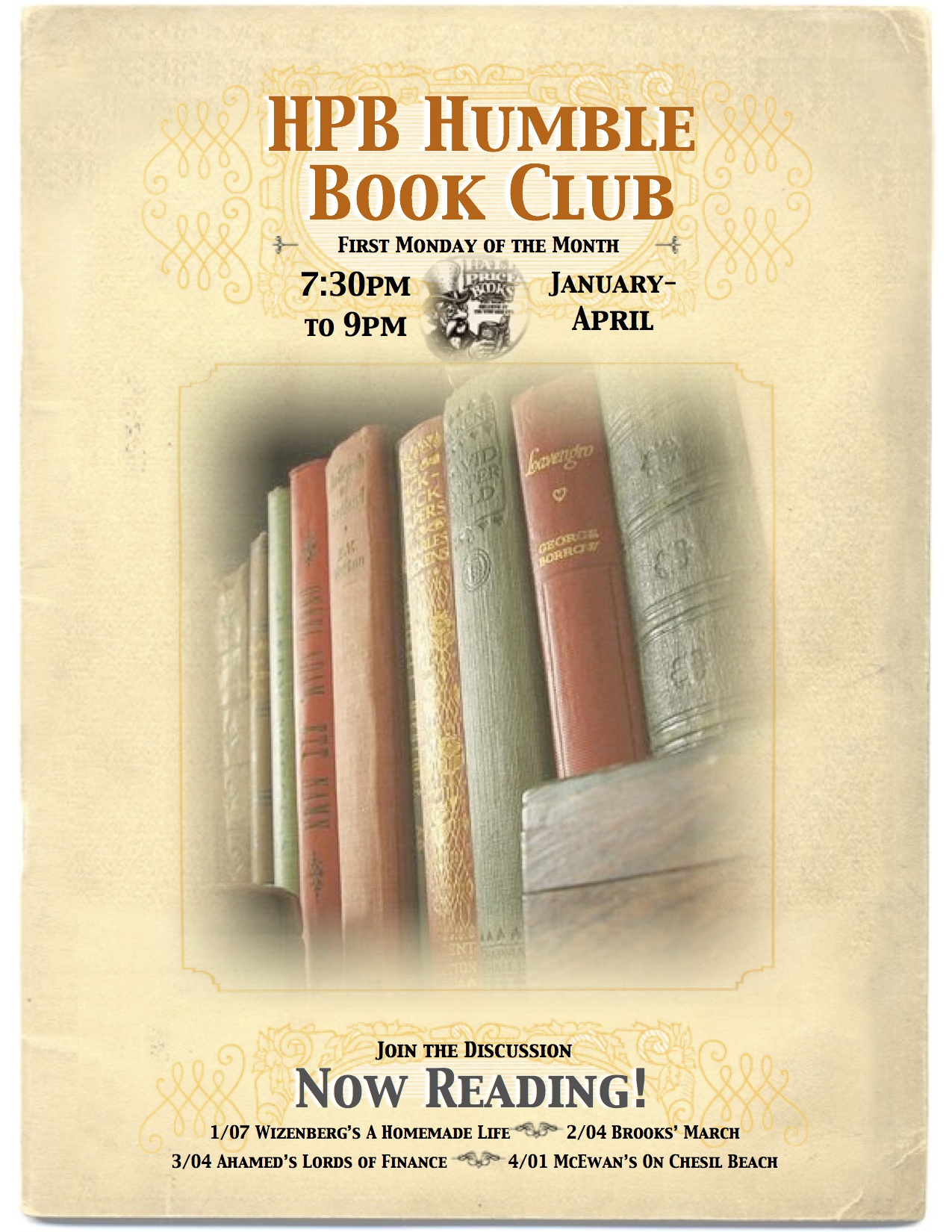 Ahamed’s Lords of Finance was recommended to me by a customer at Half Price Books, it was actually chosen for the Humble location’s book club by that same customer, and I am so glad I took his advice. We will be discussing the book as a group March 4th, 2013, starting at 7:30 pm. Additional members are welcome, so if you are interested in the book and are in the area, please join us. Treats are provided.
So far, the book is enlightening and informative, it covers a lot of the banking information provided in the documentary Zeitgeist without the haze of conspiracy theories and blasphemy. I imagine we will have a lot to discuss when we meet. Until then, I plan to share my own thoughts here.
Other titles in my personal Economic Library:
Adam Smith’s The Wealth of Nations
Thorstein Veblen’s Conspicuous Consumption
Craig Karmin’s The Biography of the Dollar
Thomas Stanley’s The Millionaire Next Door
Please share any titles you think should be added from a historical, philosophical, or sheer financial perspective.
My Classical Re-Education Part 2
Kiddo and I started the year reading The Confessions over breakfast… we got caught up in The Magic Tree House Adventures and that got put on the back burner, but I intend on putting a good dent in this list this year, so we need to get back on it. Feel free to join me.

The Story of Me: Autobiography and Memoir
PART TWO of The Well-Educated Mind
Augustine – The Confessions
Margery Kempe – The Book of Margery Kempe
Michael de Montaigne – Essays
Teresa of Avila – The Life of Saint Teresa of Avila by Herself
Rene Descartes – Meditations
John Bunyan – Grace Abounding to the Chief of Sinners
Mary Rowlandson – The Narrative of the Captivity and Restoration
Jean-Jacques Rousseau – Confessions
Benjamin Franklin – The Autobiography of Benjamin Franklin
Henry David Thoreau – Walden
Harriet Jacobs – Incidents in the Life of a Slave Girl, Written by Herself
Frederick Douglas – Life and Times of Frederick Douglas
Booker T. Washington – Up from Slavery
Friederick Nietzche – Ecce Homo
Adolf Hitler – Mein Kampf
Mohandas Gandhi – An Autobiography: The Story of My Experiments with Truth
Gertrude Stein – The Autobiography of Alice B. Toklas
Thomas Merton – The Seven Storey Mountain
C.S. Lewis – Surprised by Joy: The Shape of My Early Life
Malcolm X – The Autobiography of Malcolm X
May Sarton – Journal of a Solitude
Aleksandr I. Solzhenistyn – The Gulag Archipelago
Richard Rodriguez – Hunger of Memory: The Education of Richard Rodriguez
Jill Ker Conway – The Road from Coorain
Elie Wiesel – All Rivers Run to the Sea: Memoirs
More Homeschooling with a Toddler – Pirates!
It took longer than expected, but we read through Magic Tree House book #4 Pirates Past Noon
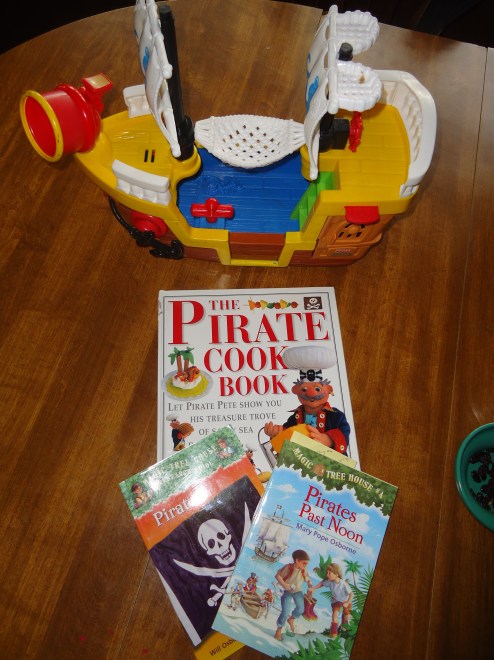
While reading the companion book, kiddo sorted sea shells and counted her treasure…


After that we learned about Vikings and ancient maps… even learned how to spell “Map.”


And that’s what homeschooling a two year old looks like.
Homeschooling a 2 Year Old
Looks like this…

I read Magic Tree House #3 Mummies in the Morning and its companion research guide Mummies and Pyramids while she looked at lots of pictures. The books with pictures were The Kingfisher Atlas of the Ancient World, a Reader’s Digest What Life Was Like, a coffee table book called The Pyramids and Sphinx, and a hardback I plan to use as a textbook when we do this again called Life in the Ancient World

Then we learned that P is for Pyramid. After several pictures, lots of blue lines, a few attempts to write some letters, she can at least say the word and identify the drawing – mostly – sometimes she says triangle or boat instead. I think she sees triangles and thinks of the sails on a crude drawing of a sailboat.
Anyway, that quickly turned into this:
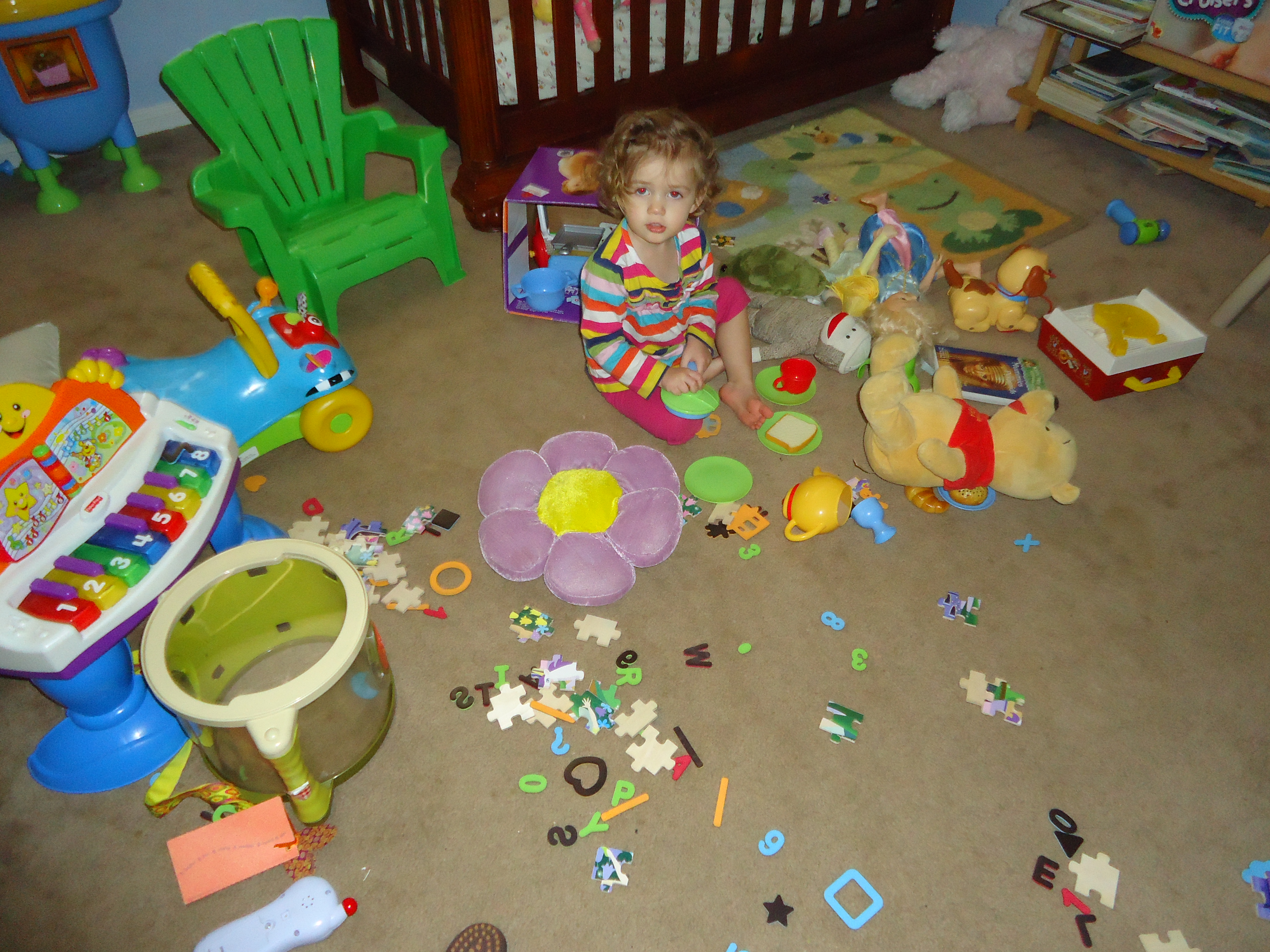
And that’s what homeschooling a two year old looks like.
Magic Tree House Adventures – Knights!
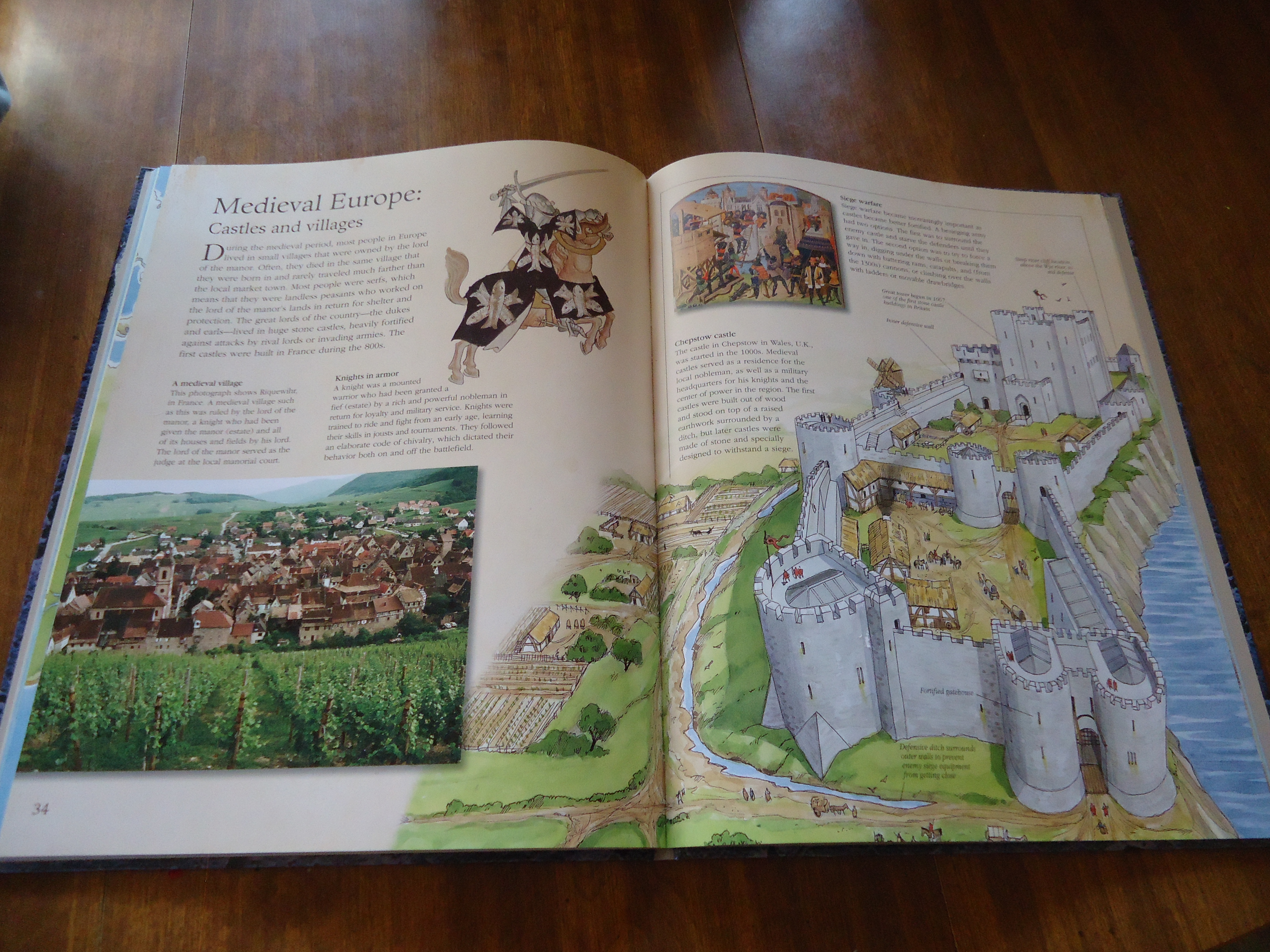
The Kingfisher Atlas of the Medieval World
(… Castles! And Medieval Times!)
 Today we read up on everything Knights and Castles
“A Feudal System has four parts! From top to bottom it goes: King, Barons, Knights and Serfs!” Sadly, I’ve already forgotten the tune to which we were singing/chanting this bit of information, maybe one day it will come to me again, or maybe we’ll find a new tune. Either way, munchkin was climbing in and out of the laundry basket this morning singing, “King! Baron! Knight! Serf!” so I win.
 It was at this point that I decided: in addition to reading through this pairing and prepping kiddo’s future education (when she’s old enough to tackle these projects properly with crafts, writing assignments, and vocabulary tests), I’m going to blog our prepping routines… separate from the Weekly Low Down on Kids Books installments. I know I will find it handy for when we repeat this reading exercise in a few years, but maybe someone else can find it handy now.
I can’t wait to take the kiddo to Medieval Times. I’ve always enjoyed the place and once she is old enough to go, I think it would be a great way to end an educational adventure. As she’s only two and today’s reading was somewhat (though not completely) impromptu, I took her to the closet thing to a castle we have readily available.

The Spring Community Playground, part of Liberty Park looks like a giant, wooden castle to me. It has several keeps, a palisade, horses to ride, and all sorts of castle/fortress styled fixtures. According to the park’s website:
This playground was built by the Spring community for the betterment of the Spring community ultimately for the enjoyment by our children with community donations and community volunteer labor. It was built in 5 DAYS from January 29th to February 2nd 2003 with over 900 community volunteers. A large majority of the volunteers were parents, grandparents and friends of students from Hirsch, Smith and Jenkins Elementary Schools. We also had volunteers from Austin, San Antonio, Dallas, Houston, Kingwood, Conroe, Laredo, and Mexico.
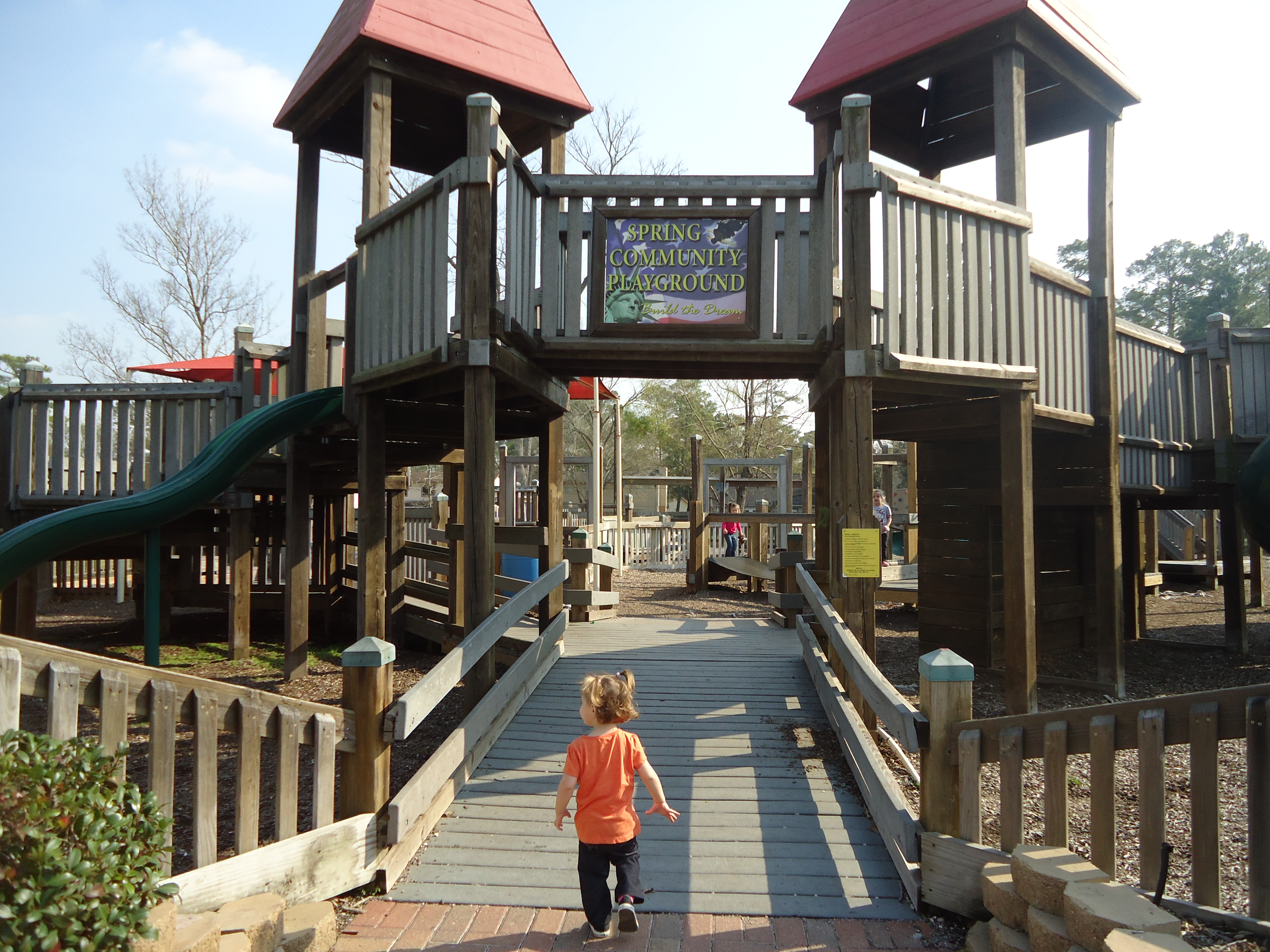
Obviously, there’s a huge difference between this and an actual castle! But it’s fun to walk the park and read the engraved pieces of wood that tell who donated what. I want the kiddo to grow up with a strong sense of community… our neighborhood is our manor, and all that.
When she’s older, we’ll be able to spread the study over the course of a week and add more books and activities. For instance, on day two we could read The Time Warp Trio
This unit would also be a great opportunity to spend the week going through one Sir Cumference book a day for the start of math lessons.
For lunch, I’ll take the opportunity to serve “feast foods.” I found an entire web page dedicated to recipes of the day, and I love to eat to match our educational themes. Plus, I want my daughter to know her way around the kitchen before she goes off to college, unlike me. So as she gets older, we’ll be making all our meals in the kitchen together – themed or not.
I would definitely try to work in her first horseback lesson during this week if she hadn’t started them already, after all knights, caballeros, Ritters, and chevaliers, are all just soldiers on horseback, as the MTH Research Guide will tell you.
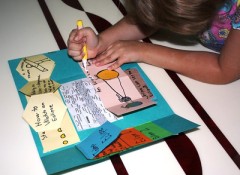
Click image to visit a lapbooking tutorial website.
For the most part, though, we will spend our days reading, making lap books, journaling what we’ve learned, playing dress up, and gearing all our artistic energy at the topic. Homeschool Mom and Blogger of My 2 Small Boys has images of her kids’ notebooks on Knights and Castles here: http://my2smallboys.blogspot.com/2012/01/middle-ages-knights-and-castles.html.
When the weekend roles around, if the study lands in the summer, perhaps we will go to the beach and build sandcastles; If in the fall, maybe we’ll head out to the Texas Ren Fest.
Knights and Castles Library List
Saint George and the Dragon (a great precursor to have on hand for Spenser’s The Faerie Queen, we’ve already read it quite a few times)
Castle Diary by Richard Platt
The Knight at Dawn by Mary Pope Osborne
Knight by Christopher Gravett
Knight ~ A Noble Guide for Young Squires
100 Things You Should Know About Knights and Castles by Jane Walker
If You Lived in the Days of Knights by Ann McGovern
Castle: Medieval Days and Knights by Kyle Olmon
Knights in Shining Armo by Gail Gibbons
Knights and Castles by Seymour Simon
The Usborne Book of Castles by Lesley Sims and Jane Chisolm
What If You Met a Knight? By Jan Adkins
Imagine You’re a Knight by Meg Clibbon
Take Care, Good Knight by Shelley Moore Thomas
The Knight and the Dragon by Tomie DePaola
In the Castle by Anna Milbourne
The Castle That Jack Built by Lesley Sims
The Tournament by Heather Amery
Some more ideas: http://www.angelfire.com/dc/childsplay/castleunit.htm
Weekly Low Down on Kids Books – Dinosaurs!
 I read Magic Tree House #1: Dinosaurs Before Dark
We had to stop a few times to draw a rhinoceros onto our ‘R’ page, check out whales and their sizes in relation to dinosaurs in our encyclopedia, and to correct behavior as she climbed in my living room window sill that is about three and half feet off the ground. We even had a brief whistling lesson after reading how the wind was whistling around the tree house. Overall, she enjoyed it, so we moved onto the Research Guide
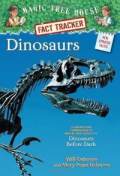 Mary Pope Osborne and her husband Will Osborne joined forces and started writing nonfiction companion books to the fictional Magic Tree House adventures. When I first discovered this, I started purchasing them in pairs, vowing to use them as fun assignments while home schooling. I’d like for kiddo to grow up in the habit of reading a nonfiction title that somehow relates to every fiction title that she devours, expanding both her facts and her imagination. What better way than to start with research guides to her first chapter books?
Why am I reading these to her so early? Frankly, it’s quite hilarious to watch a two year old run circles in your living room chanting, “Fossils! Minerals! Dinosaurs!” at the top of her lungs, while her dog (who happens to be the biggest one we own) lays in the center rolling his eyes.
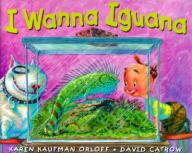 Chapter three of the research guide Dinosaurs talks about iguanas and how Gideon Mantell though the dinosaur teeth he and his wife found were giant iguana teeth. Of course, we had to stop to re-read I Wanna Iguana
All in all, we had a good ‘school day’ this morning, something we have been working on being more diligent about now that kiddo is two and it has actually managed to get too cold to venture out as much.




 Anakalian Whims
The Price of Excellence
February 20, 2013 at 4:20 am (Education, Reviews) (Appleton, Bel Kaufman, books, college, education, May Sarton, novel, professors, reviews, social commentary, students, teachers, The Small Room, universities, Up the Down Staircase)
I have a love/hate relationship with education. Or should I say formal education.
I love to read, I thoroughly enjoy research. But most my teachers over the years would tell you I was a horrible student, if they even remember me. My work was typically mediocre, often done at the last minute. The ones that do remember me probably remember a fairly obstinate and argumentative irritant, not really someone you want filling out your back row.
Yet, I find myself longing for the chance to go back and get a frivolous Master’s degree. I watch movies only to be wooed by the montages of students in glorious libraries. I fall in league with nerds like Rory Gilmore and Felicity Porter and lean toward books like May Sarton’s The Small Room .
.
Rather than an emotional feminist vs. anti-feminist story one would expect from the setting, The Small Room is about exploring the many nuances of excellence in education… and the price of obtaining it for both teachers and students.
Frankly, education is such a moving and sensitive topic. Who isn’t brought to tears by Dead Poet’s Society? Who doesn’t stand and applaud Mr. Holland’s Opus or The Emperor’s Club ? Who doesn’t watch Finding Forrester on repeat?
Then on the counter balance… Who doesn’t laugh their butt off reading Kaufman’s Up the Down Staircase and acknowledge how utterly familiar it sounds?
While reading, I imagined Appleton to be a smaller version of Wellesley.
May Sarton’s The Small Room is delightful and truthful. Without full on hating on education altogether, it takes into careful consideration the heavy weight being a teacher or a student can be on a human being and their relationships.
I have a 1976 Norton Library edition (featured above) and I fell in love with the book immediately. Long before I picked it up to read it, Sarton’s novel was part of my personal collection. I remember being so struck by the green leafy cover, the musty smell, and the promise of imaginary academia while holding the book in the used bookstore. The novel has lived up to the promise of its cover (and its smell!) and I think any alumni or teacher would appreciate the ethical discussions within its pages as Sarton and her characters attempt to define the price of excellence.
Permalink 1 Comment