How to Achieve True Boredom
 Title: How to Achieve True Greatness
Author: Baldesar Castiglione
Publisher: Penguin (Great Ideas)
The Penguin Great Ideas Books are usually my go to source of reading something in one sitting. If not that, I toss them in my bag or back pocket for a walk in the woods or for waiting room entertainment.
How to Achieve True Greatness did not live up to my expectations.
This was 93 pages of pure boredom.
I picked it up – read some pages – put it down. I took it to the bathtub with me only to find myself wanting to get out of the tub faster to pick a different book.
There were some bits about twenty pages in that interested me long enough for the book to start redeeming itself, but then I later lost interest again.
Not your best, world history masters, not your best.
Story Times are Magical

Every Wednesday during the summer I make an appearance at Half Price Books Humble, 10:30 am sharp. I make an announcement over the intercom – NOT my forte – place snacks on the children’s table, and pick out stories to read out loud to whoever arrives.
Sometimes I have crowds! Sometimes it’s just me and Kiddo hanging out reading as we would at home. Sometimes I have authors come and read their books to the kids. But ALWAYS it is a little bit magical.
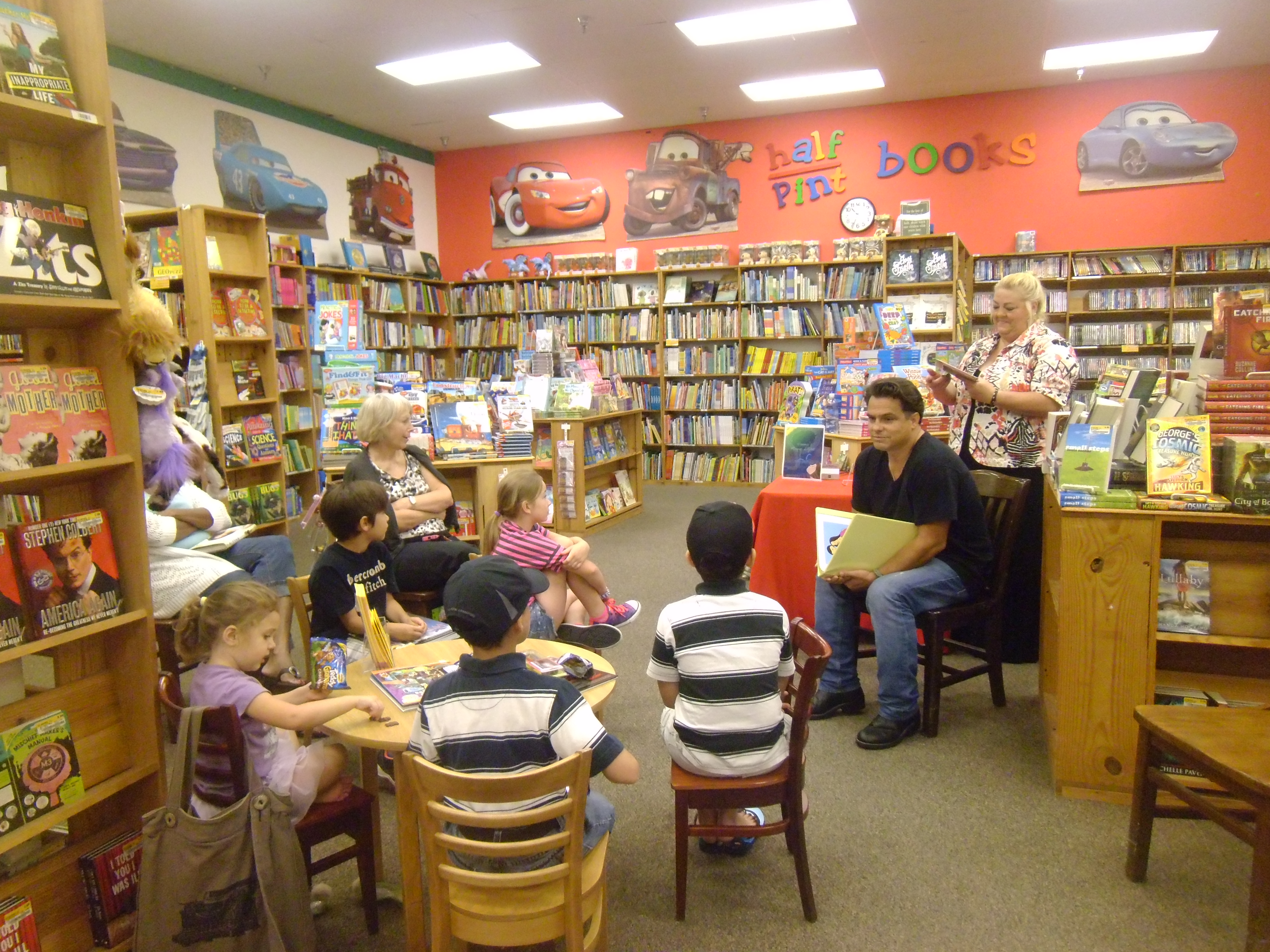 How appropriate then that Edward Castro joined us for a second time with his book Hanna’s Magic Light
Not available yet in a physical copy, Castro read to the kids from a bound manuscript while his agent showed the pictures on her tablet. The kids were riveted by the story about Hanna and her Daddy and the magical dome light in the car, turned lesson on finding your own inner light.
At the end, each kid received a cupcake and/or cookie as well as a “magic light” of their own to take home – Glow Sticks made into a necklace.
Tomorrow is Wednesday again. We won’t have Castro back this soon, but we will be featuring Song for Papa Crow, compliments of Schiffer Publishing.
Castro will return later in July. For those who cannot make middle of the week events, this will allow you to meet the author and purchase a hard copy of his picture book, as he hopes to have some in print by then:

Song for Papa Crow
 Title: Song for Papa Crow
Author: Marit Menzin
Publisher: Schiffer Publishing
Genre: Children’s Picture Book
I was delighted to have Schiffer Publishing contact me to review a selection of their picture books. There can never be too many children’s books here in the Klemm household, as kiddo devours them for breakfast, elevenses, lunch, dinner, and bedtime. We’re readers. We read. We’re also artists and we love admiring quality picture books.
As a homeschool mom of an aspiring birder, I couldn’t find Song for Papa Crow any more perfect.
This is a lovely story about how Little Crow loves to sing. He sings his heart out and in the course of teaching children what birds of North America make what sounds, we also follow Little Crow on a a journey of self-discovery and why it’s a beautiful thing to be yourself.
Menzin’s collage art is gorgeous. Kiddo and I adore all the rich colors. We spend a good deal of time outdoors and it’s wonderful to see nature portrayed with so much texture even while confined to the pages of a book.
Of course, after every book, I ask kiddo what she thinks. My three year old smiled broadly and responded, “I think it’s ridiculous.” Ridiculous, naturally, being pronounced ridicooooolous and said for the sheer enjoyment of using the word. Proven by the fact that she has asked for me to read “the Papa Crow one” at least twice a day since our first reading.
Now, a week later, I ask kiddo:
“Would you like to say anything about Papa Crow to our readers?”
“Yes,” she says decisively.
“What would you like to say?”
“Nothing at all, I just want it to be SEEN.”
Powerful words from a three year old, I think. She’s right, we could talk about how awesome Papa Crow is all day, but when all is said and done, Menzin’s collages simply must be seen.
Songs for Papa Crow will accompany us to Story Time at Half Price Books Humble for the next two weeks (July 2nd & 9th). We meet every Wednesday, all summer, at 10:30 am. Though we typically read multiple titles, we tend to choose a favorite to feature each week. We will also have a few Schiffer Kids Spring 2014 Catalogs for patrons of Story Time to peruse. Snacks are provided.
I look forward to reading more from Schiffer Books as well as Marit Menzin. The Klemms are officially fans for life.
A Remarkable Portrait
 Title: Barabbas
Author: Par Lagerkvist
Genre: Fiction/ Literature
I’m pretty terrible about not investigating books before reading them, even more terrible about not investigating them before buying them (or bringing them home). Something moves me and immediately on impulse I add it to my collection. You never know when it might come in handy. It looks like it could be interesting on a rainy day in summer when I have no internet my daughter suddenly finds herself in a nap and my brain is somewhere between writing historical fiction and flying away in a space ship. Oh, and look, that possible moment in theoretical time happened this week.
So I picked up Barabbas, a short novel that had some vague ties to an author who had won the Nobel Prize for literature. A thin slip of a thing that might find itself in the donate pile if it didn’t prove itself worthy in an hour and a half.
It proved itself. Of course it did. The concept is too fascinating to not earn itself at least 4 stars in my very critical book.
Matthew 27: 11-26
11 Now Jesus stood before the governor, and the governor asked him, “Are you the King of the Jews?” Jesus said, “You have said so.” 12 But when he was accused by the chief priests and elders, he gave no answer. 13 Then Pilate said to him, “Do you not hear how many things they testify against you?” 14 But he gave him no answer, not even to a single charge, so that the governor was greatly amazed.
15 Now at the feast the governor was accustomed to release for the crowd any one prisoner whom they wanted. 16 And they had then a notorious prisoner called Barabbas. 17 So when they had gathered, Pilate said to them, “Whom do you want me to release for you: Barabbas, or Jesus who is called Christ?” 18 For he knew that it was out of envy that they had delivered him up. 19 Besides, while he was sitting on the judgment seat, his wife sent word to him, “Have nothing to do with that righteous man, for I have suffered much because of him today in a dream.” 20 Now the chief priests and the elders persuaded the crowd to ask for Barabbas and destroy Jesus. 21 The governor again said to them, “Which of the two do you want me to release for you?” And they said, “Barabbas.” 22 Pilate said to them, “Then what shall I do with Jesus who is called Christ?” They all said, “Let him be crucified!” 23 And he said, “Why, what evil has he done?” But they shouted all the more, “Let him be crucified!”
24 So when Pilate saw that he was gaining nothing, but rather that a riot was beginning, he took water and washed his hands before the crowd, saying, “I am innocent of this man’s blood;[a] see to it yourselves.” 25 And all the people answered, “His blood be on us and on our children!” 26 Then he released for them Barabbas, and having scourged[b] Jesus, delivered him to be crucified.
 Unnecessary Summary: Barabbas was the criminal released instead of Jesus. Jesus was then crucified, the very moment that determined once and for all who would die that day.
Of course that’s a little factoid that almost every Christian knows. Many non-Christians probably know it too… Barabbas evil criminal let loose and poor Jesus killed.
I never thought about what that would mean. Not just in the grand scheme of things, but in the small ways that are epic to one and often meaningless to the masses. Barabbas – how did Barabbas feel? I never thought of it until Lagerkvist made me think about it. I picked up the book, understanding who the title referenced, but not imagining that it would be a historical piece on the person referenced – on his life, on his feelings, on his thoughts after Jesus took his place on the cross. Literally, not just in the spiritual salvation way, but physically died in his stead.
So many times we are encouraged to ruminate on Thomas (who doubted) and Peter (who denied). The thief who was admitted into paradise at the last minute, hanging on the cross next to Jesus, he’s a really big deal in the church. But Barabbas? Barabbas was just a bad dude who should have hung and died instead of our innocent savior… Really? What does that look like?
Lagerkvist tells us his version of what that looks like.
 (If you’re not quite as oblivious as me, you probably already know this by the numerous film productions that have been done based on Lagerkvist’s work. You probably also know about the Marie Corelli book which inspired its own film versions. You probably know all sorts of cool things about Barabbas that I don’t. But if you don’t know anything about it all – keep reading and I’ll tell you what I think.)
This is a fascinating tale documenting the evolution of a person’s heart, the confusion of their mind as they try to sort out philosophical things in the midst of chaos and history being made. I’m startled by such a remarkable portrait.
It came out of left field. It’s been sitting on my shelf for God knows how long. And it was stunning.
It would seem that I am stunned by everything lately. The truth is, as much as I read and review here, there are four times as many books that I pick up and discard without even making it through the first chapter. (Those are either returned to the library because I borrowed them in the first place, or are delivered to the library because I am bewildered they made it across my threshold at all.)
The moral of this story: Lagerkvist is a keeper. There’s a reason he’s an award winning author. There’s a reason his book appears on the 1001 Books to Read Before You Die list. He’s pretty incredible.
“This was wickedness, and it was fatal.”
 “It was everywhere. Arsenic. Inheritance powder, the old people called it.”
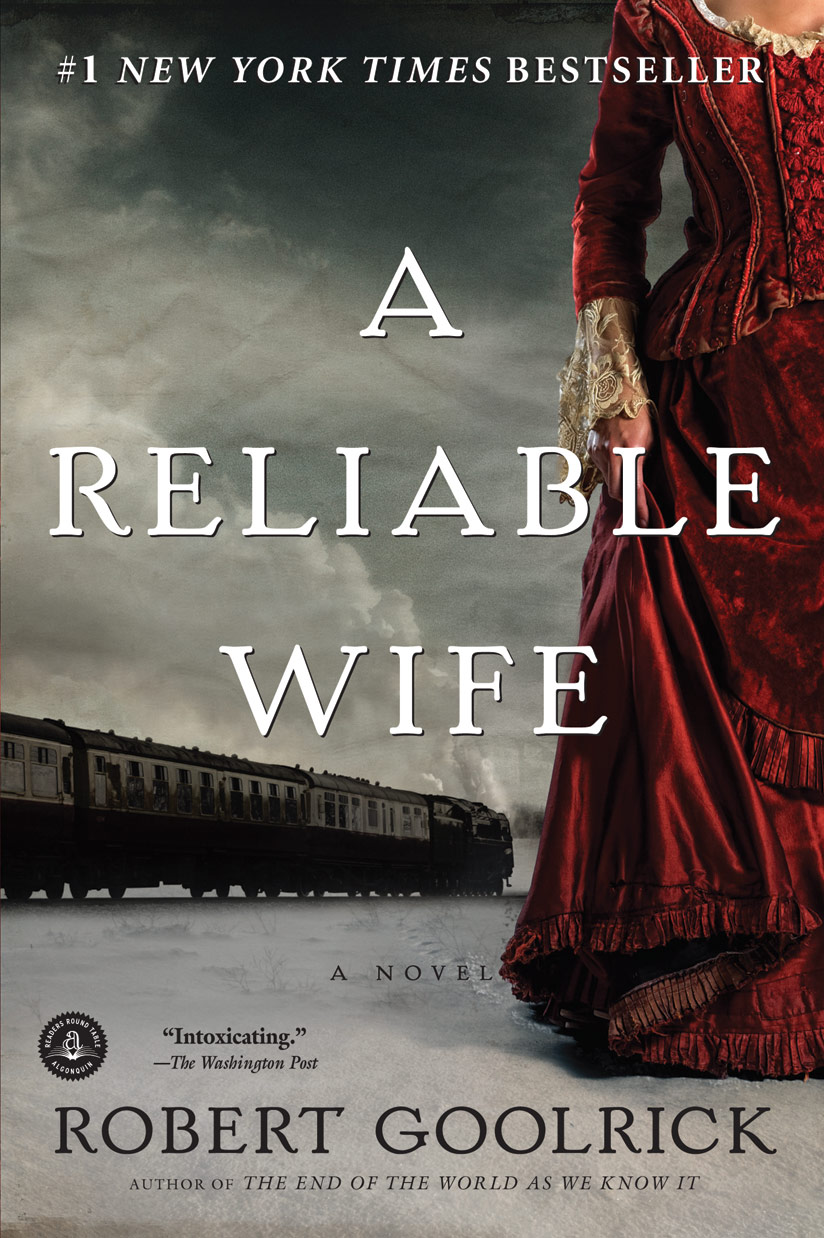
Title: A Reliable Wife
Author: Robert Goolrick
Publisher: Algonquin Paperbacks
Genre: Fiction
Length: 291 pages
Like so many others, A Reliable Wife was a freebie I acquired somehow. A number one New York Times Bestseller that seemed to be everywhere at once, yet I didn’t know anyone who had actually read it.
When I was cleaning out my personal library to take donations to the public one, my hand was on it. It almost ended up in the bag. Something stopped me, I’m not sure what. Most likely a hoarder’s impulse. The copy was too pristine. The train on the cover too gloriously mysterious. Historical fiction written by a man, not a woman, which for some reason tends to make all the difference.
Maybe it was because of my post about my selection practices and my thoughts as to what titles concerning prostitution would be at my daughter’s fingertips. The book is highly inappropriate, but it gives a thorough view of what turns people to bad decisions. What makes someone become a person with poisonous intentions and morals.
How easily anyone could slip into this awfulness.
“Yet it was a dream he had held in his heart for so long that nothing could replace it, nothing made up for his loss and his desire for restitution.”
Who hasn’t suffered from the same sort of persistence chasing an idea that maybe should have been abandoned?
“This was wickedness, and it was fatal,” is the theme that runs through Goolrick’s riveting novel. Maybe it’s the Baptist fire and brimstone in my veins that makes a story like this appeal to me, because I don’t mind wickedness when it is properly portrayed as something evil. It’s when wickedness is disguised as something desirable that I have a problem with it in novels.
Goolrick’s novel is amazing. I couldn’t put it down and I was so glad I chose to read it instead of placing it my library donation bag this week. My husband, not much of a reader, now wants to know the story and read the book as well – suckered by the blurb on the back jacket as I was nose deep in the pages. I’ve already encouraged a friend to purchase it as well. She quickly found a copy in clearance at Half Price Books, well worth a spare dollar.
Censorship vs. Guidance… oh and that other thing called Hoarding
 As I clean out my library, I find myself selecting what to discard mostly based on my daughter’s mind rather than my own. I read Sarah Dunant once, it was interesting, I don’t recall it blowing me away. Looking at the titles I have, I find myself wanting to keep hardbacks and the Sarah Dunant copies I have are clean, pretty, and one is a hardback. If I purchased them, which I doubt, it was most likely out of a clearance pile somewhere. At most I imagine I spent 50 cents or a dollar.
But that is not why I find myself stacking them in the donate to the library pile. Instead, it is because I find myself thinking – “Is this necessary? Does she need this? Even if it wasn’t necessary, is it important?” There are scenes in which I’d rather not my child’s brain be muddled with unless it belongs to something epic or beautiful. Sexual content, murderous content, without a larger than life literary lesson or great impact on the worldview seems so wasteful.
 I sit here with William Kennedy’s Ironweed. It is a Pulitzer prize winner. It is the copy I was handed in high school by a teacher who found I had read everything else on the required reading list and then some. It’s brilliant, I don’t contest that. But I remember being appalled and annoyed by it. I remember thinking, “Reading this is not going to make me a better person in any way – AND I’m not particularly enjoying it either.” The book hoarder in me kept it because it was something I read in high school for class. I kept it because it was a Pulitzer prize winner. I kept it under the assumption that maybe I missed something and it was important.
The mother in me finds myself putting it in the library donate pile. If she wants to read it later, she can check it out at the library – but I only want to keep things in my house that I can either recommend or things that I, myself, haven’ t read yet either. If I’m going to push crass, horrible people in horrible circumstances onto my daughter, I’ll give her Steinbeck – not Kennedy. If she needs to read about prostitution, I’d rather give her Moll Flanders and Les Miserables than Slammerskin. Not to be a chronological snob, I’m just as quick to recommend Girl, Interrupted as a cautionary tale against promiscuity or The Glass Castle and A Tree Grows in Brooklyn concerning the woes and hardships of being low on the socio-economic bean pole.
Most of what is going in the bags are things I find myself with multiple copies of for some inexplicable reason. James Herriot’s books seem to breed in my house, much like plastic bags from the grocery store do in your pantry. I swear I only brought home one, but there are three copies of All Things Wise and Wonderful. Even more perplexing is the fact that I have yet to read anything he wrote.
 There are piles of Anita Shreve books. I’ve also never read an Anita Shreve title. I find the covers used to market her work exceptionally dull. When I shelved fiction at the bookstore, I cringed whenever I opened a box to find them peering up at me. Yet, I have copies of these books in my own home. They never sell, they are in abundance at the library, I find myself walking home with freebies from various places often. Again, thinking, ‘what if I become terminally ill and somehow run out of reading material.’
Book hoarder recovery 101: If you aren’t going to read it healthy, don’t anticipate reading it when ill. Also, someone will probably be willing to go to the library for you should the need arise.
This is hard for me. Then, of course, I think – is Anita Shreve important or a past time? And if she’s a past time, that is fine, but do I need so many past times lurking in my space? There comes a point when you are surrounded by so many options, you can no longer choose. It is too overwhelming and you find yourself at a hole in the wall public library that has fewer options than your own house, just to narrow the selection field. Maybe one day I’ll read Anita Shreve. Maybe I’ll love her. Maybe she’s amazing. But for now, she’s going in the donate bag.
Yet, I have hardbacks of John Grisham I can’t bring myself to let go. My twelve year old self still riveted by such drama. I could argue that it is because many of them are first edition hardbacks, but then there are my paperback coffee house and tea house mysteries that stay on the ready for a good bubble bath or morning on the back porch. Can’t let those go – yet.
How do you sort your keepers from your donates?
The Beginner’s Goodbye
 Title: The Beginner’s Goodbye
Author: Anne Tyler
Publisher: Knopf
Genre: Fiction
Length: 198 pages
I have two Anne Tyler books on my bookshelf. I acquired them somehow, possibly gifts or hand-me-downs from someone else. I know I didn’t buy them, because I’ve never felt moved to read them. Perhaps they were freebies I toted home thinking, “I might need these if I start dying from cancer.” It’s morbid, but it is a frequent thought where free books are concerned. I worry that I will be trapped in the house or the hospital without reading material. That must be a phobia of some kind or another, I’m sure of it.
The two books I have are Back When We Were Grown Ups and Digging to America. They sit perched there right after Mark Twain and before John Updike. I almost put them in the garage sale we had this week, but couldn’t bring myself to do it. Something about them makes me want to hold on to them even as I try to decide what to keep and what not to keep during our ‘we might be moving, but aren’t sure’ months.
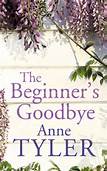
 This last week at the library, however, I caught a glimpse The Beginner’s Goodbye in the stacks. On the cover is a coffee cup and a dainty tea cup, immediately invoking the idea that two very different companions will be separated and someone will find themselves with a hole in their heart.
There are many covers out for this book, published in 2012, by a Pulitzer prize winner, everyone wants to add their own touch and be associated with it. But this one with the cups, that’s what did it for me – that is what captures the essence of the book in my mind. That’s what conveyed that essence to me from the shelf and prepared me for a mood that I wanted. The other covers are beautiful, but I probably would have gone on forever ignoring them.
Anne Tyler wrote something in The Beginner’s Goodbye that I wish I had written. I suppose I say that fairly frequently, but it is the highest compliment I know how to give. There is much in the reading world I enjoy with all my heart but wouldn’t necessarily long to have my name attached to it. This, is not one of those things, this is lovely and beautiful and gives you a taste of sweet humanity that even the greatest of storytellers seem to miss sometimes.
Appropriately titled and timed for my life, I’m learning to say goodbye to books that I anticipated keeping until my kid was old enough to read and discard them. I might be saying goodbye here soon to my extensive library. Granted, I could get rid of half my books and still have more books than anyone else I know, but sorting through them is hard for me. By checking out this book from the library, Anne Tyler has made it clear that I at least need to read her other two before I give them up – and that when I give them up they should be wrapped and lovingly gifted, not tossed in a garage sale.
Wrapping up Clare, Clary, and Clockworks
 Titles: City of Heavenly Fire
Author: Cassandra Clare
Genre: Fantasy/ Teen
*SPOILERS*
So I was finally able to wrap up two series, The Mortal Instruments and the prequel series Infernal Devices. It was kind of refreshing to finish something and know that I know as much of the story that is available to know at the moment.
City of Heavenly Fire was exactly what I expected. Great closing to it all, not a lot of surprises. The only thing that did surprise me were the number of new characters that were introduced, seemingly to kick start another set of books. But Clary and Jace are finally basking in their glorious together-ness, the readers got a wedding (Clary’s mother and Luke of course), and the teen couple finally sealed the deal which was expected, gratifying for the masses, but also disappointing for me – the girl who waited.
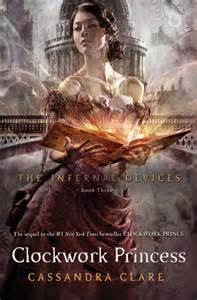 Clockwork Princess was not nearly as satisfying. It went as expected (the ending sort of spoiled by having already read City of Heavenly Fire), but also disappointed me in the sense that sometimes a girl should actually have to do a little more choosing. No one gets everything they ever wanted that thoroughly, and Tessa being allowed to love both boys so completely thrusts you outside of the book’s reality and back into your own by the sheer fact that no one should be allowed such a fairy tale. Even in happily ever afters, a girl has to pick a prince. You didn’t see Clary marrying Jace and running into the ever after with Simon or vice versa. It was sweet and wonderful, but too sweet and too wonderful, and therefore fell flat to me.
I’m glad I read them the way I did though, I am. Even if things were a little anti-climactic, I understand stories and the fact that the characters simply have to live their lives and sometimes those lives are anti-climactic. I’m just also a little relieved that both series have ended.
I still adore Cassandra Clare, I still look forward to reading more of her writing in the future. But for now, I think I may have burned myself out. Or maybe Clare burned herself out. I’m not sure and it’s probably not fair for me to decide right now.
Circle of Quiet, Trails of Solace
 Title:A Circle of Quiet
Author: Madeleine L’Engle
Publisher: Harper Collins
Genre: Memoir/ Spirituality
Length: 229 pages
A Circle of Quiet is powerful. So powerful it inspired me to write nearly 10,000 useable words, to writers you may note the awe I have when I say useable.
Some were used for the sequel to my novella, a novel that is supposed to come out in the fall of this year – fingers crossed. But most of the words were for a new book, stories about my trails in the woods that are itching to be told but I’ve not known how to tell them because it’s all still happening, my trails are still real.
What is most impressive to me about A Circle of Quiet is not how many beautifully quotable quotes there are, but how completely relevant L’Engle’s story is to me. So relevant, I didn’t noticed until 3/4 of the way through the book that it was published in 1972 and the things she writes about occurred in the early seventies if not the late sixties.
I was baffled to discover this. A Wrinkle in Time and the rest of her children’s books are as fresh to me as the Harry Potter series. I read them as I child without the impression that they were old. In my mind, L’Engle has been an author of the 80’s who would be around as long as C.S. Lewis once the years had passed. I did not realize that the books were much older than that and that the years had already passed. A Wrinkle in Time was first published in 1962.
How is this possible that every moment, every ache, every joy (aside from winning the Newberry of course, as I’ve won nothing) is one I feel in every fiber of my being as a thirty year old in 2014? When she was born in 1918. What struck me most is that A Circle of Quiet is timeless.
Madeleine L’Engle is timeless.
This is a must read for any mother, any writer or creative, any soul searching for God, any person trying to balance their introversion with their extroversion, and ultimately any person.
She published these from her journals, which she admits were written for publication, but still I am honored to have been allowed a peek into the window of her thoughts.
Unexpected Odes to Literature
 Title: City of Lost Souls
Author: Cassandra Clare
Genre: Young Adult/ Fantasy
Length: 534 pages
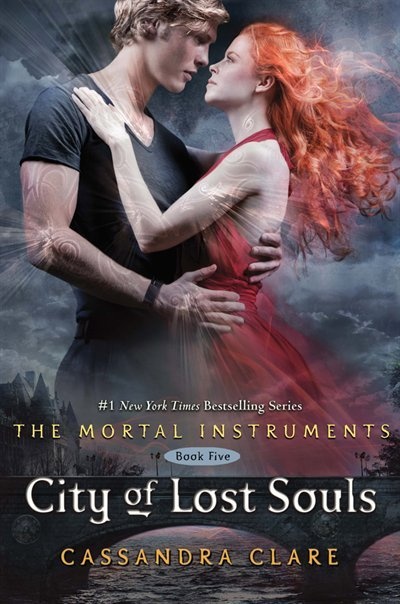
For me, what makes the writings of Cassandra Clare so captivating isn’t the fairy tale romance, the paranormal elements, or the bad ass fight sequences… at the heart of it all, it’s the way Clare manages to make a young adult fantasy saga an sequence of unexpected odes to her favorite pieces of literature.
“No man chooses evil because it is evil. He only mistakes it for happiness, the good he seeks.” – Mary Wollstonecraft
“Love is familiar. Love is a devil. There is no evil angel but Love.” – William Shakespeare, Love’s Labour’s Lost
“I love you as one loves certain dark things.” – Pablo Neruda, “Sonnet XVII”
“All changed, changed utterly: A terrible beauty is born.” – William Butler Yeats, “Easter, 1916”
Whether the story was constructed around these quotes, or the quotes  were slipped into the story, the two halves were beautifully married together. Just as Clare always manages to do.
If you recall my review of The Book of Secrets you should be well aware of how much I cherish this particular aspect of storytelling. I love peeping into the mind of the author and what they’ve read before – what work we may have both cherished. I love to see how others acknowledge how literature builds a soul. Even if that soul is an imagined character in another book.
A reviewer on Goodreads mentioned they thought it was silly that all these Shadowhunter kids were completely oblivious of what went on in the mundane world half the time – Jace completely misses references to Madonna or Dungeons & Dragons games – but are well versed in William Shakespeare and Dante.
As a classical book geek it makes perfect sense to me. I was raised on Charles Dickens and the Brontes, not the latest boy band or pop culture trends. Poetry is timeless. New Kids on the Block obviously not so much.
One doesn’t expect these odes and references in a paranormal teen romance. I suppose that’s what makes them so stunningly lovely.






 Anakalian Whims