The Keeping Quilt
Little girl got soap in her eye in the bath tub tonight. It was awful. There was banshee-like screaming, bright red faces from all involved, and a lot of tears. Her daddy, the man with the magic hands, was able to pat her back long enough to soothe her into a half slumber after we got the eye rinsed out and pajamas donned. Just as we headed out of the room, though, a little voice piped up from beyond the darkness, “But you didn’t read me my bedtime story.”
So snuggled under her own quilt, I whispered to her the story of Patricia Polacco’s family –
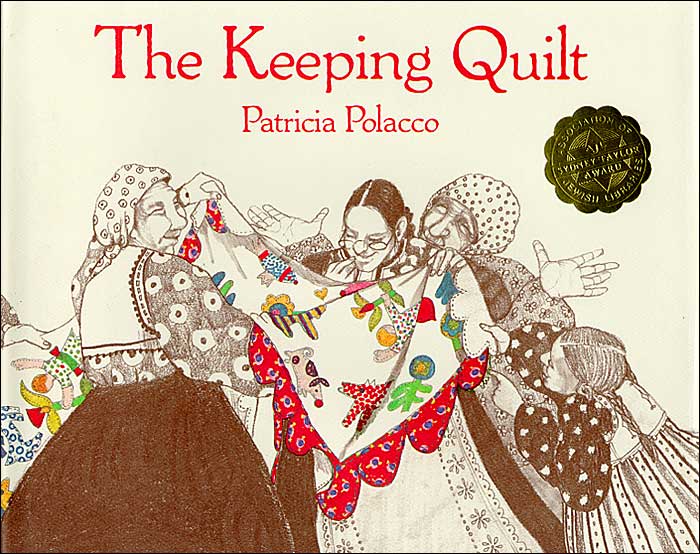 Title: The Keeping Quilt
Author: Patricia Polacco
Publisher: Aladdin Paperbacks
The Keeping Quilt is a beautifully illustrated family history that spans six generations. From the first immigrants of a family coming to America, through the making of a family quilt from the few cherished possessions they have from the mother country, through weddings, births, and old age, The Keeping Quilt tells a story of many lives united by love and history.
This book doesn’t just belong in every child’s library, but every quilt lover’s library as well. As we were reading, I couldn’t help but be reminded of Rich Fabric edited by Melinda McGuire and all the beautiful family histories captured in that volume as well.
I’m so glad I stumbled across this book today at the bookstore, honored to have been given the opportunity to step into Polacco’s family for the evening, and amazed at how perfectly soothing it was for a child who was emotionally and physically exhausted after a battle with a bar of soap.
Histories and Education
 In my pursuit for knowledge, and for schooling my own child, I have been pretty diligent about reading as much history as I have the mental capacity to remember. That means I read at least one non-fiction book a month (whether history or not) and I include one non-fiction book per quarter in the Half Price Books Humble Book Club line up.
This quarter we’re planning to discuss Herodotus’ Histories in March. (We meet the first Monday of the Month at 7:30 pm.) This isn’t just a fascinating work to read for book club, it was also on my life long list of books to read before I die. It’s a tome; but it’s important, I think.
Not only is it important, I have a pretty awesome copy (The Landmark Herodotus
So as I make my way through this book, that could serve as a book press for other books if I ever needed it to, I will share with you the gathered notes of our club members:
THE HISTORY OF HERODOTUS
(Notes provided by Glenn Ray)
Book 1 CLIO
Below are the important kings and many of their exploits from book 1 ‘CLIO’. There are 9 books in all.
The ‘¶’ below is used to represent chapter #’s in this book.
A vertical line ‘|’ on a row by itself means next person down is child of this king.
NOTE: Where there is not a ¶ starting the line, then these are mostly from Wikipedia.
Below are 3 lines of kings, not all ancestral succession:
-
Lydia (modern day western Turkey) kings: Gyges, Ardys, Sadyattes, Alyattes, Croesus
-
Mede/Persian kings: Deioces, …Cyaxares, Astyages, Cyrus the Great, … Tomyris of Massagetae (not Mede or Persian) …
-
Darius I
Gyges
(¶8 Candaules was king of Sardis & Lydia before Gyges,
& his favorite spearmen was Gyges;
Candaules shows Gyges his wife (Nyssia) naked)
(¶11,12, 13 Gyges, at Nyssia’s command, kills Candaules, becomes king; but
that vengeance for the Heracleidai (descendants of Heracles (Hercules)) will come upon the descendants of Gyges in the fifth generation [that being Croesus below].)
(Gyges reigned from 716 BC to 678 BC (or from c. 680–644 BC).)
(¶14 led an army against Miletus)
|
Ardys
(Ardys II or Ardysus II) 678-629 BC (or 644-c.625)
(¶15 became king of Lydia; and continues daddy’s fight against Miletus)
|
Sadyattes
(629-617 BC (or c.625-c.600))
(¶16 became king of Lydia for 12 years; made war vs Cyaxares – king of Medes)
(¶18 and continues daddy’s fight against Miletus)
|
Alyattes
king of Lydia (619–560 BC)
(capital Sardis, & controlled all Asia Minor west of the River Halys, except Lycia.)
(fought against Cyaxares – king of Media, during the Battle of Halys, /wikipedia)
(¶18 and continues daddy’s fight against Miletus)
(¶25 reigned 75 years)
|
Croesus (pronounced ‘KREE-sus’)
(GLR: some info below is from: http://www.ancient.eu.com/croesus/)
King of Lydia 560-547 BC (palace of Croesus was at Sardis.)
(GLR: Croesus, you will see, is one mean grandpa)
(funded construction of the great Temple of Artemis at Ephesus, one of the Seven Wonders of the ancient world. / http://www.ancient.eu.com/croesus/)
(¶30 asks Solon who is happiest).
(Solon was an Athenian statesman, lawmaker, and poet)
(¶53 Croesus is also famous for asking the Oracle at Delphi whether he should go to war against Persia. And… destroy a great empire)
(¶55 Croesus consulted the Oracle & was told …a mule of the Medes shall be monarch…)
(¶69 alliance with the Lacedemonians)
(¶73 marching into Cappadokia to fight Cyrus, who to avenge his brother-in-law Astyages (who was defeated by Cyrus)
(¶79 Croesus’ horses feared the camels of Cyrus and ran.)
(¶84 Cyrus’ man Hyroiades scaled the wall of the citadel at Sardis and Croesus is defeated)
(¶86-7 Croesus in the Pyre)
(¶91 Croesus learns the mule = Cyrus)
Deïokes (or Deioces)
(In the late 8th century BC)
(¶96 – was the first king of the Medes per Herodotus.
(¶97…his decisions proved to be according to the truth)
|
Phraortes
king of Media 665 – 633 BC)
(Phraortes started wars against Assyria, but was defeated
and killed by Ashurbanipal, the king of Neo-Assyria.)
|
Cyaxares [or Kyaxares in Gutenberg version]
king of Media 625–585 BC)
(¶73 Scythians serve Cyaxares human meat, and Scythians runaway to Alyattes at Sardis for protection)
|
Astyages
(king of Media 585 BC-550 BC)
(ruled in alliance with his two brothers-in-law, Croesus king of Lydia
and Nebuchadnezzar king of Babylon, whose wife, Amytis, Astyages’ sister,
was the queen for whom Nebuchadnezzar was said to have built the Hanging Gardens of Babylon)
(¶108 dream abo vine from Mandane; ordered Harpagos to kill grandson [Cyrus])
(¶118, 119 Astyages serves Harpagos his own son)
(Bible xref: Daniel 13:65(1). (1)This is per the “Douay-Rheims 1899 American Edition” of the Bible, note the KJV stops at chapter 12.)
|
¶107 Daughter – Mandane married Cambyses from Persia
|
Cyrus the Great,
king of Persia, 600 BC or 576 BC–530 BC
(¶55, 56 & 91 Cyrus is the mule)
(Bible xref: 2 Chron 36:22-33; Ezra 1:1-8, 3:7; 4:3,5; 5:13-17, 6:3,14, Isaiah 44:28, 45:1,13; Daniel 1:21, 6:28, 10:1,
and 1 Esdras 2. [Note: Church councils rejected 1 and 2 Esdras as non-canonical])
(was the monarch under whom the Israelites Babylonian captivity ended / Wikipedia)
(was prompted by God to make a decree that the Temple in Jerusalem should be rebuilt / Wikipedia)
(¶79 Cyrus uses camels against Croesus’ horses (horses fear the camels and ran.)
(¶84 Cyrus’ man Hyroiades scaled the wall of the citadel at Sardis and Croesus is defeated)
(¶141 Cyrus spoke fable to the Ionians and Aiolians, piper played for the fishes in the sea)
(¶155-156 Cyrus takes on his mean grandpa Croesus [who multiple times tried killing Cyrus] as closest councilor)
(¶178-183 Cyrus plans & does to conquer Assyria & Babylon; Describes city of Babylon)
(¶205 Cyrus attempts to conquer Massagetae & their queen Tomyris)
(¶209 Cyrus dreamed Dareios/Darius would attempt to over throw him)
(¶211, captures 1/3 of her army & son Spargapises sleeping)
(¶213 -214, After Tomyris’ son, commits suicide, she defeats & kills Cyrus & give thee thy fill of blood.)
(¶216, Massagetae custom: when a man becomes very old, he is slaughtered, flesh boiled and the family banquet upon it.)
Darius I 550–486 BC
the third king of the Persian Achaemenid Empire
(Reigned 522 BC to 486 BC (36 years))
(Darius is mentioned in the Biblical books of Ezra, Nehemiah, Daniel, Haggai, and Zechariah.)
(¶187 Darius attempts to rob Babylon Queen Nitocris’ grave)
(¶199. Now the most shameful of the customs of the Babylonians…)
More notes to come as we progress through our reading . And when I’m done with Herodotus, I plan to conquer Xenophon…
I’ll keep you posted.
In the meantime, I challenge everyone to pick up any ancient history book and learn something about the world they didn’t know before this year. The most fascinating thing to me about it all is that, even though civilizations change and grow and change and grow… people essentially, are always – at their core – pretty much the same. I love learning about the world today through the eyes of our past.
The Secret Keeper and Storytellers
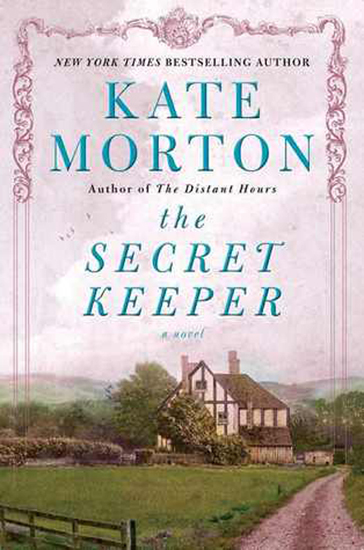 Title:The Secret Keeper
Author: Kate Morton
Publisher: Atria Books
Genre: Fiction/ Historical Fiction
Length: 484 pages
I broke my Kate Morton rule. I read TWO Kate Morton novels in a 12 month period. And it was wonderful.
Forget my previously mentioned warnings to space out her books as long as it takes her to write them. This was a perfect winter read, she sucked me in – as always – and I found myself thinking it was her best piece since The Forgotten Garden. Don’t I say that every time?
I don’t just love Kate Morton as a reader, I find her inspiring as a writer. When everyone else is diving into NaNoWrMo – something I signed up for, but just really don’t get – I dive into Kate Morton and find that’s the push I need to get my own stories out of my head. (Same goes for Stephen King, that man really pushes my buttons and moves me to write.)
Semi side note: Is it just me or is NaNoWrMo distracting as all get out. I write 2k words a day on average – granted, not all usable, obviously – but every time I open an email for NaNoWrMo I find myself reading and sifting through a bunch of stuff and not getting ANY writing done at all. It’s fake motivation for me. It’s a complete and utter distraction. Like going to a pep rally. I’m more excited for a football game when I’m at the football game, but if you push me through the noise of a pep rally I just don’t feel like going anymore. SO counter productive.
You really want to be motivated to write? Read a good book. Read a really good book. Find someone who just moves you and you can’t help but think – I want to do that. Not exactly that, mind you, I want to write my own stuff. But I want to get a story out that moves people the way I’ve just been moved. Or excites people the way I’ve just been excited. The best motivation for a storyteller, I think, is to hear/read a good story.
Kate Morton’s stories are always good. No, not good, GREAT. She weaves through time with the skill of a T.A.R.D.I.S. and the hearts of a TimeLord. She is always a master of her chosen histories and reveals stories with an onion layer effect that always makes me giddy. The best moment of every one of her books is the, “I knew it!” moment. I love that she feeds you all the details but somehow leaves you thinking she might just surprise you – even though you don’t want to be surprised because you need to be right about this one detail that has dropped bread crumbs all over the story but hasn’t outright made itself obvious.

Click to read another blogger’s review.
Even more than that, though, is Morton’s uncanny ability in every novel to write a character that feels so overly familiar to me. Or, if not familiar, someone I want to be familiar. The Secret Keeper had a lot of familiar faces from my real world.
Random Post on Random House
 Normally I post on the quality of the topic of a book, not the quality of the book itself. Sometimes I mention these factors, but usually only a line or two within a rant about how impressed I am with the content.
I’ve been reading Thomas Jefferson: The Art of Power
I didn’t notice it right away. It took me holding it for hours to truly appreciate the matte finish of the dust jacket. There is a lot of feeling missing from my fingertips from years of me abusing my own hands with activity; but during rare moments of my hand brushing against the jacket just so or turning the page and letting the weight fall in my left hand just right, I felt with pleasure the smooth grit of a not entirely slick dust jacket. I love that feeling.
 The binding is nothing special. I’d like to report that it is sewn AND glued just how I like it, but it’s just glued in sections. But the classic photograph and illustration pages in the center found in almost all history books and biographies, they are lovely. They aren’t the typical glossy finish ones that you find in most biographies. They are not the twelve year old girls’ room poster quality. Instead, they appear to be printed on acid free paper. The ink quality is something to behold while the pages maintain a slightly matte appearance as well. It’s pretty gorgeous. It is the book I’ll use to show my daughter pictures of many of the men who laid the framework for our independence. It’s where we will look to see a depiction of the surrender of Cornwallis.
I read a lot and I acquire a lot of books, but not everything I acquire are good quality copies. I am notorious for reading coffee stained, marked up, dog eared paged crap that someone else was throwing in a recycle bin. It does not phase me to peruse something that smells like my grandmother’s attic (or your grandmother’s attic, or my dog’s grandmother’s attic…). So it was a little different and refreshing to read something so…. nice. And it sounds silly to be saying this to such a large publishing house, but: Good Job, Random House.
We’ll be discussing the actual content of the book tonight at the Half Price Books Humble book club meeting at 7:30 pm. Come join us.
Eratosthenes
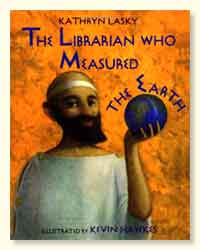 Title: The Librarian Who Measured The Earth
Author: Kathryn Lasky
Illustrations: Kevin Hawkes
I stumbled on this book by complete accident. Most my homeschooling tools I seek out or find while searching the non-fiction section with a thought in mind. This book I merely acquired and had no idea it was going to be added to our core curriculum.
Although I love the Sir Cumference books, I often wondered how I would properly include those books into a classical education for my child when studying the circumference belongs in the times of Ancient Greece. Now I have my solution. Sir Cumference will be fun re-iteration of facts learned. Where The Librarian Who Measured will definitely be a part of our first years of school.
 I’m sure I learned about this guy at some point in school, but it didn’t sink in. His name didn’t even sound vaguely familiar when I started reading this story to kiddo before bed last night. But as I read, my mind raced to the day we will sit and discuss Eratothenes in context. We will talk about Ancient Greece and the ancient libraries. We will discuss oranges and circumferences. We will talk about the planet and maps of the world. We will study things in a manner in which she will remember it – as opposed to a passing one liner in a text book. This book made me happy for days of school in our future.
The Vikings Take Over Our Library
 As everyone else heads back to school, I looked over the last month and realized we really did treat the hottest months of the year like a summer vacation this year… mostly lolling around the house between events, taking extra naps after our dance parties in the living room, and mostly hiding our pasty skin from the hot, Texas sun. So I tackled cleaning out the closets, while everyone else was out buying school supplies, and organized our life the way it has always been organized in my brain… in unit studies. Of course, that got me in the mood to really tackle “school time” with more vigor and this last week or so we jumped back into the swing of things with Ancient Greece and Rome and then The Vikings and the Celts.
Viking Ships at Sunrise by Mary Pope Osborne was next in our Magic Tree House Adventures. We have not acquired the Viking research guide yet, but I believe there is one. We also re-read DK’s Eye Wonder Viking book, we had read it once before while perusing the exciting world of piracy, and a little repetition is good for a kiddo.
 But the really exciting book for this particular unit study was The Hero Beowulf.
Eric A. Kimmel’s retelling of Beowulf is a pretty neat picture book add on for little people. It’s illustrated by Leonard Everett Fisher and is complete with an author’s note about the original poem in the back. Beowulf, after all, isn’t just a monster myth, it’s the “oldest surviving epic poem in English literature,” all the way from the sixth century, to your hands now.
I can’t reiterate enough how much the classical education style appeals to me by teaching so much history through the other subjects… or rather teaching all the other subjects by tackling history so thoroughly. I love that there are so many resources, like Kimmel’s picture book, to make the tales and the culture more real and the epic poem more accessible when the time comes to tackle the original work; because in classical education everything repeats at a higher level over and over again.
After reading The Hero Beowulf, kiddo ran to grab other books with Viking ships on them and said, “Look mommy, more Beowulfs!” So she doesn’t entirely get it yet, but hey, she’s two.
Happy Fourth of July

The Half Price Books Humble book club read John Adams by David McCullough this month. We discussed it together Monday night, even though I had only read the first 400 pages. The best thing about holidays, for me, though is their ability to mandate what gets read off the TBR pile next. So this week, as I researched for book club, lounged with family, watched fireworks, and read to the kiddo… this is what freedom looked like:
 Title: John Adams
Author: David McCullough
Genre: History
Publisher: Simon & Schuster
Length: 751 pages
1001 and one things to discuss about this book, and we mostly got caught up in the assessment of the character of John Adams. Was he an ambitious man willing to run off from the family and farm at a moments notice to pursue more exciting ventures of fame? Or, was he a great man of virtue who was gifted with the sight of the big picture, willing to sacrifice personal happiness for the greater good of the establishment of our country? Before reading the book, considering my skepticism regarding ALL politicians, I probably would have said the former. But McCullough has me convinced it was the latter that held true.
Of course, I am biased, mostly by the sheer fact that Adams was a great reader. Nothing romanticizes a person more to me than their love for a good book, for the art of research, and for a passion for knowledge and action. Several times throughout the biography, Adams is quoted saying such excellent things as,
“I must judge for myself, but how can any man judge, unless his mind has been opened by reading.”
Where others in the group found him willing to cast aside his wife and children for politics, I found him endearing. He wrote to his wife avidly. He and Abigail would often refer to each other as ‘dearest friend,’ and their relationship seemed to be what kept him grounded and successful. In addition to that, it also seemed that any chance he had to take his children with him, he did. Off sailing across the pond to Europe, the boys equipped with an educated father and a personal tutor, they got first hand experience seeing how nations make peace and build relationships. Sure, Adams renounced his son Charles later in life and that relationship was never rebuilt before Charles’ death, but in my opinion Charles did not deserve anymore second chances. Charles, the favorite as a child, turned out to be the bad seed in the bunch – possibly spoiled by being the favorite to so many – as he turned to alcoholism and abandoned his family. It was John and Abigail who raised his children and looked after his wife, leaving their own son to his own devices as they tried to do right by all his mistakes.
John Adams was quite the fascinating man, one I have, until now, always overlooked in history. Having shared a birthday with George Washington my whole life, he always got my ‘favorite’ vote as a child. As an adult, the Alexander Hamilton vs. Aaoron Burr phenomena fascinated me – mostly driven by that infamous ‘Got Milk’ ad as well as Joseph Ellis’ riveting storytelling in Founding Brothers
With all this important political talk, I found it necessary to re-read the Declaration. With toddler in tow for nearly all my reading ventures, it’s important to find kid friendly things to read alongside all my own reading. That’s where Sam Fink comes in handy…
 Title: The Declaration of Independence
Illustrated & Inscribed: Sam Fink
Publisher: Scholastic Nonfiction
Length: 160 pages (but only takes about 15 minutes to read aloud)
I absolutely adore this copy of the Declaration of Independence. As a homeschool mom, I love creating my own curriculum and finding unique ways to share information with my kid. Kiddos everywhere, whether homeschooled or public schooled, should find this a fun way to absorb the meaning behind the declaration and be introduced to the ideas of why it was so important for it to be made and signed.
With large print, clear illustrations, and political cartoons to accompany nearly every sentence – if not sentence fragment – Fink helps walk a kid (and even some adults) through every nuance of our founding fathers’ meaning and intention. If read often enough, you may find you have a kid who has memorized the declaration long before they are ever asked to do so for school purposes. This is just a good old fashioned fun picture book that just so happens to also be an important document to our country’s history. Sam Fink is pretty awesome and I am so glad he tackled this project.
In addition to all that,
 Title: George III
Author: Christopher Hibbert
I’ve been plucking through a biography of King George III for awhile now. It’s been loitering on my TBR pile and periodically I get the bug to read a chapter or two.
I am no where near finished reading this book, Hibbert is very detailed but also very dry as a biographer, but I find it a handy reference and do look forward to the times that I decide to sit down with it.
I like having large sweeping views of history as well as the tiny details. Reading through John Adams and peeking here and there at George III this week, I was grateful to have already tackled Napoleon’s Wars recently. It helped me keep straight in my mind what was happening with the French while a few of the Adamses friends were busy getting beheaded. Another handy tool for both children and adults while reading through history is The Time Chart of History of the World
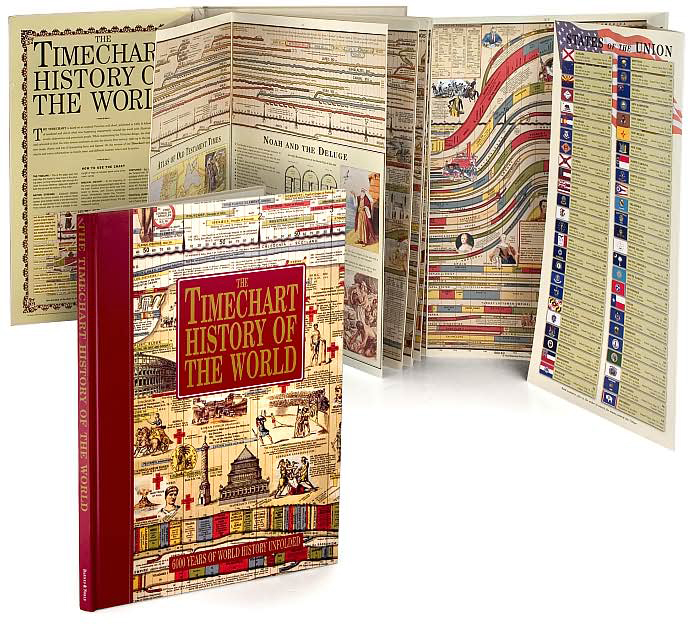
True to the Code
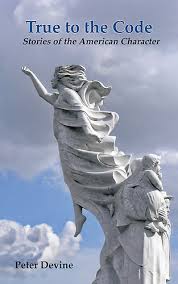 Title: True to the Code

Author: Peter Devine
While reading Peter Devine’s new book True to the Code, I realized that this is not a book to read in one sitting. Instead, it should be divided up over time and each story discussed in a club or an ethics class along with that portion of history.
Devine has married ethics, history, and the over all culture of America into a book that defies category. Novel? Not really. Collection of short stories? Probably the most accurate, but still not quite how I’d like to label it. Philosophy? Yes, but easier to read.
So where do you put this in a bookstore? My easy solution… up front with the author.
Devine is most engaging when interacting with other readers. His lovely wife pours lemonade and serves cookies while he pleasantly gets to know those around him. It’s impossible not to feel like you get to know him a little back.
 He has the air of being well traveled and well researched. He has a comfortable patriarch mentality to him splashed with a bit of edgy hippie. He is fun, endearing, knowledgeable, and a joy to have in a bookstore. Although I met the man at a very informal event, I imagine he could make a cozy guest speaker at a gathering similar to the ones Mensa is known for.
I plan to keep his book True to the Code on hand and place the stories as supplemental reading for the kiddo’s homeschool curriculum. After kiddo has read all the stories in chronological order of their place in history side by side her research, I’d like her to review them as a whole.
This is a great book to keep around for students… of both the traditional and world variety.
Falling in love with History…
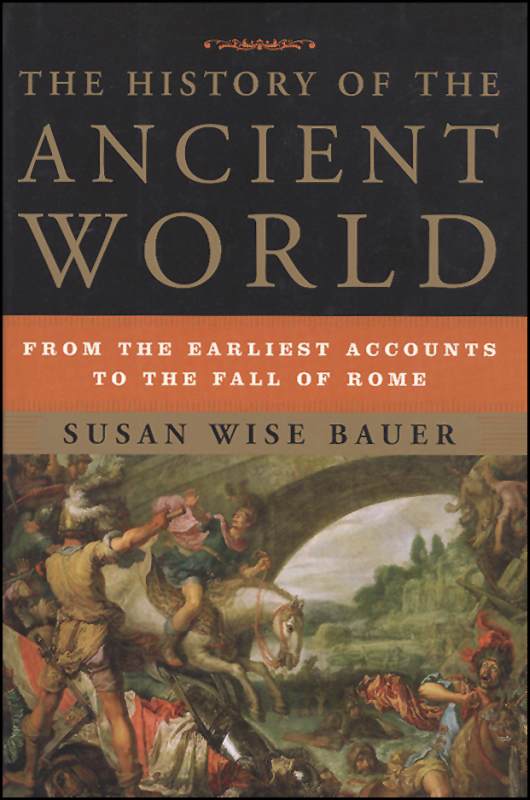 Title: The History of the Ancient World
Author: Susan Wise Bauer
Publisher: Norton
Genre: History
Length: 868 pages
I enjoyed history in school, but only when it was taught by certain teachers. I distinctly remember thoroughly loving Coach Masters, my World History teacher in high school. In hindsight, I’m not sure if it was because he was so awesome, or because it was the first time someone actually presented me with history I could be passionate about – not just enjoy in passing. Masters made you dive in with all you had and really learn it; it wasn’t just dates and factoids, it was people, their dreams, their loves, and their wars.
As an adult, reading history has become a little more specific. I tend to read a lot of Ancient and Medieval history most, they are kind of my go to topics. There is so much that was skipped over in school and it is so riveting! So naturally, when I decided to homeschool my daughter I started collecting the Susan Wise Bauer history books – they are fascinating overviews of history as well as wonderful teaching tools.
Reading Susan Wise Bauer reminds me of that history class with Coach Masters. She gets personal.
It took me a full year to read The History of the Ancient World, mostly because I made a promise to do at a snail’s pace. I plan to use it as a loose textbook for kiddo’s high school years and I wanted to make sure that you could pause, go read other things, and come back to it. Is it reasonable to assign this for a year in addition to x number of other books? Yes, oh, well then lovely.
The book is wonderful and impressive. Bauer makes history accessible and easy to understand in a world filled with dull and extensive flow charts that will make even the most knowledgeable scholars heads spin.
My absolute favorite is a lengthy footnote on the Borg (from Star Trek) and how similar the mentality of the Borg was to a tribe of people sweeping the land in the very earliest parts of history. ‘See?’ she practically says, ‘It’s good to be a sci-fi nerd.’
My only lament – and this may simply be a first edition issue – is that toward the end I began to find typos (I think). There’s an amputed that should be amputated. I honestly thought maybe it was a variance of the word I had never seen used and had to look it up. There’s a died that should have been die. These two things tripped me up for a second, but I found it a little refreshing. Having just written a book myself it was good to know that someone I esteem so highly also makes errors when writing her books.
But then there was the bit that tripped me up a LOT. During the aftermath of Alexander the Great’s death there are two spellings for what I’m 99% positive is supposed to be one person. Welcome to the great Cassander vs. Cassender dilemma…
The first time I saw this, I thought: Is there one person or two? Am I really ignorant with poor reading comprehension and these are two distinct people? There’s no way I can be the only person to find the longest running series of typos ever… But for pages on end Bauer switched from Cassander to Cassender.
If it is a typo, I get it. In my novella I couldn’t keep my fingers from typing Lilly Hollow to save my life, when the name of my imaginary town is Lily Hollow. It drove me absolutely crazy going through and fixing them all. If there is a typo found in my novella post publication, I would bet money that it will be in the form of an extra L.
With Cassander and Cassender there are soooooo many times that it is written as both. Part of me is still convinced that there is a strong possibility that I am just that dumb. I will be seeking out a second edition just to figure it out. The ancient world is full of mystery and excitement and long winded Chinese dynasties and Egyptians going crazy with who they marry and who they kill, but the acting king(s) of Macedonia post Alexander the Great is the guy(s?) that throws me for a loop.
All in all, though, I STILL think this is a must have in any historian’s or homeschooler’s library. It was worth every penny and I think that this one – for once – is one I actually paid full price for at Barnes & Noble. Bauer will remind you that there is so much to discover and be passionate about in history, because there’s just so much of it in general… you may even fall in love.




 Anakalian Whims
Eden’s Outcasts – A Review
March 10, 2013 at 9:18 pm (Reviews) (A Whisper in the Dark, American History, An Old Fashioned Girl, bill bryson, Bill Cosby, biography, books, Bronson Alcott, Civil War, debt, Dickens, Eden's Outcasts, education, fame, family relationships, feminism, Fruitlands, Goethe, history, homeschooling, jo march, John Matteson, Little Women, Louisa May Alcott, Love and Self-Love, mental illness, pulitzer prize winner, race relations, Ralph Waldo Emerson, reviews, social commentary, Thereau, transcendentalism)
Author: John Matteson
Genre: Biography/ History
Publisher: W.W. Norton & Company
Length: 497 pages
I knew I wanted to read this book the first time I saw it at Jill’s Books in The Woodlands a few years ago. I have loved Louisa May Alcott all my life and in the last few years I’ve really started to enjoy the art of the biography. My best friend bought it for me on the spot because she is one of those beautiful people who doesn’t think people should be denied their bookish desires. It wasn’t until March (a novelization of the younger years of Marmee and Mr. March) was chosen for the HPB Humble Book Club that I actually committed to sitting down with it in an attempt to understand Brooks’ portrayal of the patriarch.
*Notes about A Family in Debt*
So my review of the biography begins with Bronson Alcott’s astonishing ability to over zealously botch everything he touches. This trait of Bronson is made overwhelmingly clear around page 181. By this time in the biography, his utopian commune Fruitlands has failed, he has lost all his manuscripts, the house the family is living in was purchased with his wife’s inheritance, and he has completely disappointed me. At this point in his life Bronson refused to be employed and takes up an architectural endeavor on Emerson’s land, a building that would be nicknamed “Tumbledown Hall” and “The Ruin.” For a man portrayed as one so taken with education, he tackled projects with a whole lot of zeal and not nearly enough research. When he did research, others’ ideas were usually disregarded in order to implement his own innovative plans. To me, most his plans pretty much always sucked.
On the other hand, Louisa, his daughter, was exceptionally prudent. She had an intense crush on Ralph Waldo Emerson when she was young, which I find adorable, but never shared the love letters she wrote to him. Instead, when the crush was over, she burned them, but continued to look up to Emerson as a teacher. Emerson would be a part of Louisa May Alcott’s life from her birth until his death.
Bronson may have failed in many things during the first half of his life, but his efforts as a father are later a solid testament to home schooling. Matteson shares on page 182 that
Bronson Alcott, I believe, had some serious issues. Matteson has the grace to allow you to come to this conclusion on your own before he shares the fact that mental illness did indeed run in the family and that it is likely that both Bronson and Louisa May were manic depressive or bipolar, but that there is no way to know for sure.
Bronson’s worldview was both passionate and skewed. He established his house at Hillside (a few years before the well-known Orchard House) as an underground railroad station and fought viciously for equal political rights for African Americans. Then in contradiction to his own actions stated that blond hair, blue eyed people were closer to God and that black men should not be allowed to reproduce. How these beliefs reside in one human being baffles me. It reminds me of an observation Bill Bryson made in his book The Lost Continent, where when traveling the United States he identifies a curious contradiction in American culture and race relations. In the north, Yankees are known for their belief in equality and pretend to make no distinction between black and white in personal treatment and political issues, yet they live very segregated lives and rarely share the same neighborhood. However, in the deep south, there is a general assumption of hatred between the two groups, but they live side by side as neighbors.
Why such dichotomy? I find it all rather ridiculous. In Bronson’s case, he refused to use products made by slaves and destroyed his career on the principle that even black students had a place in his school. Kudos! But then he thinks something so crass as an idea that black men should be denied their God given right to have children. Absurd!
I find Bronson entirely too duplicitous. He insisted on a family commune but almost left his family to a more philosophic way of life. He was passionate about fatherhood, but made it very difficult for his children to feel worthy of his praise. He desired a Utopia, but in every action tore what could have been to the ground. His ease in living off hand outs from the labor of his friends while simultaneously declining anything done honestly through the labor of animals is confusing. It is no wonder to me that the father figure in Little Women is both absent and idolized. The fact that Bronson went to such great lengths to have a perfect transcendental family and then refused to accept work when it was offered because he had as “yet no clear call to any work beyond [him]self,” is irritating. The Alcotts were flooded with debt and Bronson had the means to fix it, but was too busy living in his head.
The greatest contradiction of all is that in the second half of his life he would rectify my horrible opinion of him…
*Notes about An Authoress*
The thing I love most about biographies is the same thing I love about “bookish” books – they provide lists, a more diverse reading experience. While reading Eden’s Outcasts, the biographer periodically offered reviews and insightful critiques to Alcott’s little known works. So while reading her biography, I was also led to read specific stories out of A Whisper in the Dark , like Love and Self-Love. It also led me to desire to seek out a piece called Hospital Sketches.
Matteson continues to offer literary criticism on many of Alcott’s publications and goes into a lengthy discussion of An Old Fashioned Girl . It is during this portion of the biography that Bronson has redeemed himself as a father in my eyes. At this point he was quietly living at Orchard House in between traveling and making his money. His ideals were far less irritating later in life than when he had a poor young family to support, because at this point Louisa’s fame had made the entire Alcott family debt free. This success and income is also what finally made Bronson a more supportive father who spent many of Louisa’s later years doting on her and praising her success.
This age old story of the parent-child relationship reminds me of a Bill Cosby sketch where he laments his parents as grandparents.
In the story An Old Fashioned Girl, Alcott actually praises her father by inferring that,
Matteson continues to say,
This is a much different sentiment than that during the aftermath of Bronson’s failed Fruitlands. Mostly proud father, but partly opportunist, Bronson wrote, “I am introduced as the father of Little Women, and I am riding in the chariot of glory wherever I go.” Bronson may have begun to be capable of providing for his wife and family, but only because Louisa made it possible with her fame.
As Matteson picks apart Alcott’s life and novels, he states:
Of her own fame, Alcott said: “I asked for bread and got a stone, – in the shape of a pedestal.”
*What it all Means to Me…*
All in all Matteson’s biography of Louisa May Alcott and her father is the most well-written and thorough biography I’ve ever had the pleasure of reading. I hung on every word.
All the detailed family relationships, the well thought out literary critiques, and little factoids like the fact that Louisa was the first Concord woman to register to vote, made the whole book a joy to read.
Above all, I am pleased that Matteson has finally put into words a truth that has been part of my own beliefs since childhood when I first read most of Alcott’s work. Without reading Matteson’s biography I may have never come to understand a piece of myself and where aspects of my own worldview were initially formed. It seems that my ideas regarding feminism may be largely attributed to what Louisa imparted to me through her novels, as our views are nearly identical.
Louisa’s ideas call for
Matteson also says that
Whether you want to be a doctor or stay home and bake pies, male or female – just do it well.
I could not agree more.
Permalink 2 Comments